Oragent AI Agent: Complete Foreign Trade Customer Research and Market Analysis in 5 Minutes

Oragent, an AI agent for foreign trade, compresses days of market research into 5 minutes.
Oragent (Dingyi ORA Agent) is an AI agent purpose-built for foreign trade scenarios. With a single command, it automatically generates in-depth market analysis reports covering product selection, regulatory risks, and marketing calendars—compressing what once took two to three days into just 5 minutes. This article details its core features and real-world results.
The Pain Points of Foreign Trade Research: Empiricism Is Losing Its Edge
Anyone working in foreign trade knows that customer research and market analysis are the most time-consuming and skill-demanding stages in the customer acquisition chain. For a veteran with ten years of experience, producing a complete in-depth overseas market research report often takes two to three days—poring over industry reports, comparing data from multiple countries, sorting through consumer trends, and finally making a "gut-feeling" judgment based on experience.
This pain point is not an isolated case, but a structural dilemma faced by the entire industry. The global trade landscape has been continuously reshaped since 2020: supply chain fragmentation, rising geopolitical risks, and fragmented consumer preferences—these overlapping variables mean any "market judgment from six months ago" may be severely disconnected from current reality. Meanwhile, the intensity of competition on cross-border e-commerce platforms is accelerating on a quarterly basis, and the window left for foreign trade professionals to "research slowly" is shrinking dramatically. Against this backdrop, traditional research methods that rely on personal experience accumulation are becoming obsolete far faster than practitioners expect.
The core problems of traditional research methods are threefold: heavy reliance on personal experience, lag in information updates, and difficulty in achieving cross-verification of data.
What is data cross-verification? In the foreign trade industry, a single data source (such as one industry report or customs data) often suffers from inconsistent definitions, lagging statistical periods, or incomplete regional coverage. Professional market analysts typically reference customs import/export data, third-party e-commerce sales data (such as Amazon BSR rankings, AliExpress bestseller lists), Google Trends consumer trends, and industry association reports from various countries all at once, cross-referencing multiple sources to improve the credibility of conclusions. This work is extremely time-consuming when done manually and demands a very high capacity for information integration—which is precisely one of the core value points where AI tools come in.
When market changes accelerate and competitive windows narrow, this "one step behind" research pace can easily cause businesses to miss opportunities, and even step on the landmines of regulatory compliance and product selection.
According to a hands-on demonstration by a seasoned foreign trade practitioner on Bilibili, the AI agent tool Oragent (Dingyi ORA Agent) is attempting to restructure this process—compressing what was originally a week of foreign trade market research into just five minutes.
What Is Oragent: A Dedicated Market Strategist for Foreign Trade Professionals
Oragent is an AI agent designed for foreign trade scenarios, with a core positioning of "one-click market analysis."
Understanding the Essential Difference of AI Agents
The essential difference between an AI agent and an ordinary Q&A-style AI lies in its ability to "autonomously plan and invoke tools." Ordinary conversational AI is primarily based on single-turn or multi-turn Q&A, passively responding to user input; whereas an AI Agent can break down a complex goal into multiple subtasks, autonomously decide which external tools to invoke (search engines, databases, API interfaces, etc.), and chain the outputs of each step together to form a final result. This architecture is known as the "ReAct framework" (Reasoning + Acting) and is the underlying logic of today's mainstream Agent systems.
It is worth further understanding why the ReAct framework excels in complex task scenarios: it alternates between the two processes of "reasoning" and "acting"—after each tool invocation, the Agent first reasons about and evaluates the returned result, then decides which tool to invoke next or whether it can already summarize the output. This "think-act-observe" loop mechanism allows the Agent to dynamically adapt to information changes during task execution, rather than mechanically following a fixed script. For foreign trade research scenarios, this means that when a data source returns incomplete information, the Agent can autonomously determine whether it needs to supplement the search with other sources, rather than directly outputting a conclusion with gaps. For foreign trade scenarios, this means users don't need to manually switch between multiple tool platforms; the Agent can complete a series of heterogeneous tasks—information retrieval, data cleaning, logical reasoning, and report formatting—all under a single command.
Oragent has built-in professional skill modules for foreign trade research, and can automatically invoke relevant capabilities based on a single natural language command to complete the entire process from data collection and cross-verification to report output.

Users don't need to master complex prompting techniques—they simply issue a command like "Help me create an in-depth analysis report on the overseas market for pet products in the second half of the year," and the AI agent will automatically apply its built-in skills to complete the market research and generate a structured professional report.
Oragent's three core value propositions: authoritative report output, reduced errors through data cross-verification, and dramatically compressed research time. It integrates research actions that were previously scattered across multiple tools and information sources into a single conversational entry point.
Hands-On Demonstration: The Full Process of Overseas Pet Product Market Analysis
In the actual demonstration, the tester used the overseas pet products market as an example for verification. After entering the command, Oragent output a professional in-depth analysis report in HTML format within minutes—a stark contrast to the two to three days required for traditional manual research.

The content coverage of this foreign trade market analysis report is quite comprehensive:
- Market overview and regional scale comparison: quickly grasp the overall landscape and distribution across key regions
- Consumption structure analysis: break down the consumption share and user preferences of different categories
- Bestselling product directions: identify product categories worth prioritizing recently
- Cross-analysis of category-country popularity: clarify which categories are more popular in which countries
- Key trend directions: assess the market's growth drivers and directions of change
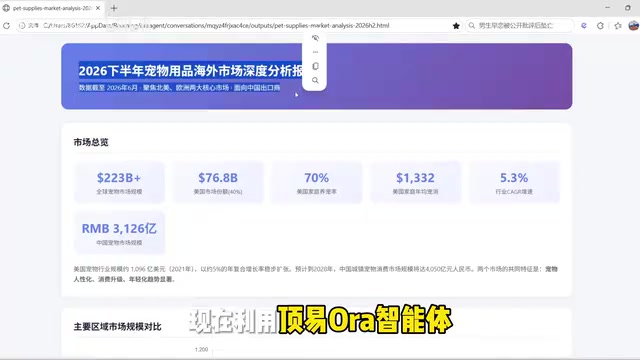
The value of this report lies not only in its "comprehensive information," but more importantly in how it organizes scattered data into an analytical framework usable for decision-making, so users no longer need to extract conclusions from raw data themselves.
From Analysis to Implementation: Covering the Entire Foreign Trade Customer Acquisition Chain
Another highlight of Oragent is that it doesn't stop at "providing analysis" but extends to the "how to execute" level. The report includes actionable online and offline marketing channel recommendations, as well as specific action checklists, clearly indicating what to do at each step and how to prioritize them.
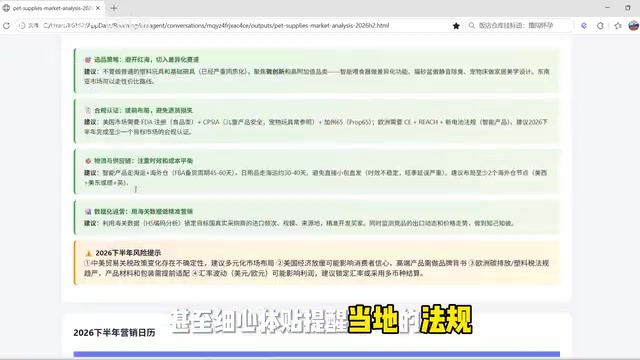
Two detail designs worth noting: first, local regulatory risk avoidance reminders, which help foreign trade companies identify compliance landmines in advance; second, marketing calendar planning, which makes the pacing and time points concrete, so marketing actions have a basis to rely on rather than being based on gut feeling.
For foreign trade professionals, this means the AI research tool upgrades from an "information advisor" to a "battle map"—not only telling you where the market opportunities are, but also telling you when, through which channels, and at what pace to execute.
Industry background: Why are vertical AI tools rapidly penetrating the foreign trade sector? Since 2023, the competition in AI large-model applications has been shifting from "general-purpose foundations" toward "deep cultivation of vertical industries." The special nature of the foreign trade industry lies in its heavy reliance on multilingual information processing, cross-border compliance knowledge, and dynamic awareness of global supply-demand relationships—all of which are capability domains that general-purpose AI cannot use out of the box. The core competitiveness of verticalized AI tools lies in combining industry Know-How with large-model reasoning capabilities, using approaches such as retrieval-augmented generation (RAG) or customized tool chains to make model output more aligned with actual industry needs. The rise of foreign trade AI tools like Oragent is a concrete manifestation of this trend: focusing on "grafting" general model capabilities onto the specific scenario of foreign trade customer acquisition, and creating differentiated value through scenario-based product design.
A Rational Perspective: The Capability Boundaries of AI Research Tools
Of course, reports output by any AI agent need to be evaluated rationally. "Zero error" is more of a marketing slogan; AI-generated market data may still suffer from timeliness bias or insufficient source transparency, so it is advisable to manually verify the authority of data sources before making key decisions.
Two core limitations of AI-generated reports are worth users understanding: first is the "hallucination problem"—large models may generate seemingly reasonable but actually fabricated data in domains where training data coverage is insufficient, which requires special vigilance when it comes to specific market size figures or growth forecasts; second is "timeliness decay"—large models have a cutoff date for training data, and if they are not connected to real-time data sources, their output on market trends may lag by months or even more than a year.
The mainstream solution in the industry for both problems is RAG (Retrieval-Augmented Generation) technology. Its core principle is that before the model generates an answer, it first retrieves the document fragments most relevant to the question from an external real-time database or knowledge base, then injects this "fresh information" as context into the model's reasoning process, so that the model outputs verifiable conclusions rather than relying entirely on the "memory" solidified during training. For foreign trade research scenarios, a well-developed RAG system means that when the model generates market analysis, it can retrieve the latest customs data, platform sales rankings, or industry news in real time, fundamentally solving the problem of timeliness decay. This is also the deeper reason why professional vertical AI tools are often more suitable for foreign trade research than general-purpose large models—the former typically build customized retrieval pipelines for industry data sources, rather than relying on the model's own internal knowledge with a cutoff date. An important criterion for evaluating whether an AI research tool is reliable is whether it can provide traceability of data sources, rather than merely outputting conclusive text.
But it is certainly true that foreign trade AI tools represented by Oragent are changing the efficiency paradigm of research. It is not meant to replace the judgment of experienced foreign trade professionals, but to free them from tedious information-gathering work, allowing their experience and energy to be devoted to higher-value strategic decision-making.
Conclusion
Oragent is a typical example of AI agents being implemented in vertical industries: rather than being general and all-encompassing, it targets the specific scenario of foreign trade customer acquisition, connecting research, analysis, and implementation into a complete chain. For foreign trade practitioners still making market judgments "based on gut feeling," such tools are worth a try—even if only used as a "first-draft generator" for research, they can significantly improve efficiency at the outset. Truly understanding the global market and unlocking precise foreign trade customer acquisition may well begin with saying goodbye to manual research.
Key Takeaways
Related articles

Gemini 3.7 Flash Spotted in Google Cloud Console — Launch Countdown Begins
Developers spot Gemini 3.7 Flash in Google Cloud Console, sparking discussion about its relationship to Pro and Google's model distillation strategy.

AI-Memory: Building a Cross-Tool Long-Term Memory System for Coding AIs
AI-Memory is a Rust-based open-source project providing long-term memory for Claude Code, Cursor, Aider and other Agent coding CLIs, enabling seamless handoff between vendors.

Bullet Enters the Stage: YC Newcomer Bets on a Faster Coding Agent
YC S26 startup Bullet launches a speed-focused coding Agent targeting developer latency pain points. Analysis of its differentiation, acceleration techniques, and market opportunity against Cursor and Claude Code.