Ordewell: Breaking Down a Single Goal into an Ordered Chain of Coding Agent Tasks

Ordewell auto-decomposes complex coding goals into ordered task chains to fill the AI planning-orchestration layer.
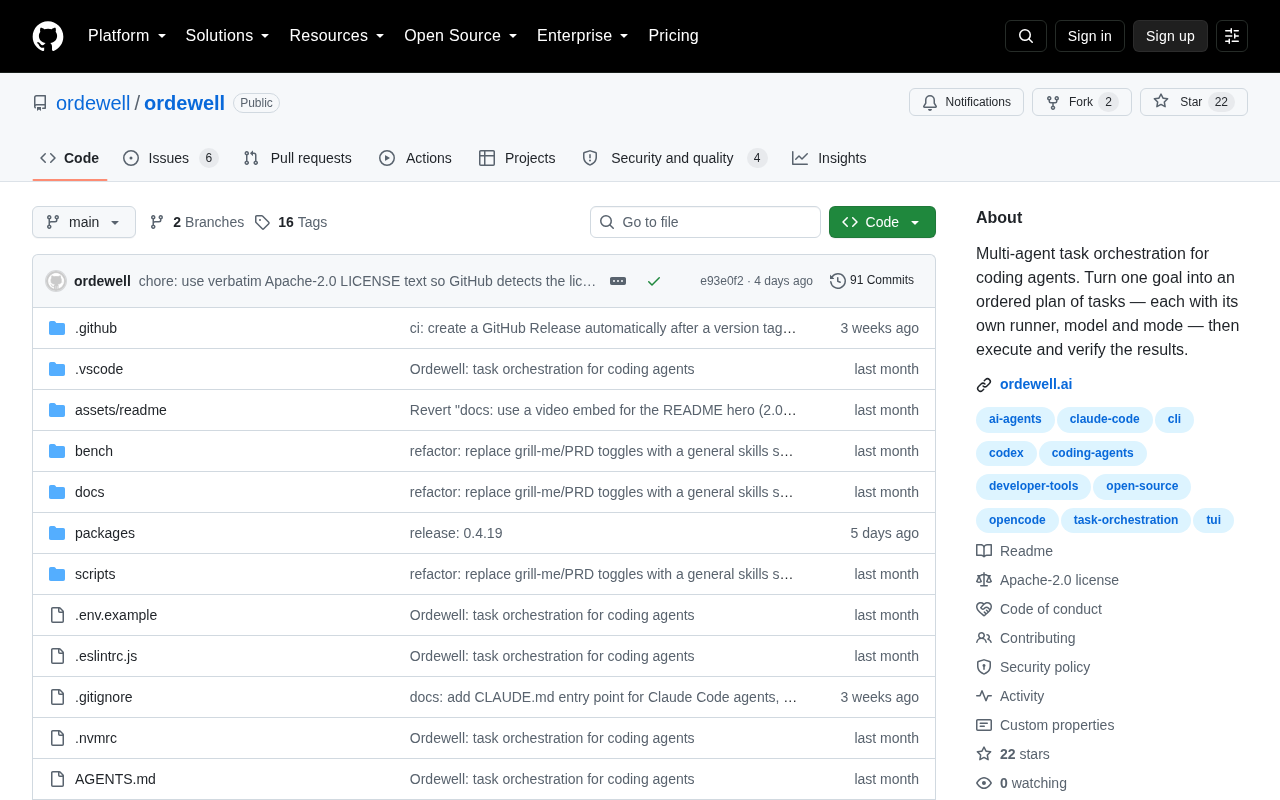
Ordewell is an early-stage project that debuted as a Show HN post. Its core idea is to automatically decompose a high-level programming goal into a task chain with explicit sequential dependencies, which downstream coding agents then execute step by step. It directly addresses the classic pain points of single-agent handling of complex multi-step tasks: context window limits causing early constraints to be lost, ignored task dependencies, and poor progress visibility. In the layered AI coding tool ecosystem, Ordewell positions itself in the "planning and orchestration layer" above code generation and execution — outputting structured, executable task lists rather than generating code directly. Key questions around decomposition quality, user intervention mechanisms, and integration with mainstream agent frameworks remain to be validated.
From a Single Goal to an Ordered Task Chain
As coding agents gradually become part of developers' everyday workflows, a growing pain point has emerged: individual agents excel at executing clearly defined small tasks, but often struggle to handle complex, multi-step engineering goals. Ordewell is a solution aimed squarely at this problem — its core idea is to automatically decompose a high-level goal into a series of sequentially ordered coding agent tasks.
The project recently appeared on Hacker News as a Show HN post. While the discussion hasn't gained significant traction yet (around 5 upvotes at the time of posting, with no comments), it addresses a direction that has been repeatedly discussed as a critical piece of the AI coding tool ecosystem: task orchestration.
Why "Ordered" Task Planning Matters
Asking an LLM-driven agent to accomplish a large goal in one shot typically runs into several classic problems: limited context windows cause later steps to lose track of earlier constraints; tasks with dependencies get executed in parallel or out of order; and there's no way to track overall progress.
Ordewell's emphasis on an "ordered plan" is a direct response to these issues. Rather than simply slicing a goal into sub-tasks, it establishes an execution sequence — which step must come first, and which outputs feed into subsequent steps. Making these dependencies explicit can, in theory, significantly improve both the success rate and controllability of multi-step programming tasks.
The Value of Decomposition and Ordering
In real-world software engineering, a seemingly straightforward goal (e.g., "add user authentication to an existing project") often implies multiple stages — database schema changes, backend API implementation, frontend integration, test writing — each with strict sequential logic. Handing all of this to a single agent at once frequently leads to inconsistencies or missed steps. Ordewell attempts to productize the kind of "plan-then-sequence" process that human engineers perform intuitively.
Positioning Within the Agent Tool Ecosystem
Today's AI coding tools can be roughly divided into layers: the foundation is code generation models, the middle layer consists of execution agents (capable of reading/writing files and running commands), and Ordewell aims to occupy the higher "planning and orchestration layer." It doesn't necessarily generate code directly — instead, it transforms a goal into a structured, ordered task list that downstream coding agents can execute step by step.
This layered approach aligns with a consensus forming across the industry: as agent capabilities grow, effectively organizing and scheduling multiple agents — and managing the decomposition of complex tasks — is becoming the key factor in determining real-world productivity. As a lightweight tool focused specifically on "plan generation," Ordewell fills exactly this gap.
Task orchestration has already produced several representative solutions in the agent framework space. LangChain's Agent Executor, Microsoft's AutoGen multi-agent conversation framework, and LlamaIndex's Workflow module all address "how to get multiple agents to collaboratively complete complex goals" at different levels. Compared to these general-purpose frameworks, Ordewell's differentiated position lies in its focus on programming scenarios, with a single responsibility: generating executable task lists. It's a more vertical, more lightweight entry point. The industry also has systems like Devin and SWE-agent that attempt end-to-end autonomous completion of software engineering tasks, but they bundle planning and execution within the same agent. Ordewell's approach is to explicitly separate the planning layer, allowing downstream execution agents to stay focused.
Questions Yet to Be Validated
As an early-stage project that has just made its debut, the publicly available information about Ordewell is still quite limited. The Show HN post itself lacks specifics about its technical implementation, which agent frameworks it supports, and concrete examples of its decomposition results.
Several questions are worth watching: How is the quality of task decomposition ensured? When the decomposition result is suboptimal, can users intervene to adjust the task order or content? How well does it integrate with mainstream coding agents (such as IDE-embedded agents or command-line agents)? These questions all require real-world feedback to validate. For any planning-focused tool, the accuracy of decomposition and the ability to intervene often matter more than the mere ability to decompose.
Summary
Ordewell represents a concrete attempt to evolve AI coding tools toward an "orchestration layer." It targets a genuine pain point — single agents struggling with complex goals — and proposes a solution through the concept of an ordered task chain. Although the project is still early-stage with limited community response, its direction aligns closely with the broader trajectory of the agent ecosystem. For developers interested in AI-assisted development workflows, task orchestration tools like this are worth keeping an eye on.
Background Note
Context window limitations are one of the core reasons why large language models fail on long tasks. While leading models' context windows have expanded to tens or even hundreds of thousands of tokens, as conversation turns accumulate, the model's "attention" to early constraints significantly degrades — a phenomenon known as "lost in the middle," where critical information positioned in the middle of the context is effectively ignored. For multi-step programming tasks, this means that architectural decisions, naming conventions, or interface contracts established in step one may be forgotten by the model by step five. Breaking large goals into independent short tasks, each with its own clean context, is an engineering practice direction for mitigating this problem.
Related articles

Complete Guide to Running Your Own Local DeepSeek: Web Access, Knowledge Base & Privacy
Step-by-step guide to deploying a private DeepSeek locally using Ollama, Chatbox, and AnythingLLM — with web access, RAG knowledge base, and full privacy.
AI Agent Development: A 4-Stage Learning Roadmap from Beginner to Enterprise-Level Practice
A complete AI Agent learning roadmap from zero to enterprise-level: covering ReAct, multi-agent collaboration, Prompt tuning, RAG, MCP, and real-world projects.
A New DeepSeek Harness Experiment: Agent Supervising Agent for Self-Evolution
A developer built an "Agent supervising Agent" self-evolution system using DeepSeek Harness, with a ledger mechanism enabling near-unattended overnight software iteration.