Orthogonal Null-Space Projection: UUE, a New Lightweight LLM Unlearning Framework
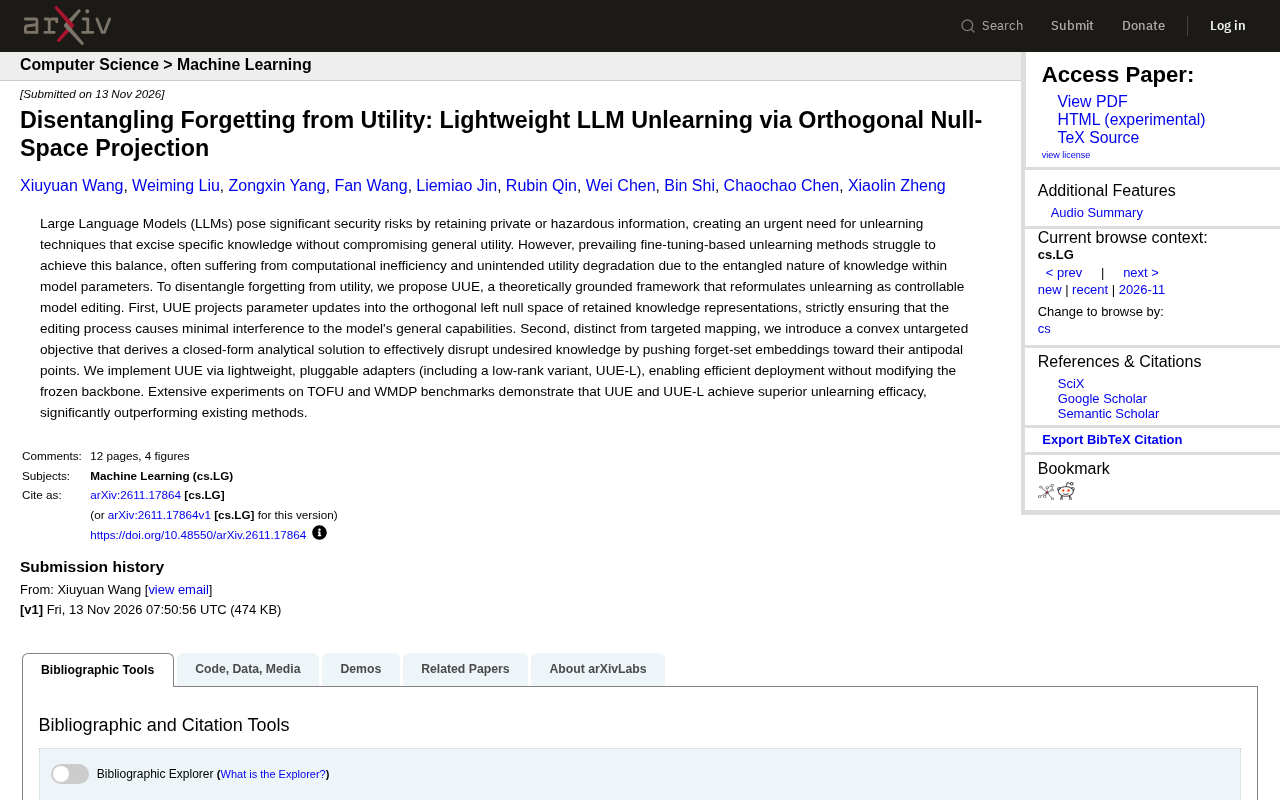
UUE disentangles forgetting from utility on lightweight adapters using orthogonal null-space projection and convex target-free optimization.
This article introduces the UUE framework, which reformulates large-model unlearning as a controllable model editing problem. To address the pain points of fine-tuning-based unlearning—high computational overhead and strong entanglement between forgetting and general capabilities—UUE adopts a two-step strategy: first projecting parameter updates into the orthogonal left null space of retained knowledge to geometrically ensure editing does not touch the directions of general capabilities; then using a convex target-free objective function to push the forget-set representations toward their antipodal points, with a closed-form analytical solution that avoids the uncertainty of iterative optimization. The framework is implemented with lightweight pluggable adapters, including a low-rank variant UUE-L, while the backbone model remains frozen. On the TOFU and WMDP benchmarks, forgetting effectiveness significantly outperforms existing methods, offering a low-cost path for deployment scenarios that frequently update sensitive-knowledge blacklists, though real-world robustness and adversarial unlearning remain to be verified.
Large language models memorize private or dangerous information during training, and how to make a model "forget" specific knowledge without damaging its general capabilities has long been a difficult problem in the field of safety alignment. A recent paper proposes the UUE framework, which reformulates unlearning as a controllable model editing problem and, through orthogonal null-space projection and convex target-free optimization, achieves disentanglement of forgetting and utility on lightweight adapters.
The Entangled Challenge of Forgetting and Utility
Existing fine-tuning-based unlearning methods face a dilemma: on the one hand, computational overhead is high; on the other hand, because knowledge is highly entangled in model parameters, deleting specific knowledge often simultaneously weakens the model's general capabilities. The paper points out that this "forgetting–utility" entanglement is the fundamental reason current methods struggle to balance the two.
The core idea of UUE is to abandon direct fine-tuning and instead adopt the perspective of model editing. It decomposes the forgetting process into two controllable steps: constraining the direction of parameter updates, and designing a target-free objective function to destroy undesirable knowledge.
Orthogonal Null-Space Projection: Minimizing Interference with General Capabilities
The first step of UUE is to project parameter updates into the orthogonal left null space of the retained knowledge representation. Simply put, during editing the model adjusts parameters only along directions that "do not affect existing general knowledge," thereby strictly guaranteeing minimal interference of the editing process with the model's general capabilities.
This constraint theoretically separates forgetting from utility: the forgetting operation is restricted to a subspace orthogonal to the retained knowledge, and the parameter directions housing general capabilities are left untouched. Compared with fine-tuning methods that rely on empirical regularization terms, this geometric constraint is more interpretable.
The left null space is a concept in linear algebra: for a matrix A, its left null space consists of all vectors v satisfying vᵀA = 0. In unlearning tasks, if the representation of retained knowledge (e.g., layer-wise activations or gradient matrices on the retain set) is treated as a matrix, then parameter updates lying in its left null space are orthogonal to that representation and do not change the expression of retained knowledge in the model. UUE exploits exactly this to restrict the parameter changes caused by forgetting to directions "unrelated to retained knowledge," geometrically ensuring that general capabilities are not eroded.
Convex Target-Free Optimization: Pushing Toward Antipodal Points
Unlike traditional targeted mapping, UUE introduces a convex target-free objective function that destroys undesirable knowledge by pushing the embeddings of the forget set toward their antipodal points. This objective function has a closed-form analytical solution, avoiding the uncertainty of iterative optimization.
The paper emphasizes that this target-free design does not require the model to learn specific replacement outputs; instead, it reverses the knowledge direction of the forget set at the representation level, thereby achieving forgetting while keeping the model structure unchanged.
Antipodal points originally refer to two points at opposite ends of a diameter on a sphere, and in representation space can be understood as two vectors pointing in completely opposite directions. UUE's "target-free" nature means it does not specify what alternative answers the model should output on the forget set; instead, it pushes the hidden representations of the forget set to their opposite positions on the unit hypersphere, flipping the direction of that knowledge from "present" to "opposite." Because the objective function is convex and involves only the flipping of representation directions, a closed-form solution can be written without gradient-descent iteration, thereby avoiding the instability and uncertainty brought by the optimization process.
Lightweight Adapter Implementation: UUE and UUE-L
UUE is implemented through lightweight, pluggable adapters, including a low-rank variant UUE-L, and deployment requires no modification of the frozen backbone model. This means that in practical applications, the unlearning module can be mounted on demand without retraining the base model.
Experiments on the TOFU and WMDP benchmarks show that UUE and UUE-L significantly outperform existing methods in forgetting effectiveness. The paper attributes this to the utility preservation brought by the orthogonal constraint and the forgetting efficiency brought by target-free optimization.
An adapter is a small trainable module inserted between layers of a frozen backbone model, typically consisting of two linear transformations for down-projection and up-projection, with far fewer parameters than the backbone. UUE implements the forgetting operation on adapter parameters while keeping the backbone weights unchanged, so the module can be mounted or unmounted on demand during deployment. UUE-L is a low-rank variant that further compresses adapter parameters via low-rank decomposition, reducing storage and computational overhead while maintaining forgetting effectiveness—suitable for scenarios requiring maintenance of multiple unlearning modules.
Implications for Safety Alignment Practice
The value of UUE lies in providing a pluggable, low-cost unlearning path. For scenarios requiring frequent updates to sensitive-knowledge blacklists, the adapter approach is easier to maintain than full-parameter fine-tuning. However, the paper currently reports only benchmark results, and robustness and adversarial unlearning effectiveness in real deployments remain to be verified.
Overall, formalizing unlearning as model editing with geometric constraints provides a new theoretical tool for disentangling forgetting and utility, and offers a feasible direction for lightweight safety deployment.
TOFU (Task of Fictitious Unlearning) is a standard benchmark for evaluating machine unlearning, consisting of fictitious author question-answer pairs, used to test whether a model can forget a specified author while retaining the rest of its knowledge. WMDP (Weapons of Mass Destruction Proxy), on the other hand, focuses on forgetting dangerous knowledge (biosecurity, chemistry, cyberattacks, etc.), measuring whether general capabilities are preserved after removing harmful capabilities. The two benchmarks represent two typical scenarios—"privacy unlearning" and "safety unlearning"—and UUE reports better results than baselines on both.
Related articles

Gemini 4 Neon Leak: A Potential Strong Contender Against Opus 5.5
A Hacker News thread suggests Gemini 4 Neon looks like an Opus 5.5 competitor. This article unpacks the product positioning behind this community signal, shifts in the top-model competitive landscape, and what it means for developers' model selection strategy.

Claude Fable 5.2's Self-Authored Short Film 'Fable' Sparks Discussion
A short film 'Fable,' credited to Claude Fable 5.2 for script, visuals, and directing, appears on Hacker News. This article analyzes the significance of full-pipeline AI creation, community reactions, and what it means for content creators.

Anthropic IPO Pricing: A Signal of AI Giants Going Public
Anthropic's IPO pricing draws attention. This article analyzes its potential impact on AI industry valuation, commercialization paths, and the competitive landscape, and highlights public-market expectations and challenges for AI companies.