Otiumz Deep Dive: A New Paradigm for AI-Powered Multi-Identity Social Apps

Otiumz combines multi-identity subaccounts with AI digital selves to reimagine social networking.
Otiumz is a new AI-powered social app that lets users manage multiple identities through subaccounts while leveraging AI digital selves to handle conversations, generate openers, and maintain social continuity. Positioned at the intersection of AI companionship and multi-identity social networking, it takes an "AI-enhanced rather than AI-replaced" approach to real human connections, though it must still overcome the classic cold-start challenge facing all social platforms.
When Social Apps Meet "Multiple Identities"
The core logic of traditional social platforms is built around a carefully curated single identity. Whether it's the corporate professional on LinkedIn or the lifestyle blogger on Instagram, users are often forced to compress themselves into one "unified persona." In reality, however, people are never one-dimensional—the you at work, the you in your friend circle, and the you in your hobby community might be three entirely different people.
The root of this identity compression can be traced back to the product architecture of social platforms—one account corresponds to one identity, and one identity faces all audiences. Sociologist Erving Goffman pointed out as early as 1959 in The Presentation of Self in Everyday Life that people naturally switch between "front stage" and "backstage" performance modes in different social contexts. Traditional social platforms compress all contexts onto the same stage, generating massive identity anxiety.
Recently launched on Product Hunt, the AI social app Otiumz targets precisely this pain point. With its tagline "AI-powered social app for every side of you," it attempts to break free from the shackles of single-identity constraints. The product falls under the categories of messaging, artificial intelligence, and social networking, and was built by Carter Wang.
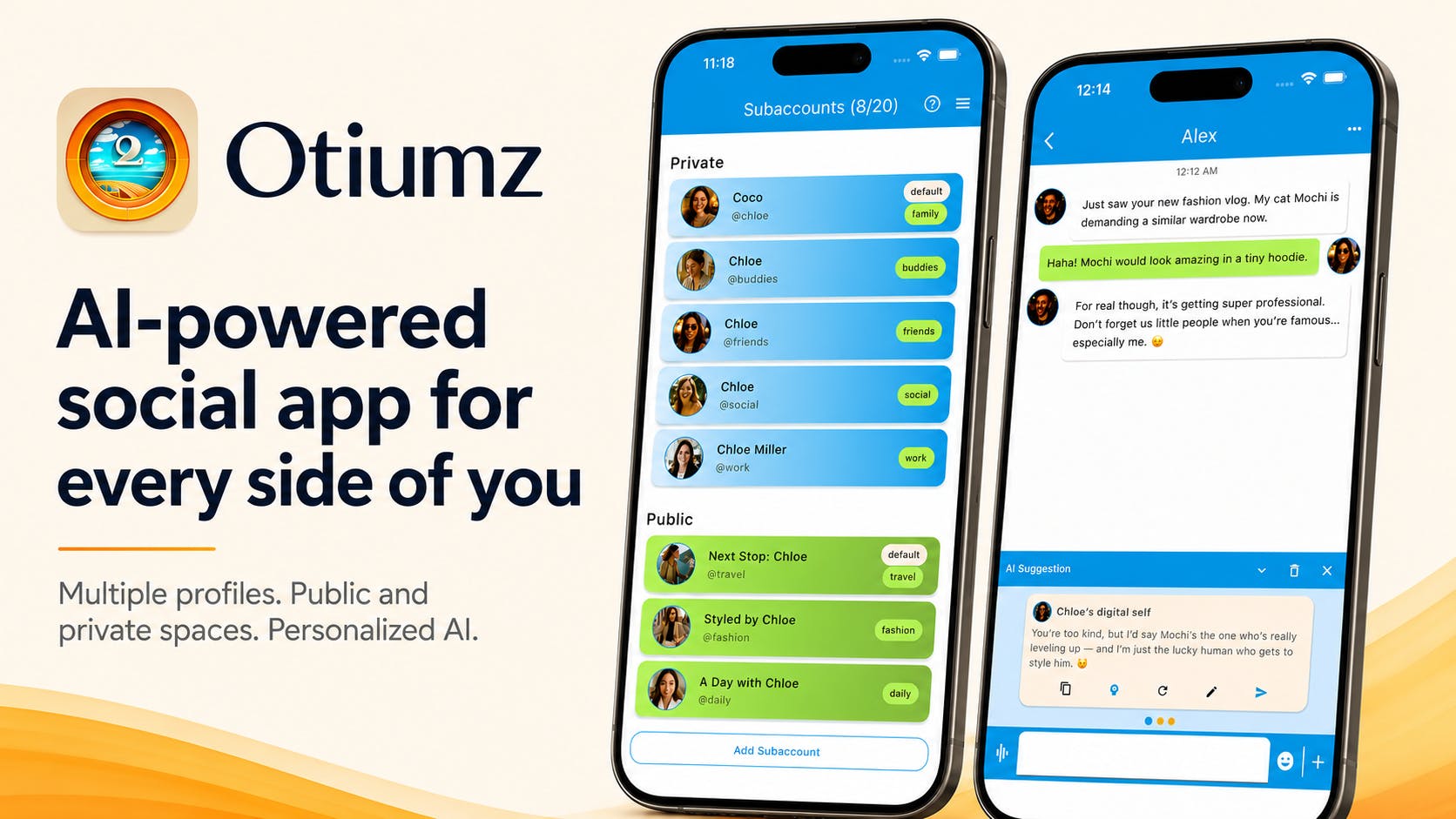
Core Features: One Account, Multiple "Yous"
Subaccount System: A Native Solution for Multi-Identity Management
Otiumz's most distinctive feature is allowing users to create multiple "Subaccounts" under a single primary account. You can establish different identities for different social scenarios—one for public sharing, another exclusively for a private inner circle—without any interference between them.
This design responds to an increasingly common reality in contemporary social life: a large number of young users are already using "alt accounts" and "Finstas" (Fake Instagram accounts) to segment different social relationships. The Finsta phenomenon first emerged around 2015, primarily among Gen Z users. These users create private Instagram accounts with very few followers, open only to close friends, for sharing unfiltered daily life—forming a stark contrast with their carefully curated main accounts. According to Pew Research Center surveys, over 40% of social media users aged 18-24 have at least two accounts, which clearly demonstrates the mismatch between single-identity architecture and young users' needs.
Otiumz productizes and systematizes this spontaneous behavior, turning "multi-identity management" into a native app capability rather than a workaround requiring users to register multiple accounts. From a product design philosophy perspective, this represents a mindset shift from "fighting user behavior" to "embracing user behavior."
A Complete Social Feature Matrix
At the foundational social layer, Otiumz offers a relatively complete feature set:
- Moments sharing: A content publishing mechanism similar to WeChat Moments
- Public and private circles: Both open connections and private group interactions
- People discovery: Helping users expand their social networks
- Instant messaging: Text chat support
- Voice and video calls: Real-time audio/video communication
Looking at this feature combination, Otiumz isn't content with being merely an "AI toy"—it aspires to become a fully functional social platform for daily use. This means it needs to match the baseline experience of mature products like WeChat and WhatsApp in terms of messaging stability and low-latency audio/video calls, which represents a considerable technical bar for a startup product.
AI's Central Role: Digital Selves and AI Characters
If the multi-identity system is Otiumz's skeleton, then AI capabilities are its soul. This is also what fundamentally distinguishes it from traditional social apps.
Training Your Own "Digital Self"
Otiumz allows users to create and train multiple "Digital Selves" and "AI Characters." Users can choose one to drive social interactions, manifesting across three levels:
- Conversation opener generation: Solving the most common social awkwardness of "not knowing how to start"
- Personalized reply suggestions: Offering response options based on your expression style
- Optional auto-replies: When you're offline or away, your AI self can continue conversations on your behalf
From a technical implementation perspective, the "personalized training" of digital selves typically relies on fine-tuning or few-shot learning techniques for large language models. Users "teach" the AI their language style, expression habits, and value preferences by providing historical conversation records, writing samples, or direct interactions. Current mainstream implementation approaches include: persona description injection based on Prompt Engineering, personal knowledge base referencing based on RAG (Retrieval-Augmented Generation), and style transfer based on lightweight fine-tuning techniques like LoRA. Each method involves different trade-offs between training cost, personalization accuracy, and inference efficiency, and the upper bound of personalization quality directly determines users' sense of identification that "this is me."
The elegance of this design lies in transforming AI from an "external tool" into "an extension of you." The digital self isn't a generic chatbot but a personalized AI trained to be "like you," thereby maintaining social relationship continuity even in your absence.
The Boundary Question of AI-Mediated Socializing
The concept of "AI socializing on your behalf" also raises philosophical and ethical questions worth examining. If the person communicating with you is actually talking to your AI self, how do we define the "authenticity" of such social interaction? While auto-reply features improve efficiency, they may also dilute the sincerity of interpersonal connections.
This question traces back to philosopher John Searle's famous "Chinese Room" thought experiment—a person who doesn't understand Chinese can still produce seemingly fluent Chinese responses using a rule book, but does such communication possess genuine "understanding"? In a social context, if your friend sends you a warm greeting and you later discover it was AI-generated, would your feelings change? MIT sociologist Sherry Turkle foresaw this dilemma in Alone Together—technology keeps us "always connected but never truly connecting." Since 2024, AI social products like Character.AI and Replika have already exposed risk cases of users becoming overly dependent on AI relationships, prompting the entire industry to think more carefully about the appropriate boundaries of AI in interpersonal relationships.
This is the core tension that no AI social product can avoid. Otiumz preserves user autonomy by making auto-reply an "optional feature"—a balance point between efficiency and authenticity. But the deeper question remains: even when users actively choose AI-mediated socializing, does the receiving party have the right to know they're conversing with AI rather than a real person? This information asymmetry could become a focal point of future regulatory attention.
Product Positioning and Market Opportunity
From a market perspective, Otiumz sits at the intersection of two hot trends: AI companionship/AI characters (like Character.AI) and multi-identity social networking.
The current AI social track has formed two distinct directional branches. One is "AI replacement" products, represented by Character.AI (valued at over $5 billion) and Replika, where users directly establish emotional connections with AI characters—the AI itself is the social counterpart. The other is "AI enhancement" products, where AI serves as a catalyst and assistive tool for real human-to-human socializing, reducing social friction without replacing real relationships. The former faces ethical risks and regulatory pressure around user addiction and emotional dependency, while the latter needs to prove that AI assistance genuinely improves rather than damages the quality of real interpersonal relationships.
Unlike pure AI chat apps, Otiumz's AI is an assistive tool serving "real social interactions between people" rather than a virtual companion replacing real humans. This "AI-enhanced rather than AI-replaced" positioning is theoretically more acceptable to mainstream users and offers greater commercial imagination. From a business perspective, AI enhancement products can more easily integrate proven commercial models like advertising, membership subscriptions, and value-added services that mature social platforms have already validated, rather than relying on a single subscription monetization path like AI replacement products.
However, as a newly launched product, Otiumz faces the same core challenge common to all social apps—cold-starting the network effect. The value of a social platform depends on user scale; without quickly accumulating enough active users and quality content, even the most elegant feature design struggles to drive retention.
Network effects are both the most critical moat and the hardest threshold to cross for social products. Metcalfe's Law states that a network's value is proportional to the square of the number of users, meaning a social network with few users has virtually no utility value. Historically, social products that successfully crossed the cold-start barrier typically employed one of the following strategies: Facebook's "density-first" approach starting from the single campus of Harvard; Clubhouse creating scarcity through invite-only access and celebrity effects; or Discord building vertical community stickiness with gaming communities as the entry point. For Otiumz, the AI functionality itself may constitute a form of "single-player value"—even without friends on the platform, users can still interact with AI characters and train their digital selves. This theoretically reduces dependence on initial network density, providing some buffer space for cold-starting.
Early attention indicates market interest, but there's still a long way to go before forming a scaled social network.
Conclusion
Otiumz represents a new approach to social products in the AI era: rather than forcing users to maintain a single perfect persona, it acknowledges and embraces human multifacetedness while using AI digital selves to lower social costs and maintain relationship continuity.
Whether it succeeds ultimately depends on two key factors: first, whether the AI self's training produces results that are genuinely "like you" and sufficiently practical—which involves the maturity of natural language processing technology in personalization; and second, whether it can cross the most difficult cold-start threshold of social products—which requires finding a precise enough initial user base and growth flywheel. Regardless of the outcome, this exploration direction of "one person, multiple facets + AI enhancement" offers a noteworthy new perspective for the crowded social space. As AI infrastructure matures, social product innovation has shifted from "connecting more people" to "better expressing and managing the self"—and this may well be the core proposition of the next generation of social platforms.
Related articles

Poison-Resistant Concept Anchoring: A New Approach to Defending Against AI Data Poisoning
Deep dive into Poison-Resistant Concept Anchoring, defending against data poisoning via signed anchors and bounded updates. Experiments show 62% poison isolation with 0% false rejection rate.

Hungarian Algorithm Explained: Principles, Complexity, and Engineering Implementation Guide
In-depth explanation of the Hungarian Algorithm: core principles, O(N³) time complexity advantages, and engineering implementation. Covers assignment problem definition, step-by-step algorithm walkthrough, Python/C++ libraries, and applications in multi-object tracking and resource scheduling.
OpenAI's First Enterprise AI Report: H…
OpenAI's First Enterprise AI Report: How ChatGPT Is Changing the Way Organizations Work
OpenAI's first enterprise AI report reveals three key traits of ChatGPT Enterprise adoption: the shift from novelty to necessity, writing and coding as top use cases, and data governance as a core prerequisite.