Over Half of European Enterprises Now Use AI Agents, SMB Users Surge 8x

Over half of AI usage among European enterprises now involves AI agents, SMB users have surged 8x, and the focus is shifting toward deep embedding.
A recent economic research report shows that more than half of AI usage among EU business customers already involves AI agents, with European SMB users growing 8x—a sign that enterprise AI is moving from experimentation to deep usage. AI agents can autonomously plan tasks, call external systems, and execute multi-step workflows, and are moving from technical demos into daily operations such as customer service automation and supply chain coordination. The report notes that the core challenge is not adoption rate but turning broad adoption into deep usage—requiring workflow restructuring, a redefinition of human-machine division of labor, and supporting data governance. Finance, retail, and manufacturing lead in acceptance, while heavily regulated industries are more cautious. Opportunities lie in end-to-end process efficiency and helping SMBs narrow the digitalization gap; concerns include blurred responsibility boundaries from agent autonomy, missing monitoring and auditing mechanisms, and the impact of early failure cases on confidence.
AI Agents: From Peripheral Tools to Enterprise Mainstream
European enterprises are rapidly embracing AI agents. According to a recent economic research report, more than half of AI usage among EU business customers already involves AI agent tools, while the number of SMB users in the region has grown 8x. This signals that enterprise AI is moving from "dipping a toe in" to "deep usage"—a transformation from broad adoption to deep embedding is underway.
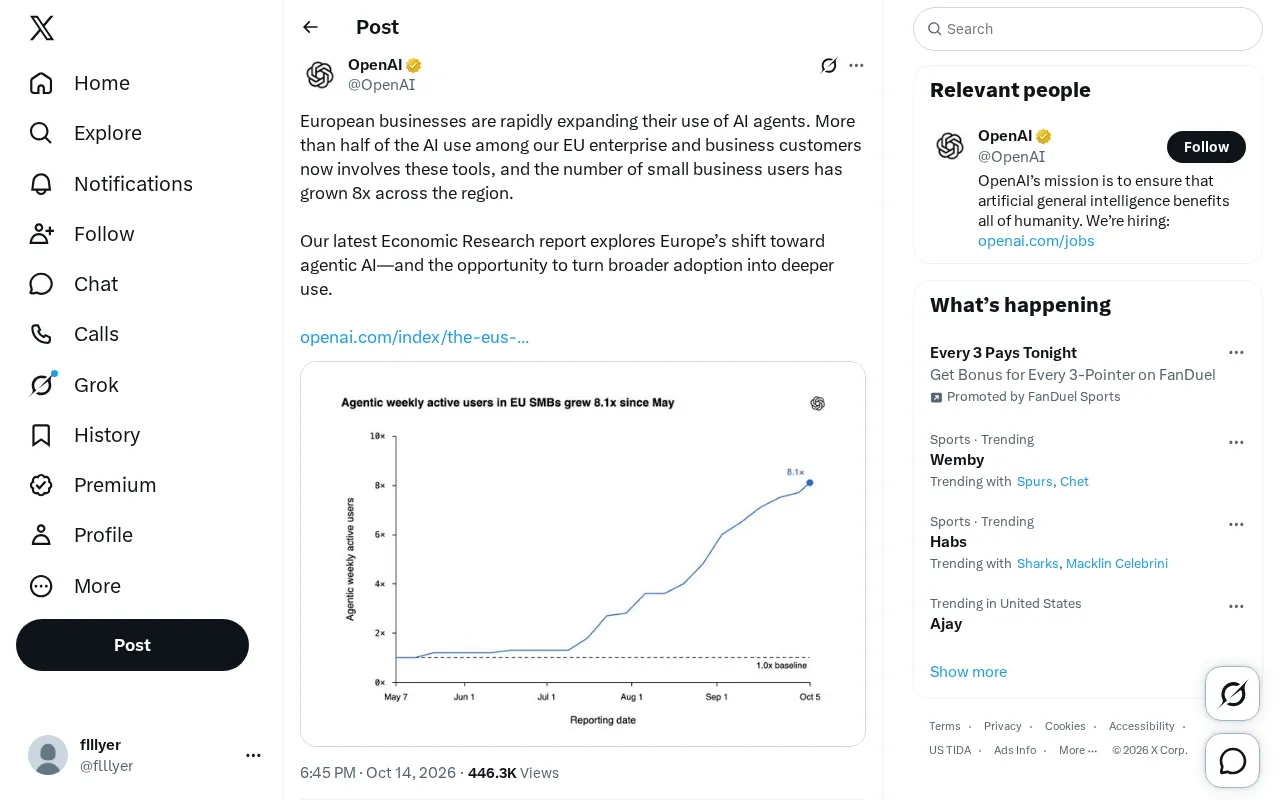
The report's core finding is that AI agents are no longer just experimental projects for large enterprises. Among EU enterprise and business customers, over 50% of AI use cases are now related to AI agents. These tools can autonomously plan tasks, call external systems, and execute multi-step workflows, and they are rewriting how enterprises work.
Over the past year, discussion of AI agents has largely centered on technical demos and proof-of-concept work. The data now shows that European enterprises have already brought agentic AI into daily operations. From customer service automation to supply chain coordination, AI agents are beginning to take on complex tasks that previously required humans to stitch together.
The 8x growth in SMB users is particularly noteworthy. This group typically lacks dedicated AI teams yet shows stronger willingness to adopt. The reason is not hard to understand: AI agents lower the barrier to automation, enabling cross-system operations without deep customization—an outstanding value proposition for resource-constrained SMBs.
AI agents are fundamentally different from traditional generative AI tools. Ordinary chatbots or content-generation tools usually respond to a single input and finish the task once text or an image is produced; AI agents, by contrast, are goal-directed and autonomous—they can break a high-level goal given by the user into multiple subtasks, decide which external tools or APIs to call and in what order, and adjust strategy based on intermediate results during execution. For example, an AI agent handling customer service tickets can automatically query the order system, determine refund eligibility, call the payment interface to complete a refund, and hand off to a human when an exception occurs. This closed-loop capability of "plan—call—execute—feedback" upgrades AI agents from passive response tools to "digital employees" that can independently complete business processes—and this is precisely the technical foundation that enables them to be embedded in core enterprise operations.
From "Using It" to "Using It More Deeply"
The report's title highlights a key proposition: how to turn broader adoption into deeper usage. This is the core challenge currently facing the European AI market.
High adoption does not equal high value. Many enterprises remain at the surface level—using AI agents for a single task without embedding them into core business processes. Deep usage means restructuring workflows, redefining human-machine division of labor, and making accompanying adjustments in data governance and permission management. This requires not just tools, but an upgrade in organizational capabilities.
From an industry perspective, finance, retail, and manufacturing are relatively ahead in accepting AI agents, because these sectors contain many repetitive, cross-system processes that can be standardized. By contrast, industries subject to strong regulatory constraints are more cautious in their pace of rollout.
"Adoption" and "depth of use" are two indicators at different levels when assessing enterprise AI maturity. Adoption rate measures how many enterprises or use cases have connected to AI tools, usually counted by number of users, licenses, or active use cases; depth of use focuses on the extent to which AI has changed the business process itself—for example, whether it is embedded in core systems, whether it handles key decision points, and whether it delivers quantifiable efficiency or revenue gains. High adoption but low depth of use often manifests as "shadow AI"—individual employees use tools to boost efficiency, but there is no process restructuring at the organizational level. The industry commonly uses "AI maturity" frameworks to describe this progression: from experimentation and exploration, to localized deployment, to process integration and organizational reinvention. The transformation emphasized in the report is essentially about pushing enterprises across the gap between "having tools" and "changing processes."
Opportunities and Concerns Coexist
This wave of AI agent expansion among European enterprises is backed by a clear window of opportunity. Agentic AI can connect previously isolated automation tools into end-to-end processes, unlocking considerable room for efficiency gains. For SMBs, this could be an opportunity to narrow the digitalization gap with large enterprises.
Concerns also exist. The stronger the autonomy of AI agents, the blurrier the boundaries of responsibility when something goes wrong. As European enterprises scale up usage, they need to establish monitoring, auditing, and rollback mechanisms in parallel. In addition, an 8x growth in user base means many enterprises are encountering agentic AI for the first time, and supporting training and best-practice accumulation are not yet mature—early failure cases could affect subsequent confidence.
The report does not provide a specific industry breakdown or timeline, but its signal is clear: the focus of enterprise AI application in Europe is shifting from "whether to use" to "how to use it well." For AI vendors, competition in the next stage will not be about the number of features, but about whether they can help enterprises truly embed agents into business processes.
The responsibility boundaries and auditability of AI agents are key governance challenges that distinguish agentic AI from traditional software when it is deployed. The behavior of traditional automation scripts is explicitly defined by code, and errors can be traced to specific rules; AI agents, however, perform autonomous planning and tool invocation based on models, and their decision paths are probabilistic and nondeterministic—the same goal may follow different execution trajectories. This means that when an agent takes a wrong action (such as issuing an erroneous refund or incorrectly modifying inventory), it is difficult to simply attribute it to a "program bug" or "operator error." Therefore, enterprises need to implement three types of mechanisms when deploying: first, observability, fully recording each step of the agent's planning, tool calls, and intermediate outputs; second, least privilege, limiting the systems and operations the agent can reach; and third, human review checkpoints and rollback mechanisms, setting confirmation steps before high-risk actions. The transparency and record-keeping requirements for high-risk AI systems under the EU AI Act are also directly related to this.
Implications for Enterprises
For European enterprises currently evaluating AI agents, this set of data provides several reference points. More than half of peers are already using related tools, and the window for waiting and watching is narrowing. The explosive growth in SMB users shows that the entry threshold for agentic AI has dropped to an acceptable range.
But blindly following the trend is not advisable. Enterprises first need to identify processes suitable for agentization—cross-system, multi-step tasks with relatively clear rules are priority candidates. At the same time, they should plan data permissions and human review checkpoints in advance to avoid the risk of losing control when agents run autonomously.
The European market has a relatively strict regulatory framework for AI, which is both a constraint and an advantage. Compliance requirements force enterprises to pay more attention to transparency and traceability when adopting AI agents, which in the long run helps build a trustworthy agentic AI application system.
The full report can be accessed via the original link, which provides a more detailed data breakdown of the structural changes in the European AI agent market.
One-line Summary
More than half of AI usage among European enterprises now involves AI agents, SMB users have surged 8x, and the focus is shifting toward deep embedding.
Paragraph Summary
A recent economic research report shows that more than half of AI usage among EU business customers already involves AI agent tools, and the number of SMB users in Europe has grown 8x, marking a shift in enterprise AI from experimentation to deep usage. AI agents can autonomously plan tasks, call external systems, and execute multi-step workflows, and are moving from technical demos into daily operations such as customer service automation and supply chain coordination. The report points out that the core challenge is not adoption rate, but transforming broad adoption into deep usage—requiring workflow restructuring, a redefinition of human-machine division of labor, and supporting data governance. Finance, retail, and manufacturing are leading in acceptance, while heavily regulated industries are more cautious. Opportunities lie in end-to-end process efficiency gains and in helping SMBs narrow the digitalization gap; concerns include blurred responsibility boundaries due to agent autonomy, missing monitoring and auditing mechanisms, and the impact of early failure cases on confidence.
Related articles

The Touchscreen MacBook and Apple's Delightful Mess: A Deliberate Gamble
The Vergecast unpacks the touchscreen MacBook Pro's launch logic, the ProLed naming controversy, the iPad squeezed between iPhone and Mac, and how Apple stays competitive with premium hardware in the AI era.

Fifty Years Studying Power: Robert Caro's Writing and Insights on Power
Robert Caro reflects on 50 years studying power: Lyndon Johnson's persuasion and leverage, Robert Moses's transformation from idealist to ruthless builder, the dilemmas of large-scale construction, and his methods of compressing themes and solitary focus in biography writing.

Can a $20,000 Robot Do Your Chores? The Test Results Are Surprising
A YouTube test video shows how a $20,000 robot responds to commands like washing dishes, turning off lights, taking out trash, and feeding the dog. This article analyzes its real capability boundaries, the state of voice interaction technology, and how far household robots are from mainstream adoption.