Overpath: Meet Molly, the AI Teammate Built for Sales Teams

Overpath's AI teammate Molly targets the execution gap between CRM and sales analytics tools.
Overpath is an AI tool positioned at the sales "execution layer," with its core product being an AI teammate named Molly. Unlike Gong or Clari, which focus on post-hoc analysis and revenue forecasting, Overpath aims to intervene in real time during active deals — flagging risks before calls, auto-drafting follow-ups, and giving managers visibility into true pipeline health — all grounded in a team's own sales methodology. Its standout feature is persistent cross-conversation memory, addressing the common AI pain point of starting from scratch every session. The product earned 78 upvotes on Product Hunt, though real-world validation remains limited.
Beyond CRM: The New Battleground for Sales Execution
In the modern sales tech stack, CRMs handle deal logging and intelligence tools dissect the data — but the layer that actually determines success or failure, how deals are executed and moved forward, has long been a tool-free zone. Overpath targets exactly this "execution gap." The product launched on Product Hunt with 78 upvotes and a #15 ranking, staking out a clear position: an AI teammate that actually understands the business, built for revenue teams.
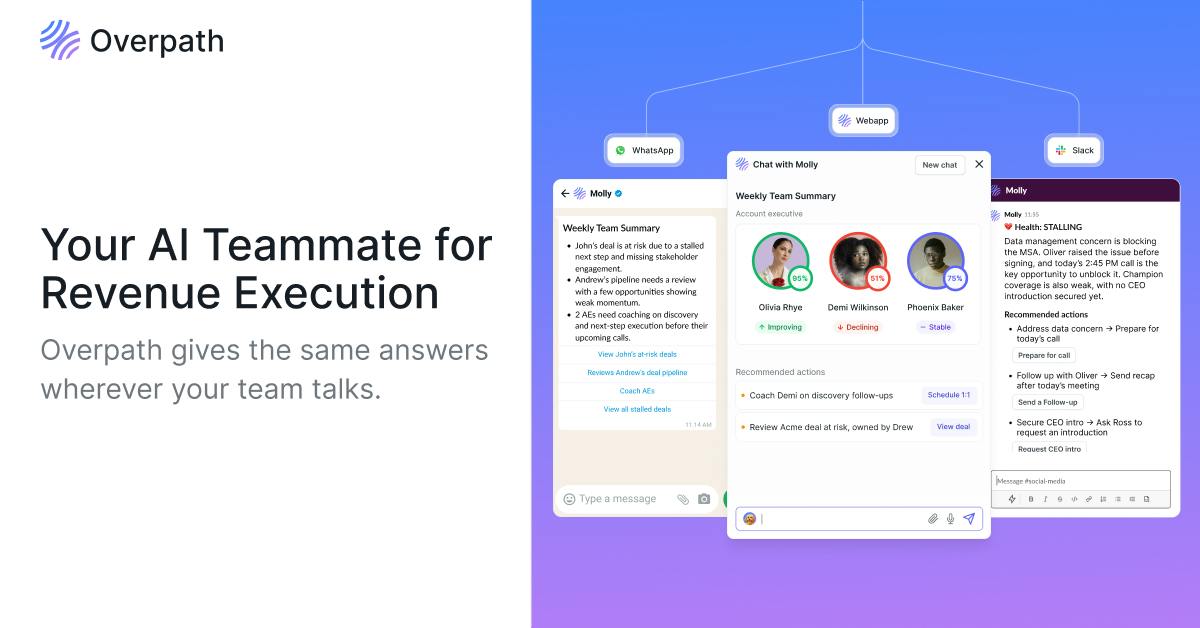
The core philosophy is captured in one line from the product page: "No CRM ever made a rep sell better. Overpath can." That slightly provocative statement cuts straight to the pain point of traditional sales tools — they're great at recording and analyzing, but rarely intervene in the actual work of selling.
Molly: More Than a Chatbot
Overpath's product persona is an AI teammate named Molly. Unlike the generic AI assistants flooding the market, Molly is designed to be "rooted in your methodology, your deals, your business context." That means no generic sales advice — Molly works from a team's existing sales methodology and the specifics of each deal in play.
According to the official description, Molly delivers several key capabilities: she flags the gaps in a deal before the call happens, drafts the follow-up before you even ask, and gives managers a clear picture of how the pipeline is actually running.
Eliminating "Memory Loss"
One detail worth highlighting is Overpath's emphasis on "No memory loss between chats." This is a common failure mode in AI applications today — every conversation starts from scratch, as if meeting for the first time. In sales, deals unfold over weeks or months. If an AI can't remember what was discussed last time or where a deal stood at the previous stage, its value drops dramatically. Molly aims to solve this through persistent contextual memory, making the AI a true full-cycle deal companion rather than a one-off Q&A tool.
"Memory loss" is a structural limitation of current large language model (LLM) applications. Mainstream LLMs have a context window limit per session, and more critically, two separate conversations share no information by default — the model has no knowledge of prior exchanges when a new chat begins. Developers typically work around this in two ways: writing historical summaries into each session's system prompt, or building an external vector database that converts user data into retrievable memory chunks dynamically loaded during conversation. Overpath's emphasis on "persistent cross-conversation memory" suggests it likely uses a similar persistence mechanism — managing each deal's communication history, stage progress, and team context in a unified store. This matters enormously in sales, where a complex B2B deal can span months and multiple rounds of communication. Without the full context, AI recommendations become generic and lose their value.
Pipeline Visibility for Managers
Another selling point for Overpath is the transparency it promises sales managers. Traditionally, managers' understanding of the pipeline depends on data entered by reps into the CRM — data that's often lagging and frequently inaccurate. Overpath claims to "show every manager exactly how the pipeline is actually working," which effectively elevates the AI from a personal assistant to a team collaboration and management layer.
If this capability holds up in practice, the implications for sales management are significant. Managers no longer have to rely on subjective rep reporting — they can see an objective picture grounded in actual deal activity.
Positioning: Filling the Execution Layer
The product logic behind Overpath breaks the sales tech stack into three layers: CRM handles "recording," intelligence tools handle "analysis," and Overpath sits at the "execution" layer. This framing carves out clear differentiation space. Competition in AI sales tools is fierce — players like Gong and Clari have staked out territory in conversation intelligence and revenue forecasting — so Overpath's choice to target execution positions it as the missing link between CRM and analytics.
That said, it's worth keeping perspective: the available information comes primarily from the Product Hunt launch page, which is official messaging. The actual effectiveness of the product, the accuracy of its AI recommendations, the reliability of its contextual memory, and the depth of its CRM integrations all remain to be validated by real users. 78 upvotes signals meaningful attention, but just 2 comments means community feedback is still limited.
Gong and Clari are two of the most prominent players in sales tech today, and understanding them helps clarify Overpath's differentiation logic. Gong is known for "conversation intelligence" — recording and analyzing sales calls and emails to surface best practices and tell reps which approaches work. Clari focuses on revenue forecasting, using AI to model pipeline data and help leadership predict whether quarterly targets will be hit. What both have in common is post-hoc analysis — they digest sales behavior that has already happened and output insights and predictions. Overpath's "execution layer" logic is different: the goal is to intervene in real time during active deals, guiding reps on what to do next rather than running retrospectives. This "coach-in-the-moment" positioning genuinely lacks a dominant incumbent in the stack — but it also means the product requires deep understanding of sales processes, and the quality of the AI's recommendations directly determines its value, leaving little room for error.
Who Should Pay Attention
For B2B sales teams actively looking for sales automation and AI-assisted tooling, Overpath deserves a spot on the watch list. Its three emphasized pillars — methodology-grounded guidance, persistent memory, and management visibility — directly address the shortcomings of generic AI tools in specialized sales contexts.
Ultimately, whether Overpath can deliver on its promise of making reps sell better comes down to whether its AI can genuinely understand complex sales dynamics — or whether it's just a well-packaged script generator. That's the test every vertical AI application has to pass.
Related articles

Trump's Request to Rename the Atlantic Rejected by Google; 1Password Lets AI Agents Log In Securely
The Vergecast roundup: Trump's request to rename the Atlantic the 'Trump Ocean' was politely declined by Google's CEO; 1Password's new feature lets AI agents log into accounts without touching passwords; OPPO launches the world's first 200-megapixel phone, the Find X10 Pro Max. All three point to the boundaries of tech authorization and trust.

The Truth About American College Party Culture: The Risks Schools Won't Admit
Behind American college party culture, the administration's "don't ask, don't tell" attitude is amplifying freshman risks. This article analyzes how the pandemic strengthened Greek dominance, freshmen's difficulty accessing safety information, and the chain reactions caused by a culture of denial.

OpenAI Reportedly Raising $30B at $1.25T Valuation Ahead of IPO
OpenAI is planning a $30B funding round at a possible $1.25T valuation, paving the way for an IPO. If completed, it would set a private company valuation record. This article analyzes the funding size, pre-IPO logic, and industry signals.