OVH Open-Sources Olala mini 7A1B: A MoE Model Running 160 tokens/s on 8GB VRAM

OVH open-sources Olala mini 7A1B: a 7B-total/1B-active MoE model running on 8GB VRAM at 160 tokens/s on an A4500.
OVH released Olala mini 7A1B, an open-source language model with a Mixture-of-Experts architecture: 7B total parameters, about 1B activated per request, and 256 experts per layer. Its attention combines Differential-TPA with Mamba-3, released in BF16. The biggest selling point is the low hardware bar: it runs on 8GB VRAM, hits 160 tokens/s on an RTX A4500 and 50 tokens/s on CPU alone, with a 32K context window. It will be open-sourced on Hugging Face under Apache 2.0, permitting commercial use. The article sees this as reflecting cloud vendors' trend of cutting inference costs via sparse models, and notes that MoE plus hybrid attention is becoming the mainstream recipe for efficient small models—though real-world downstream performance remains to be validated by the community.
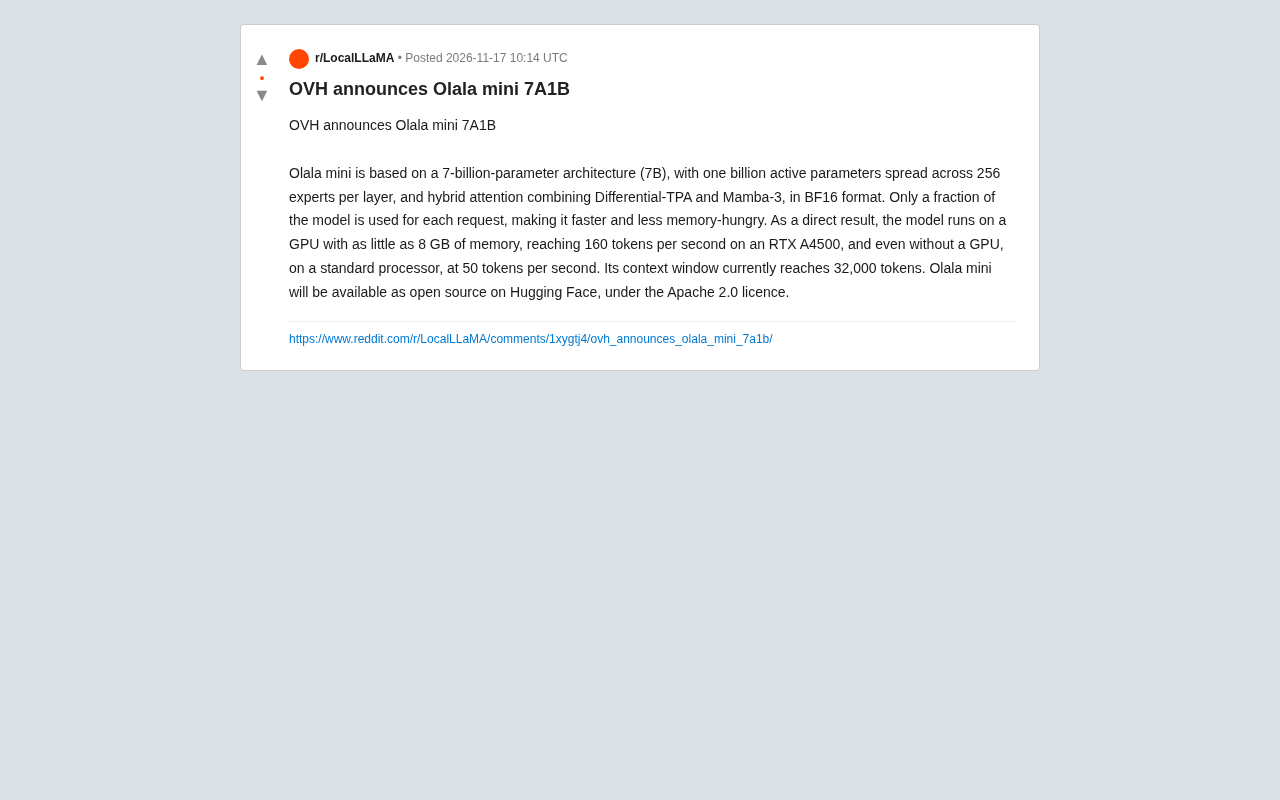
OVH recently released Olala mini 7A1B, an open-source language model built on a Mixture-of-Experts (MoE) architecture. What stands out most is that it can run on a GPU with just 8GB of VRAM and achieves a generation speed of 160 tokens/s on an RTX A4500—a figure that's quite impressive for consumer-grade hardware.
Architecture Design: 7B Total Parameters, Only a Fraction Activated at a Time
The name Olala mini already reveals the core specs: 7B total parameters, with A1B indicating that only about 1 billion parameters are activated per request. Specifically, each layer contains 256 experts, but inference only routes to a small subset of them. This sparse activation strategy allows the model to maintain a large parameter capacity while dramatically reducing actual computation and VRAM usage.
For the attention mechanism, Olala mini adopts a hybrid approach combining Differential-TPA with Mamba-3. The Mamba family excels at processing long sequences with linear complexity and complements Transformer attention; this combination is becoming a trend in recent efficient model designs. The model is released in BF16 format, balancing precision and inference efficiency.
MoE (Mixture-of-Experts) routing mechanism: An MoE layer typically uses a gating network (router) to compute weights for each expert per token, then selects the top-k experts to participate in computation. Olala mini has 256 experts per layer but activates only a small fraction, meaning each token actually passes through far fewer FFN sub-networks than the total count, with computation measured by activated experts rather than total experts. The costs are the routing overhead itself, potential training instability from imbalanced expert load, and the need to hold all expert weights in VRAM—one reason a 7B total-parameter model still requires about 8GB of VRAM.
Mamba and linear complexity: Mamba belongs to the state space model (SSM) family, processing sequences with O(n) complexity via a selective scan mechanism, rather than the O(n²) of Transformer attention. This dramatically reduces KV Cache VRAM usage during long-sequence inference and is key to Olala mini supporting 32K context within 8GB of VRAM. Differential-TPA can be understood as an attention variant with a differential mechanism, stacked alternately with Mamba layers to balance precise local retrieval and long-range linear modeling. This "attention + SSM" hybrid structure has precedents in models like Jamba and Zamba.
Performance: Usable Speeds on Both GPU and CPU
According to official figures, Olala mini reaches 160 tokens/s on an RTX A4500, and even without any GPU—running on a standard processor—it achieves 50 tokens/s. The latter means ordinary developer machines or laptops without discrete graphics have a chance to run it locally, which is attractive for privacy-sensitive or offline scenarios.
The low VRAM threshold of 8GB is one of the model's most practical selling points. Current mainstream mid-range GPUs generally come with 8GB or more of VRAM, meaning a large number of existing devices can deploy it directly without hardware upgrades. The context window is currently 32,000 tokens, enough to cover most conversation and document-processing tasks.
Open-Source Strategy and Ecosystem Significance
Olala mini will be open-sourced on Hugging Face under the Apache 2.0 license. This license permits commercial use and modification, making it relatively friendly for enterprise integration. As a European cloud provider, OVH releasing its own open-source model also reflects the trend of cloud vendors seeking differentiation and cost control at the model layer—sparse models are a practical path to lowering inference costs.
From a broader perspective, the combination of MoE and hybrid attention is becoming the mainstream recipe for small, efficient models. Whether Olala mini can establish a foothold among the many open-source small models will depend on actual downstream task performance and community feedback, but judging purely by hardware threshold and speed metrics, it already has a certain competitiveness.
Key Takeaways
- MoE architecture with 7B total parameters and about 1B activated parameters, 256 experts per layer
- Hybrid attention: Differential-TPA + Mamba-3, BF16 format
- Runs on 8GB VRAM, 160 tokens/s on RTX A4500, 50 tokens/s on CPU
- 32K context window, Apache 2.0 license, to be open-sourced on Hugging Face
Related articles

Anthropic Denies Claude Was Trained to Sabotage Work: The Controversy Exposes an AI Trust Crisis
Anthropic denies claims that Claude was trained to sabotage work but gives no specifics. This article examines the AI trust issue and the need for vendor transparency.

Gmail 'Send as' to Be Discontinued in 2027: Email Workflows Face Restructuring
Gmail's 'Send as' feature will be discontinued in January 2027, sparking Hacker News discussion. This article explains the feature's role, three affected user scenarios, and a practical preparation checklist for migrating custom sending addresses and reconfiguring domain authentication.

Character.ai Bankruptcy Auction: 21 Million Users' Private Conversations Up for Auction
Character.ai bankruptcy proceedings are auctioning 21 million users' private conversation records, triggering widespread concerns in the Hacker News community about data governance and user privacy in AI companionship products. This article analyzes the legal gray zone of data assets in bankruptcy liquidation, flaws in user agreements, and the AI industry's trust crisis.