P-Video-2-Pro Lands on Replicate: A Video Model Balancing Speed and Price

PrunaAI's P-Video-2-Pro hits Replicate, targeting Pareto-optimal balance between generation quality, speed, and cost.
PrunaAI's video generation model P-Video-2-Pro is now live on Replicate, letting developers access it via API without managing their own inference infrastructure. The model's core positioning is to approach the Pareto frontier across "quality × speed" and "quality × price" — delivering competitive generation quality while achieving a combination of inference speed and cost that competitors cannot easily beat on both dimensions simultaneously. PrunaAI's expertise in pruning, quantization, and distillation underpins these claims. However, the current public information stems from a brief tweet, with no benchmark data, sample comparisons, or detailed pricing yet available — real-world performance remains to be validated by the community.
PrunaAI Video Model Goes Live on Replicate
PrunaAI's latest video generation model, P-Video-2-Pro, is now available on Replicate, where users can call and run it directly through the model hosting service. A post on Twitter revealed that this model has a clear positioning — it aims to sit on the Pareto frontier across two key trade-offs: preference quality vs. speed and preference quality vs. price.
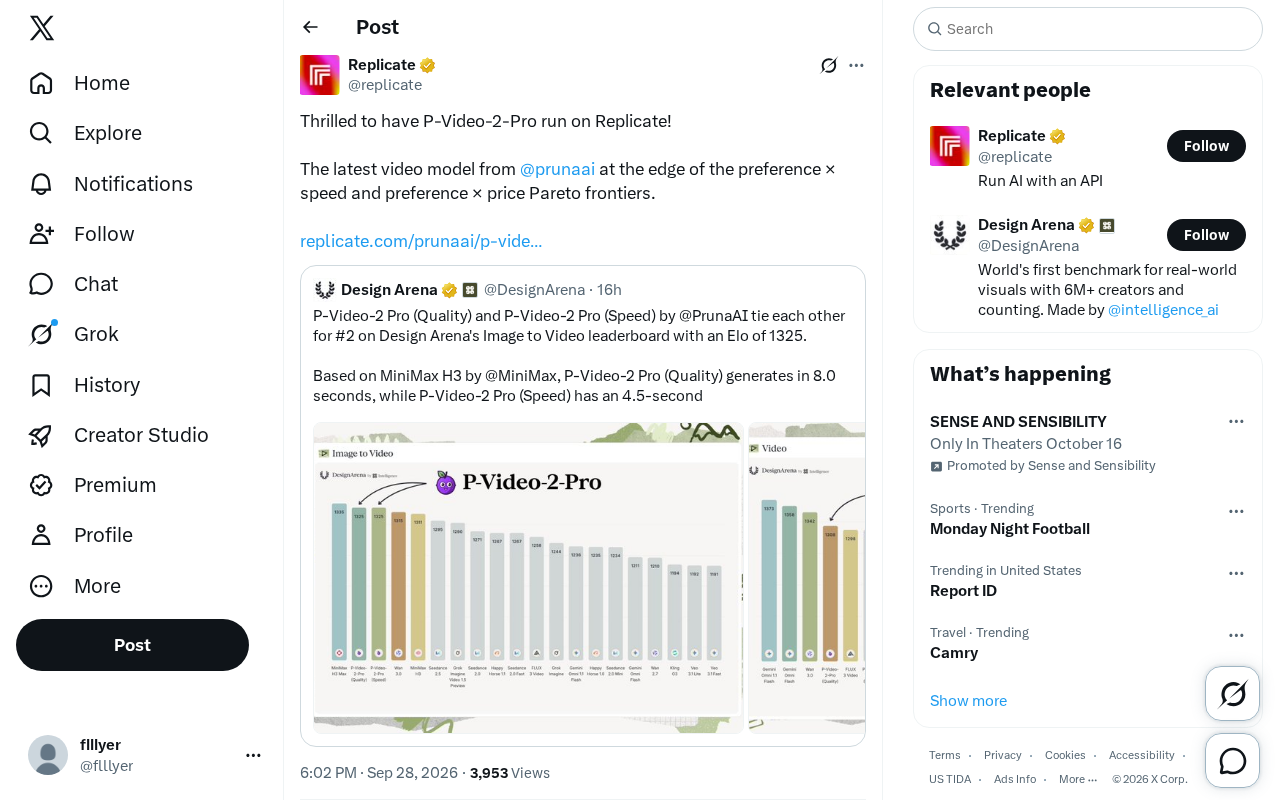
For developers and creators following the video generation space, this means one more option available for direct API access. Replicate, a platform that lets developers quickly run open-source and commercial models via API, has long been a key distribution channel for new model releases.
Understanding the Pareto Frontier Positioning
The "Pareto frontier" repeatedly emphasized in the original announcement is central to understanding this model's value proposition. In multi-objective optimization, the Pareto frontier refers to a set of solutions where you cannot improve one metric without sacrificing another.
In other words, P-Video-2-Pro claims to achieve near-optimal balance across two dimensions: "quality × speed" and "quality × price." This is a technically substantive claim — it doesn't simply assert being "the fastest" or "the cheapest," but rather argues that while maintaining preference-level generation quality, it achieves a combination of speed and cost that competitors cannot easily beat on both fronts simultaneously.
Why This Balance Matters
Video generation models often face a fundamental tension: pursuing high quality typically means longer inference times and higher compute costs. Compressing inference latency and reducing API call costs without a noticeable drop in quality is one of the core engineering challenges in deploying video models at scale. PrunaAI's expertise lies in model compression and inference optimization — a background that aligns naturally with P-Video-2-Pro's stated advantages in speed and price.
PrunaAI's core technical approach combines model pruning, quantization, and distillation. Pruning reduces model size by removing weights or neurons that contribute little to the output; quantization converts model parameters from high-precision floats (e.g., FP32) to low-bit integers (e.g., INT8), reducing memory footprint and computation without significantly sacrificing accuracy; distillation trains a smaller model to mimic the behavior of a larger one. These three techniques work in concert to enable the model to produce comparable-quality outputs with less compute during inference — which is the technical foundation behind P-Video-2-Pro's claim to simultaneously reduce inference latency and call costs. Since video generation demands several times more compute than image generation, the engineering value of these optimizations is even more pronounced in the video domain.
What This Means for Developers
With the model live on Replicate, developers can try and integrate P-Video-2-Pro through a standardized API without having to set up their own inference infrastructure. This lowers the barrier to entry and makes it easier for the community to validate the real-world "quality–speed–price" balance in practice.
That said, it's worth noting that publicly available information remains limited. The original source is a brief community tweet that includes no specific benchmark data, generation quality comparisons, or detailed pricing parameters. These key metrics will need to be filled in by official documentation, independent evaluations, or community testing.
Replicate's business model is primarily pay-per-prediction — developers don't need to pre-purchase compute resources; each API call is billed based on actual inference time and the GPU type used. This model directly reinforces P-Video-2-Pro's emphasis on "price advantage" — the faster the inference, the lower the bill per call, making the real-world cost difference more tangible than raw performance benchmarks alone might suggest. For content teams that need to generate video assets in bulk, or developers embedding video generation into product workflows, the combined effect of inference speed and platform billing is worth factoring into any model selection decision.
Summary
P-Video-2-Pro's availability on Replicate adds another entry to the video generation ecosystem. Its claimed Pareto frontier positioning — balancing preference quality against speed and price — would make it attractive for latency-sensitive or budget-conscious use cases, if validated by real-world testing. Users interested in the model are encouraged to try it directly on Replicate and assess its actual performance against their own requirements.
Related articles

Why Does the Tesla Roadster Need to Fly? A Deep Dive into Musk's Wild Demo
Tesla's Roadster launch showed wall-climbing, upside-down driving, and flying stunts—but The Vergecast notes the demo car may lack a battery, the Rocket version is invite-only and not street-legal, and the website terms don't guarantee delivery. After nine years of delays, why does this car still need to exist?

AI Is Not a Replacement: Human-AI Collaboration Through the Lens of Factory Root Cause Analysis
Starting from factory root cause analysis, this article explains how AI accelerates evidence chain construction rather than replacing human experts, exploring the pragmatic implementation logic and business value of 'AI supporting people rather than replacing them.'

AI Agent Decision Auditing: Building an Evidence Chain in Regulated Workflows
Starting from a Reddit discussion, this article analyzes three core issues in AI agent decision auditing within regulated workflows: what fields audit records should contain, how to handle feedback latency for erroneous decisions, and how to continuously calibrate LLM judge consistency with human judgment.