PaceVLA: Adaptive Temporal Action Quantization for Faster Robot Execution

PaceVLA uses adaptive temporal action quantization to boost VLA model execution efficiency while maintaining success rates.
PaceVLA addresses the low execution efficiency of Vision-Language-Action (VLA) models by proposing an adaptive temporal action quantization framework. The article notes that uniformly aggregating low-level actions into coarse-grained actions reduces execution steps but loses critical motion details in precision-sensitive phases, creating a speed-accuracy trade-off. PaceVLA resolves this through two coupled components: a pattern-specific action decoder built on a shared action expert supporting multiple temporal granularities, and quantization-guided mode selection with contextual routing that dynamically decides execution granularity at inference based on visual observations, language instructions, and historical actions. Validated on three multi-task simulation benchmarks and six real-world tasks covering long-horizon and dexterous manipulation, results show improved efficiency while maintaining task success rates.
Vision-Language-Action (VLA) models have made significant progress as general-purpose robot policies, but their execution efficiency often leaves much to be desired. The core reason is that policies learn fine-grained temporal patterns from teleoperation demonstrations, requiring a large number of low-level action steps to complete a task. Temporal action quantization offers a simple acceleration approach by aggregating continuous low-level actions into temporally coarser actions, but one-size-fits-all quantization introduces a speed-accuracy trade-off: while reducing redundant steps in some phases, it may discard critical motion details in precision-sensitive interactions.
PaceVLA is a unified framework proposed to resolve this contradiction, improving execution efficiency through an adaptive temporal execution mechanism while maintaining task success rates.
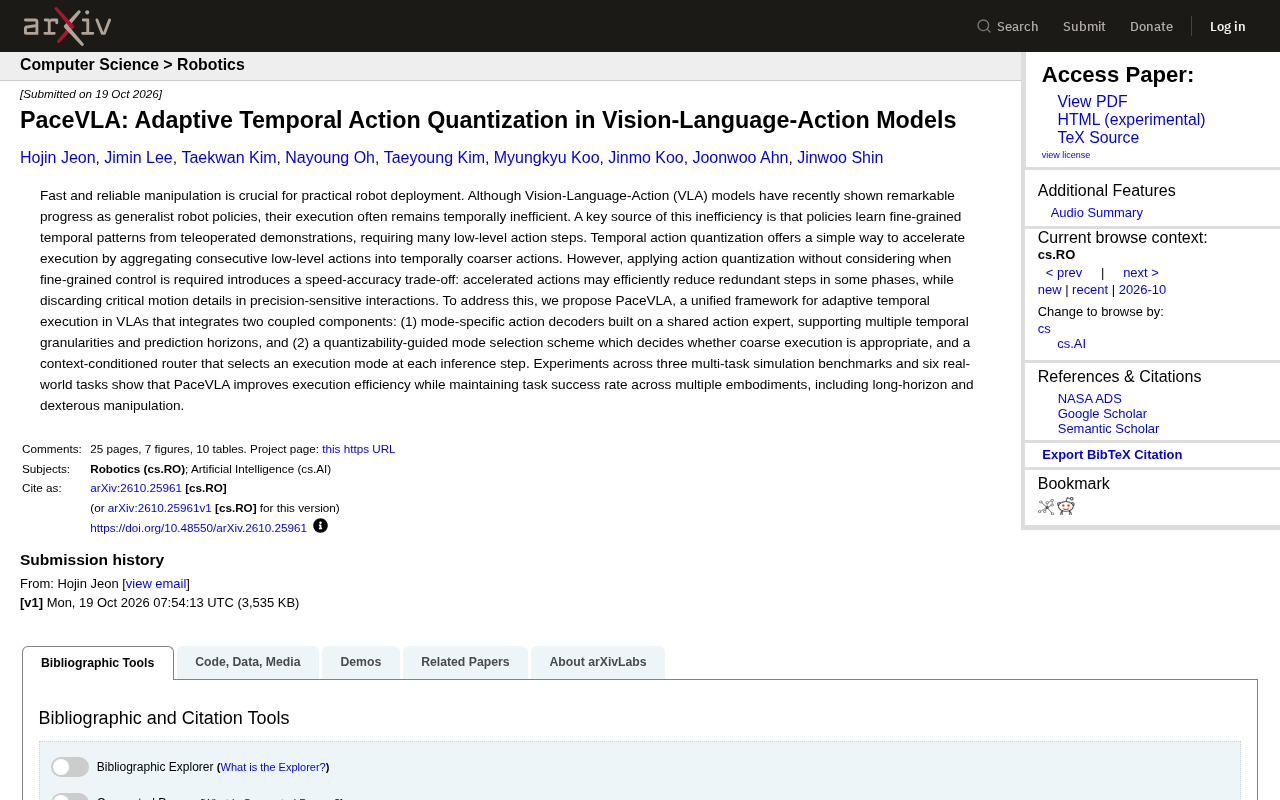
The Dilemma of Temporal Action Quantization
VLA models typically output high-frequency low-level action sequences, where each action step corresponds to an extremely short time interval. While this design provides fine-grained control, it leads to lengthy execution processes—especially when tasks contain many repetitive or transitional actions, where the accumulation of low-level action steps becomes an efficiency bottleneck.
The intuition behind temporal action quantization is simple: merge multiple consecutive low-level actions into a single coarse-grained action, thereby reducing inference and execution steps. However, the paper points out that indiscriminate application of quantization introduces a speed-accuracy trade-off. In phases requiring precise adjustment (such as grasping fragile objects or fine assembly), coarse-grained actions may skip critical feedback points, leading to task failure; while in free movement or rough positioning phases, quantization can significantly compress redundant steps. How to let the model decide for itself when to be coarse and when to be fine is the key to improving practicality.
Action chunking and temporal quantization: In robot policies, action chunking refers to predicting and executing multiple consecutive action steps at once rather than re-inferring at every step. Temporal action quantization can be viewed as dynamically adjusting chunk length: coarse granularity corresponds to long chunks with low inference frequency, while fine granularity corresponds to short chunks with high inference frequency. This contrasts with approaches like ACT and Diffusion Policy that use fixed chunk lengths—in those works, chunk length is a hyperparameter set during training and cannot vary with task phase during inference.
PaceVLA's Dual-Component Design
PaceVLA decomposes adaptive execution into two coupled components that together achieve "quantization on demand."
Pattern-Specific Action Decoder
The first component is a pattern-specific action decoder built on top of a shared action expert. This design supports multiple temporal granularities and prediction horizons, with each pattern corresponding to a different degree of action quantization. The shared expert ensures knowledge transfer and parameter efficiency across patterns, while pattern-specific decoding heads allow each granularity to be optimized independently. This architecture enables the model to possess both fine-grained and coarse-grained execution capabilities within a single framework, rather than relying on multiple independent policies.
Action expert: This concept originates from the Mixture-of-Experts (MoE) idea in vision-language models, but here it does not refer to multiple expert networks—rather, it denotes a shared backbone dedicated to action generation. It receives visual and language representations and outputs latent representations of action sequences; the pattern-specific decoding heads then map these latent representations into actions at different temporal granularities. The shared backbone reduces the total parameter count for multi-granularity training and avoids the problem of each granularity's policy operating independently and redundantly learning similar perceptual representations.
Quantization-Guided Mode Selection and Contextual Routing
The second component is responsible for deciding when to use coarse-grained execution. PaceVLA introduces a quantization-guided mode selection scheme that judges whether the current state is suitable for coarse execution, along with a context-conditioned router that selects the execution mode at each inference step based on the observed context. The router's inputs include the current visual observation, language instruction, and historical action context, and its output is a mode selection decision. This mechanism transforms "whether to quantize" from a fixed hyperparameter into a dynamic reasoning process, enabling the model to flexibly switch according to task phase.
The two components work in tandem: the decoder provides multi-granularity action candidates, while the router decides in real time which granularity to use. The paper emphasizes that this coupled design is the core of achieving adaptive temporal execution.
Context-conditioned routing: The router is essentially a lightweight classifier whose decisions are based on the current observed context rather than fixed rules. This is similar to the gating network in MoE: the gating network selects which expert to activate based on input, while PaceVLA's router selects execution granularity based on vision, instruction, and historical actions. The difference is that here the "experts" correspond to different temporal scales rather than different network branches, and the routing result directly affects the number of inference and execution steps—so routing errors manifest in both speed and success rate.
Experimental Validation: Simulation and Real World
PaceVLA was evaluated on three multi-task simulation benchmarks and six real-world tasks, covering various robot embodiments, including long-horizon tasks and dexterous manipulation. Experimental results show that PaceVLA improves execution efficiency while maintaining task success rates. This means adaptive quantization does not sacrifice reliability for speed.
Interestingly, the real-world tasks include precision-sensitive manipulation scenarios—precisely the domain where fixed quantization tends to fail. PaceVLA's performance on these tasks validates the effectiveness of quantization-guided mode selection. However, the paper abstract does not disclose specific efficiency gains or success rate figures; readers should consult the full paper for detailed data.
Implications for Robot Deployment
Fast and reliable manipulation is key to practical robot deployment. PaceVLA's approach offers a paradigm worth emulating: rather than fixing the action temporal scale during training, let the model dynamically decide execution granularity during inference. This direction resonates with the current focus on inference efficiency in VLA research and leaves room for future work—for example, integrating quantization decisions more tightly with low-level controllers, or optimizing routing strategies under more modal contexts.
For researchers and engineers focused on deploying robot policies, PaceVLA demonstrates the potential of adaptive temporal quantization in balancing speed and accuracy, and its dual-component architecture can serve as a design reference.
Related articles

OpenAI Partners with Shield: How the Astra Agent Revolutionizes IT Troubleshooting
OpenAI and Shield launch the Astra agent, which autonomously logs into computers and legacy systems to fix IT issues in real time, 35-40% faster than traditional models, with humans involved only when judgment is needed.

iPhone Duo Battery Life Tested: One Charge a Day Is Unavoidable, and the Large Screen Is the Culprit
iPhone Duo battery test: heavy use needs at least one charge a day, and about 30% remains after 6.5 hours of screen-on time. How often the large screen is unfolded is key; a MagSafe battery pack helps, and long-term degradation is also worth watching.

Kimi K3.1 Pro Open-Sourced: 2.8 Trillion Parameters Close In on Opus
Moonshot releases the open-source MoE model Kimi K3.1 Pro, with 2.8T total parameters and 104B activated, trailing Opus 5.5 by under 1 point on Terminal Bench 4.0.