Palmer Luckey Doesn't Deny Being a Prepper
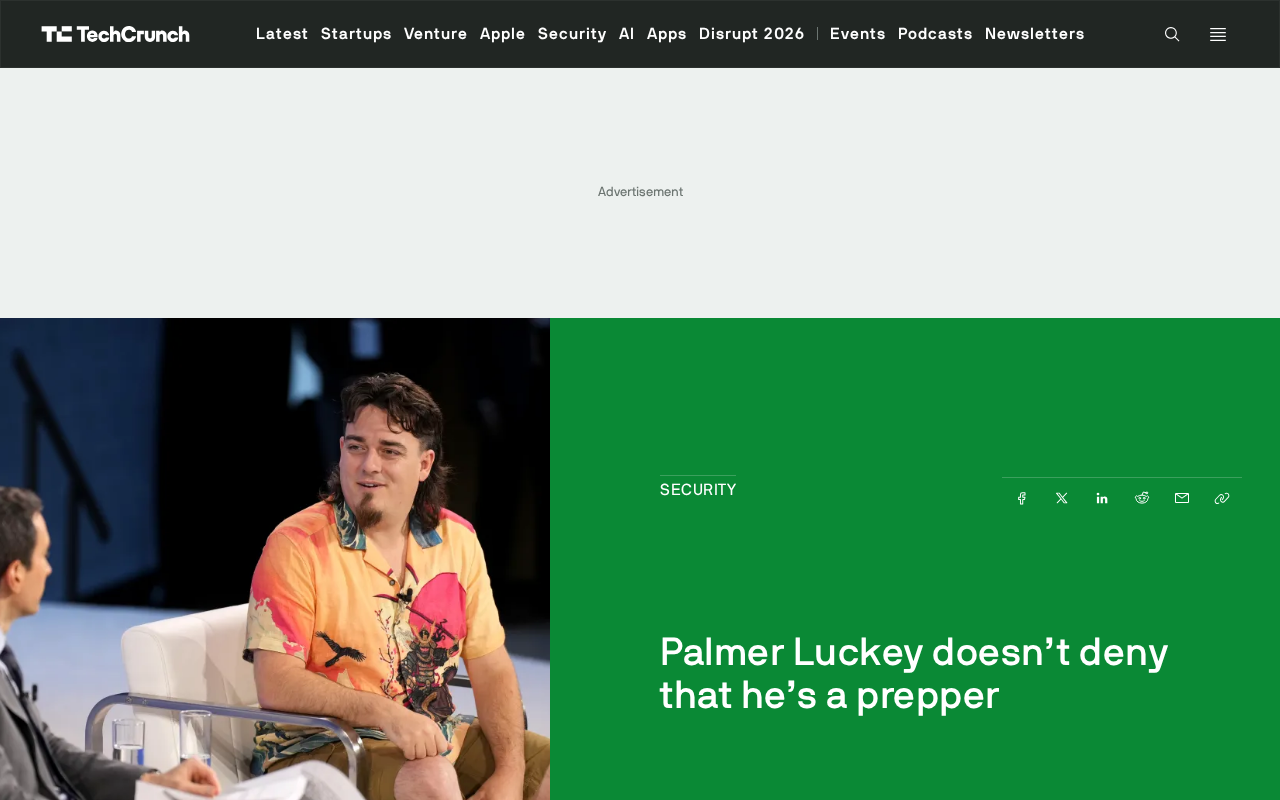
Palmer Luckey recommends three days of supplies, reflecting a pragmatic survivalist streak in tech.
Anduril founder Palmer Luckey publicly advised Americans to keep three days of food, water, and medication on hand and did not deny being a "prepper." The article notes that three days is the official baseline recommendation in emergency management. Luckey's statement reflects some tech elites' pragmatic awareness of systemic fragility—rooted in risk management rather than panic—and explores the social value of personal emergency preparedness.
Introduction: The Survivalist Leanings of Tech Titans
Palmer Luckey, founder of Anduril, publicly stated on Wednesday that Americans should always keep three days' worth of food, water, and medication on hand for emergencies. The remark came in response to a question about whether he considers himself a "prepper." According to the original report, Luckey did not deny the label—instead, he used the opportunity to emphasize the importance of everyday emergency preparedness.
As a well-known tech entrepreneur in Silicon Valley, Luckey's remarks often carry a personal flavor, but they also reflect some tech elites' vigilance toward real-world risks. This article takes his statement as a starting point to analyze how the concept of emergency preparedness has permeated the tech world, and the deeper logic behind this pragmatic attitude.
Palmer Luckey is a highly controversial tech entrepreneur in Silicon Valley. He founded the virtual reality company Oculus VR in 2012, which was acquired by Facebook in 2014 for approximately $2 billion. After leaving Facebook in 2017 amid controversy over his political views, he founded Anduril Industries the same year, focusing on providing autonomous defense systems to the U.S. Department of Defense and its allies, with products spanning drones, border surveillance, and counter-drone technology. Luckey is known for being outspoken and distinctive in style, and his public statements often draw attention from both the tech and political spheres. Understanding this background helps explain why his "prepper" remarks were amplified by the media—he is both a tech elite and a direct participant in the defense technology sector.
Three Days of Supplies: A Seemingly Simple but Often Overlooked Recommendation
Luckey's mention of "three days of supplies" was not a casual remark. In the field of emergency management, three days is the minimum recommended reserve duration in many official guidelines, intended to cope with natural disasters, emergencies, or brief supply chain disruptions. Although he did not elaborate on specifics, the practicality of this advice should not be underestimated.
For ordinary households, keeping three days of food, water, and medication means having a buffer in the early stages of a crisis, avoiding panic buying or resource runs. Luckey's phrasing did not stoke doomsday sentiment but rather reminded the public in a plain tone: emergency preparedness is an everyday responsibility, not extreme behavior.
One detail worth noting: this view has a subtle connection to the defense technology industry he works in. Anduril focuses on autonomous defense systems, and its business is itself built on the mindset of "preparing for the worst case." There seems to be a certain consistency between Luckey's personal statements and his company's mission.
The "three-day reserve" recommendation did not come out of thin air—it derives from emergency preparedness guidelines long recommended by institutions such as the U.S. Federal Emergency Management Agency (FEMA) and the Red Cross. Official guidance suggests households keep at least 72 hours (i.e., three days) of supplies, including about 1 gallon of water per person per day, non-perishable food, commonly used medications, flashlights, batteries, and copies of important documents. The reason three days serves as the baseline is that in most natural disasters or emergencies, local rescue forces can typically complete initial response within 72 hours. Reserves beyond three days are considered a higher level of preparedness. Luckey's statement aligns closely with this official framework, indicating that his advice has a realistic basis rather than being exaggerated.
Tech Elites and Prepping: Niche or Trend?
Prepper culture has a long history in the United States, but in the past it was often associated with marginalized groups or extreme scenarios. In recent years, with climate change, pandemics, and growing geopolitical uncertainty, more and more tech professionals have begun openly discussing emergency preparedness.
Luckey is not an isolated case. Some Silicon Valley investors and entrepreneurs remain vigilant about "low-probability, high-impact" events—from backup data centers to household emergency kits, pragmatism permeates every aspect of life and work. This tendency is not born of panic but of a clear-eyed awareness of systemic fragility.
Of course, prepping remains a niche topic in the tech world, and few speak about it publicly. Luckey's candid response may help open up more room for rational discussion of this topic—emergency reserves are not paranoia, but risk management.
The term "prepper" has a complex historical trajectory in American culture. During the Cold War, some families built fallout shelters due to the threat of nuclear war; in the 1990s and 2000s, prepper culture gradually became associated with militia movements and fringe political groups, and was therefore often labeled "paranoid" by mainstream society. In recent years, however, the label is being redefined. Frequent natural disasters, pandemic shocks, supply chain disruptions, and geopolitical tensions have transformed emergency preparedness from a fringe hobby into a more widely accepted form of "risk management." In the tech world, this shift is especially pronounced: many professionals are accustomed to assessing "low-probability, high-impact" events with an engineering mindset, extending backup, redundancy, and fault-tolerance mechanisms from system design into daily life. Luckey's public statement is a microcosm of this trend.
From Personal Habit to Public Issue: The Social Value of Emergency Preparedness
Although brief, Luckey's remarks touch on a broader public issue: should individual emergency preparedness be encouraged? Against a backdrop of frequent disasters, household-level reserves can ease the burden on public rescue efforts and enhance community resilience.
However, overemphasizing personal reserves can also spark controversy—for example, by exacerbating resource hoarding or neglecting systemic solutions. Luckey's advice stays at a basic level and does not address policy or social equity issues, making it more of a personal initiative than a systemic proposition.
Regardless, this defense tech founder's statement reminds us: in an era where uncertainty has become the norm, basic emergency preparedness is a life skill worth considering for everyone. Three days of supplies may be the most practical starting point.
Conclusion
Palmer Luckey does not deny being a prepper, and he used the occasion to offer a simple piece of advice: keep three days of food, water, and medication on hand. This statement reflects both his personal risk awareness and the tech world's pragmatic attitude toward real-world fragility. For ordinary readers, rather than arguing over labels, it's better to check the emergency kit at home—after all, being prepared is always wise.
One-line Summary
Palmer Luckey recommends keeping three days of supplies, reflecting a pragmatic survivalist streak in the tech world.
Paragraph Summary
Anduril founder Palmer Luckey publicly advised Americans to keep three days of food, water, and medication on hand, and did not deny being a "prepper." The article notes that three days is the official baseline recommendation in emergency management for the initial buffer period of a crisis. Luckey's statement is not an isolated case but reflects some tech elites' pragmatic awareness of systemic fragility—a tendency rooted in risk management rather than panic. The article also explores the social value of personal emergency preparedness: household reserves can ease pressure on public rescue efforts, but excessive hoarding and neglect of systemic solutions should be guarded against. Overall, Luckey's remarks serve as a plain-spoken reminder that emergency preparedness is a life skill worth considering for everyone.
Related articles

Gemini 4 Neon vs Claude Opus 5.5: Who Wins Across Five Real-World Tasks?
Bilibili creator tests Gemini 4 Neon vs Claude Opus 5.5 across 3D video, games, design, writing, and advice. Neon matches Opus daily, but 3D and design still lag.

Former Huawei Genius Youth Open-Sources AI Agent Guide: 90+ Hands-On Case Studies
Former Huawei Genius Youth Li Bojie open-sources AI Agent Book, the most systematic Chinese Agent learning repo on GitHub, with 90+ runnable examples covering context compression, memory frameworks, MCP tool calling, prompt injection attack and defense, and other enterprise-level hands-on content.

The Most Detailed FDE Tutorial on Bilibili: Case-Based Teaching from Business Practice to Interviews
B站UP主推出FDE从入门到面试实战教程,讲师深入业务一线,用马氏学习平台真实案例讲解FDE岗位要求。本文分析案例教学法、笔记策略与私密信息处理,为AI岗位求职者提供参考。