patent-disclosure-skill: An AI-Powered Open-Source Tool for the Entire Chinese Patent Workflow

An open-source AI Skill tool that assists with the entire Chinese patent workflow, from mining to examination responses.
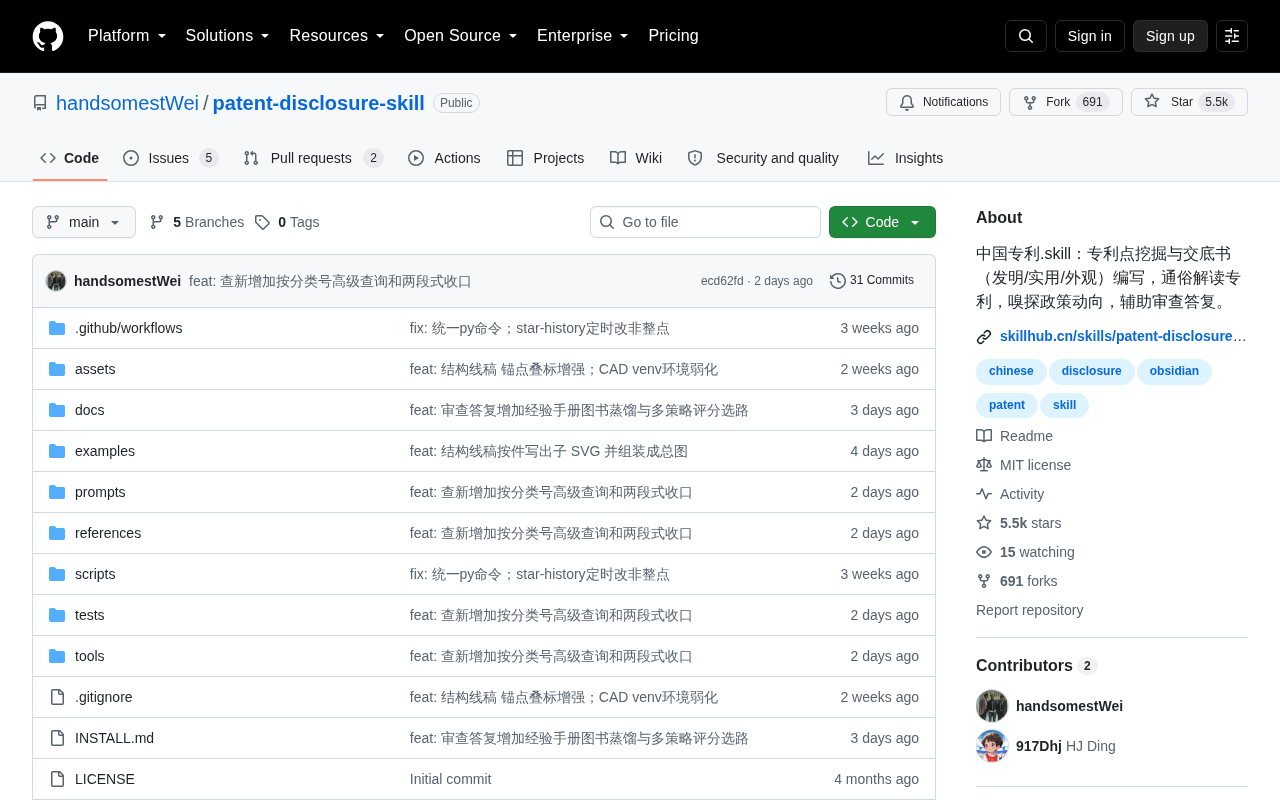
patent-disclosure-skill is a trending GitHub project offering AI-powered assistance across the full Chinese patent lifecycle. Presented as a modular .skill file for AI Agent integration, it covers patent point mining, disclosure drafting for invention, utility model, and design patents, plain-language patent interpretation, policy monitoring, and office action response assistance — helping R&D teams and IP professionals navigate China's complex patent system more efficiently.
An AI Skill Project Focused on Chinese Patent Practice
As AI-assisted tools proliferate across the tech landscape, specialized tools for vertical domains are emerging as the new frontier. A GitHub project called handsomestWei/patent-disclosure-skill has been gaining notable traction recently — picking up 38 new stars in a single day, with a cumulative total of 5,509 stars and 691 forks. While these numbers aren't explosive by general tech-tool standards, they're remarkably impressive given the project's focus on Chinese patent practice — a relatively niche and highly specialized vertical domain. This level of interest clearly indicates it has struck a real nerve.
The project's name says it all: it's a .skill tool dedicated to assisting with the entire Chinese patent workflow, covering patent point mining, technical disclosure drafting, plain-language patent interpretation, policy trend monitoring, and office action response assistance.
To understand the project's value, some background on the Chinese patent system is helpful. The China National Intellectual Property Administration (CNIPA) is one of the world's highest-volume patent offices — China received over 1.6 million invention patent applications in 2023. The Chinese patent examination system follows an "early publication, request for examination" model, with invention patents typically taking 2–4 years from filing to grant. During examination, examiners issue Office Actions (OAs), and applicants must submit responses within prescribed deadlines, amending claims and arguing inventiveness. This massive application volume and complex examination process create a natural entry point for AI tools.
Capability Design Covering the Full Patent Workflow
For most engineers and companies, patent work is simultaneously important and headache-inducing. Obscure technical jargon, stringent drafting standards, and lengthy examination processes all form high walls between R&D personnel and patent protection. This project aims to use AI capabilities to break through these barriers.
Patent Point Mining
Many valuable technical innovations go unprotected because R&D personnel lack patent awareness. The "patent point mining" feature of patent-disclosure-skill essentially helps users identify patentable innovations within their technical solutions, lowering the barrier to innovation identification.
Determining whether a technology is patentable requires simultaneous assessment of novelty (has it been publicly disclosed?), inventiveness (is it obvious to a person skilled in the art?), and practical applicability (can it be applied in industry?). Inventiveness is the most complex to evaluate. China's Patent Examination Guidelines employ a "three-step method": identifying the closest prior art, determining the distinguishing technical features and the actual technical problem solved, and judging whether the solution would have been obvious. This process requires deep knowledge of the technical field and prior art. AI tools can assist inventors in preliminary patentability screening by searching and comparing massive patent literature databases, enabling R&D personnel to assess patent value early in the technical solution development stage.
Drafting Assistance for Three Types of Disclosures
The project explicitly supports drafting assistance for invention patents, utility models, and design patents — the three major categories of technical disclosures. A patent disclosure document (also known as a technical disclosure) is the core document through which inventors communicate technical solutions to patent attorneys, serving as the starting point of the entire patent application process. A high-quality disclosure must clearly articulate the technical problem, technical solution, and technical effects while distinguishing prior art from innovation points.
Within the Chinese patent system, invention patents undergo substantive examination and must demonstrate novelty, inventiveness, and practical applicability. Utility models protect only the shape, structure, or combination thereof of products and undergo preliminary examination only. Design patents protect the aesthetic appearance of products and, since 2021, have been subject to substantive examination. The disclosure requirements differ significantly across these three types — invention patent disclosures require detailed technical solution descriptions and embodiments, utility model disclosures emphasize clear expression of structural features, and design patent disclosures center on images or photographs. This is precisely why the project provides separate drafting assistance for each type rather than a one-size-fits-all template.
The quality of a disclosure directly determines the efficiency and quality of the subsequent application documents drafted by patent attorneys. AI intervention at this stage can guide users through standardized templates and logical structures to express their technical solutions completely and accurately, significantly lowering the drafting barrier.
Plain-Language Patent Interpretation and Policy Monitoring
Patent texts have always been notoriously difficult to read, laden with restrictive and defensive legal language. For example, common claim phraseology such as "characterized in that," "said," and "comprising at least" all carry strict legal meanings that non-specialists struggle to accurately interpret in terms of protection scope and technical boundaries. The "plain-language interpretation" capability translates patent content into language that ordinary people can understand — valuable for technical due diligence, competitive analysis, and infringement risk assessment.
The "policy trend monitoring" feature reflects attention to the timeliness of the patent environment — patent policies and examination standards are not static, and staying current with the latest developments is crucial for formulating filing strategies. In recent years, China has frequently updated examination guidelines and judicial interpretations in fields such as artificial intelligence, biopharmaceuticals, and standard-essential patents, requiring dynamic adjustment of patent filing strategies. For instance, the 2023 revision of the Patent Examination Guidelines made significant updates to examination standards for computer program-related inventions, directly impacting drafting strategies for AI-domain patents.
The Skill Format: A New Modular Paradigm for AI Tools
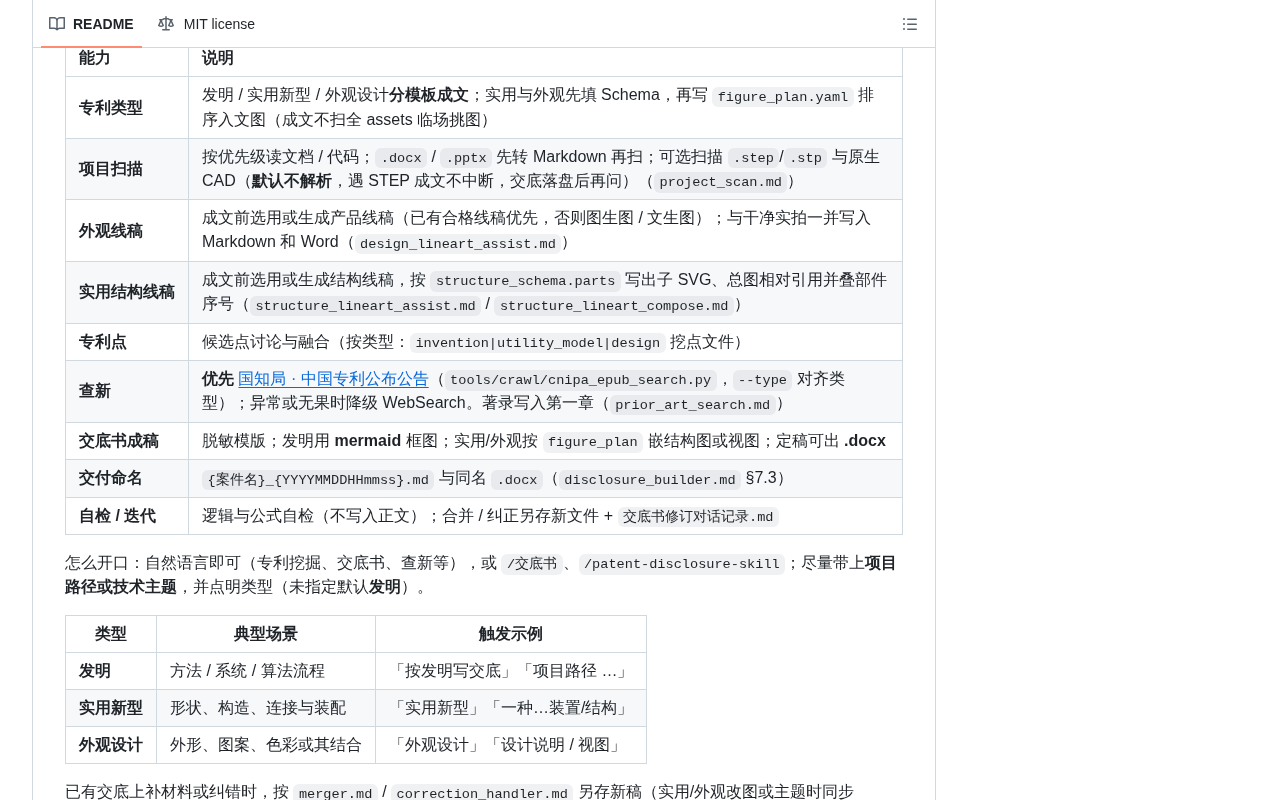
Here's a notable detail: patent-disclosure-skill is presented in .skill format rather than as a traditional standalone application or SaaS service. This reflects an important trend in the current AI tool ecosystem: modular and pluggable capabilities.
A Skill typically refers to a capability package that can be loaded and invoked by large language models or AI Agents. The .skill file format has emerged alongside the rise of AI Agent frameworks (such as AutoGPT, MetaGPT, Coze, and similar platforms). Its design philosophy draws from microservices architecture — encapsulating domain-specific capabilities as independent, composable modules that can be orchestrated and called through standardized interfaces by AI Agents. Unlike traditional APIs or SDKs, Skills typically contain prompt templates, tool chain definitions, and context management logic, enabling large language models to acquire specialized domain capabilities in a plug-and-play manner.
This format means patent assistance capabilities are no longer an isolated tool but can be embedded into larger AI workflows. Users can invoke patent-related expertise within conversational interactions without switching applications. This model is becoming a new paradigm for AI tool distribution — similar to the App Store in the smartphone era, but with finer granularity and greater composability.
This design offers two key advantages:
- Lower adoption costs: Users can trigger complex professional workflows through natural language without learning specialized interfaces.
- Continuous capability evolution: Skills can improve in tandem with upgrades to the underlying large language models, without requiring a complete system rebuild.
The project is implemented in Python, highly compatible with the mainstream AI toolchain tech stack, making it easy for developers to extend and integrate.
The Value and Boundaries of Vertical AI Tools
From a broader perspective, patent-disclosure-skill represents a pragmatic path for AI adoption — going deep in vertical domains with high professional barriers, standardized processes, and clear pain points.
Patent practice happens to check all these boxes:
- Clear standards and templates that are well-suited for AI learning and generation
- Large volumes of repetitive document work that AI can accelerate
- A high professional barrier that makes it difficult for ordinary R&D personnel to handle independently
These scenarios are precisely where AI tools are most likely to deliver real value. Similar vertical AI trends are simultaneously emerging in areas such as legal contract review, financial auditing, and medical image analysis — the AI-ification of patent practice is a typical cross-section of this broader wave.
That said, it's important to realistically acknowledge the boundaries. Patent applications ultimately carry legal consequences, and the quality of disclosure documents and office action responses directly affects the stability of patent rights. AI tools are better positioned here as efficiency multipliers and professional assistants rather than complete replacements for patent attorneys. This is especially true for office action responses that require precise legal argumentation — examiner opinions may involve complex claim amendments, inventiveness arguments, consideration of prosecution history estoppel, and other issues that require strategic judgment based on case-specific circumstances. Human professional judgment remains indispensable. Furthermore, patent agency work in China is a licensed profession requiring a patent attorney qualification certificate, and the role of AI tools must be clearly defined within this legal framework.
Conclusion
The rising popularity of patent-disclosure-skill is a microcosm of AI's penetration into specialized vertical domains. Rather than chasing the grand narrative of general-purpose AI, it has rooted itself in the concrete scenario of Chinese patent practice, delivering modular, practical capabilities in Skill format. For R&D personnel, corporate intellectual property departments, and patent agencies alike, this type of open-source tool is worth watching and trying.
As more professional domains become "Skill-ified," AI is transitioning from "can chat about anything" to "can do anything." And real value is often born precisely in these seemingly unassuming yet clearly pain-point-driven vertical niches.
Related articles

Why Does the Tesla Roadster Need to Fly? A Deep Dive into Musk's Wild Demo
Tesla's Roadster launch showed wall-climbing, upside-down driving, and flying stunts—but The Vergecast notes the demo car may lack a battery, the Rocket version is invite-only and not street-legal, and the website terms don't guarantee delivery. After nine years of delays, why does this car still need to exist?

AI Is Not a Replacement: Human-AI Collaboration Through the Lens of Factory Root Cause Analysis
Starting from factory root cause analysis, this article explains how AI accelerates evidence chain construction rather than replacing human experts, exploring the pragmatic implementation logic and business value of 'AI supporting people rather than replacing them.'

AI Agent Decision Auditing: Building an Evidence Chain in Regulated Workflows
Starting from a Reddit discussion, this article analyzes three core issues in AI agent decision auditing within regulated workflows: what fields audit records should contain, how to handle feedback latency for erroneous decisions, and how to continuously calibrate LLM judge consistency with human judgment.