Patentable Directions in RAG and Agentic AI: Three Practical Project Topic Ideas
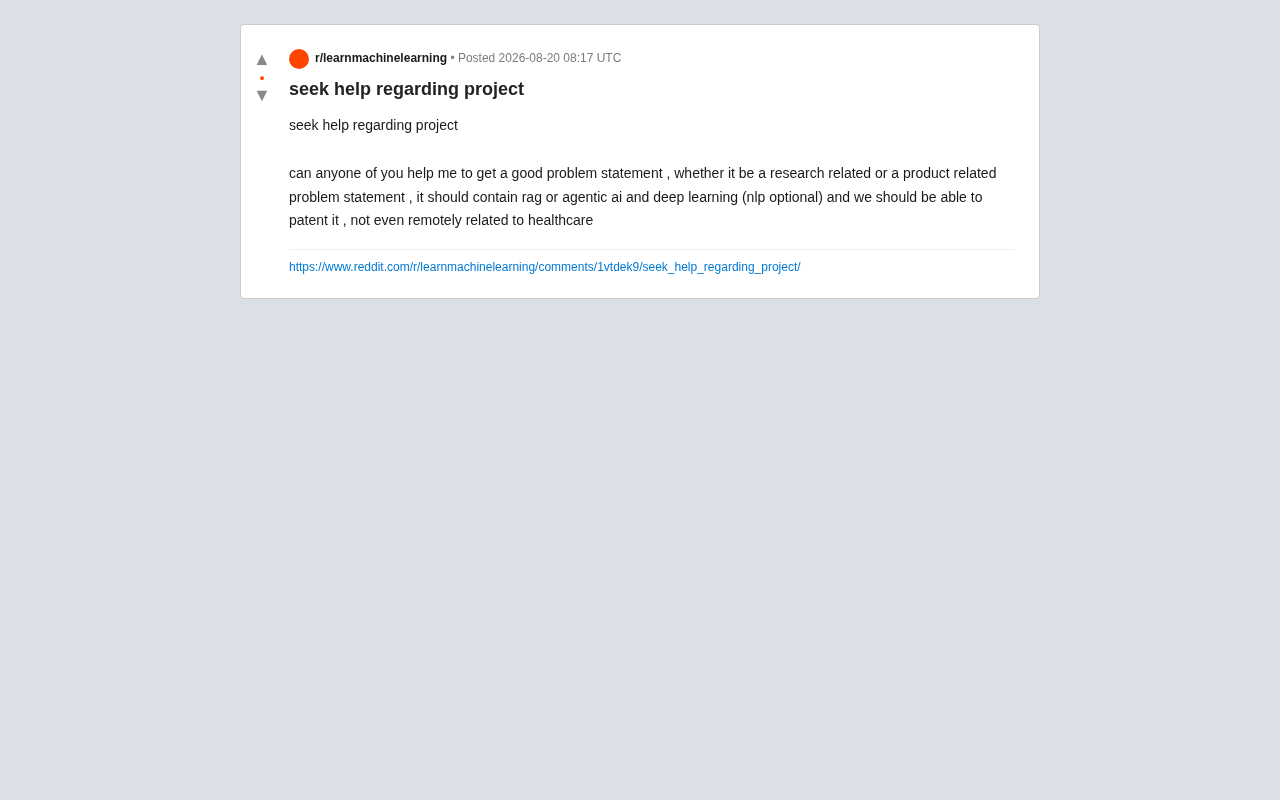
Three patentable project directions at the intersection of RAG, Agentic AI, and deep learning.
This article explores patentable project topic ideas in the RAG and Agentic AI space, inspired by a developer's Reddit post seeking guidance. It covers patent eligibility basics for AI innovations, then presents three concrete directions: a traceable RAG system for legal compliance documents, a multi-agent collaborative code refactoring tool, and adaptive chunking strategies for industrial knowledge bases. Practical advice on literature search, scope narrowing, and experimental design is also provided.
Starting from a Real Request for Help
Recently, a developer posted on Reddit asking the community to help find a suitable project topic. Their requirements were very specific: the topic should cover RAG (Retrieval-Augmented Generation) or Agentic AI, incorporate deep learning (NLP as optional), and have patentability, while explicitly excluding the healthcare domain.
This seemingly simple request actually reflects a common dilemma faced by many AI practitioners and graduate students today: once the tech stack is decided, how do you find an entry point that has technical depth, commercial or academic value, and meets intellectual property protection criteria? This article will explore a framework for patentable project topics in the RAG and Agentic AI space.
Understanding the Core Threshold for AI Patents: What Kind of Project Can Be Patented
Before searching for AI project topics, you first need to understand what "patentable" actually means. Examination standards for software and algorithm patents vary globally, but three basic conditions generally need to be met.
It's worth noting that these standards differ significantly across jurisdictions. The United States Patent and Trademark Office (USPTO), after the landmark Alice Corp. v. CLS Bank case in 2014, set a higher bar for patent protection of "abstract concepts," requiring applicants to demonstrate that their solution contains an "inventive concept" that goes beyond the abstract concept itself. The European Patent Office (EPO) explicitly excludes "computer programs as such" from patentable subject matter, but if a software solution produces a "further technical effect" — such as improving the operational efficiency of a computer system or solving a specific technical problem — it can receive protection. China's National Intellectual Property Administration (CNIPA) has taken a relatively open stance toward AI-related patents in recent years, with the 2019 revision of the Patent Examination Guidelines further relaxing examination standards for patent applications containing algorithmic features. Understanding these differences is crucial when patentability is a constraint from the very start of topic selection.
Novelty and Non-Obviousness
Patents require that the technical solution is unprecedented and not obvious to a person of ordinary skill in the field. This means that simply calling off-the-shelf RAG frameworks (e.g., directly combining LangChain + a vector database) is unlikely to constitute a patentable innovation, as this falls under routine engineering combination.
It's worth explaining why such a combination is considered "routine." LangChain is one of the most popular LLM application development frameworks today, created by Harrison Chase in 2022, offering modular components such as Chains, Agents, and Memory. Vector databases (such as Pinecone, Weaviate, Chroma, Milvus, etc.) are specifically designed for storing and retrieving high-dimensional vector embeddings and serve as core infrastructure for RAG systems. Because these tools are already highly standardized, building a RAG application by following the standard procedures in official documentation would likely be viewed in patent examination as a "routine choice by a person skilled in the art," failing to meet the non-obviousness requirement.
What's truly patentable is often a specific technical improvement — for example, a novel retrieval ranking mechanism, a verification architecture that reduces agent hallucinations, or a chunking and indexing strategy tailored to specific data structures.
Quantifiable Technical Effects
Patent applications typically need to demonstrate that the solution delivers measurable technical improvements, such as reduced inference latency, lower token consumption, or improved retrieval accuracy. Therefore, you should consider at the topic selection stage: can this innovation be supported by experimental data demonstrating its superiority?
Understanding the Core Technologies: Technical Background of RAG and Agentic AI
Before diving into specific topic directions, it's necessary to develop a deeper understanding of these two core technical paradigms.
RAG (Retrieval-Augmented Generation) is a technical paradigm formally proposed by Facebook AI Research (now Meta AI) in a 2020 paper. Its core idea is to combine the generative capabilities of large language models with the retrieval capabilities of external knowledge bases. Traditional large language models rely entirely on parameterized knowledge memorized during training when answering questions, leading to issues such as knowledge cutoff dates, hallucination generation, and insufficient domain knowledge. RAG introduces a retrieval module during the inference phase — typically based on vector similarity search — to extract relevant passages from external document repositories, which are then injected as context into the generative model's prompt, allowing the model's responses to be grounded in evidence. The current mainstream RAG implementation pipeline typically consists of five stages: document chunking, vector embedding, vector database storage, similarity retrieval, and context-augmented generation.
Agentic AI is a technical paradigm that rose rapidly during 2023-2024, upgrading large language models from passive Q&A tools to intelligent agents capable of autonomous planning, tool invocation, and multi-step reasoning. Unlike the traditional single-turn prompt-response pattern, agents can decompose complex tasks into subtasks, call external APIs and tools, dynamically adjust execution strategies based on intermediate results, and maintain state coherence across multiple interaction rounds. Representative frameworks include AutoGPT, CrewAI, LangGraph, and others. Andrew Ng listed Agentic AI as one of the most important technology trends of the year in early 2024, arguing that even with weaker base models, agent architectures can outperform single calls to stronger models on complex tasks.
Understanding the capability boundaries and technical bottlenecks of each paradigm is a prerequisite for discovering patentable innovation points.
Three Patentable Topic Directions in RAG and Agentic AI (Excluding Healthcare)
Based on the original poster's constraints, here are several reference directions with patentable potential.
Direction 1: A Traceable RAG System for Legal Compliance Documents
Documents in the legal, contract, and compliance domain are highly structured, terminology-dense, and have extremely high requirements for answer traceability. A potential innovation is to build a RAG architecture with citation tracing and confidence scoring — one that not only generates answers but also automatically annotates the source clause location for each assertion and provides a confidence score.
The patentable point here lies in: how to design an evidence chain verification mechanism that requires the agent to cross-validate retrieved passages before generating a response. This closed-loop structure of "generate-verify-trace back," if implemented with a unique design approach, has the potential for a patent application.
Direction 2: Multi-Agent Collaborative Codebase Understanding and Refactoring Tool
Software engineering is a natural testing ground for Agentic AI. You could design a multi-agent system where agents with different roles (such as a "retrieval agent," a "dependency analysis agent," and a "refactoring suggestion agent") collaboratively understand large codebases and provide cross-file refactoring recommendations.
The innovation can focus on task decomposition and conflict resolution protocols between agents — when multiple agents give contradictory suggestions, how does an arbitration mechanism reach consensus? The specific implementation of such collaborative protocols is often the core of what's patentable.
Direction 3: Adaptive Chunking and Indexing Strategies for Industrial-Scale Knowledge Bases
The effectiveness of RAG systems is highly dependent on the document chunking strategy. Most current approaches use fixed-length or simple semantic chunking. A more in-depth direction would be to design a deep learning model that dynamically adjusts chunking granularity based on document structure and query patterns.
To understand the innovation space in this direction, you first need to understand the limitations of current chunking methods. Mainstream chunking methods include: fixed-length chunking (splitting by character count or token count), delimiter-based chunking (e.g., splitting by paragraphs or section headings), recursive character chunking (RecursiveCharacterTextSplitter in LangChain), and semantic chunking (determining semantic boundaries by computing embedding similarity between adjacent sentences). Each method has its limitations: fixed-length chunking breaks semantic integrity, while semantic chunking has high computational overhead and is highly sensitive to embedding model quality. In 2024, Greg Kamradt's embedding similarity breakpoint-based semantic chunking method attracted widespread attention, but it still performs poorly on multi-level structured documents (such as legal regulations and technical specifications). This leaves ample innovation space for adaptive chunking strategy research.
By training a lightweight model to predict optimal chunk boundaries and continuously optimizing the indexing structure based on historical query feedback, this "adaptive chunking" approach — if it can demonstrate significant improvements in retrieval accuracy — simultaneously satisfies the deep learning, RAG, and patentability requirements.
Practical Advice from Topic Selection to Implementation
For project initiators like the original poster, the following pragmatic suggestions are worth considering.
First, conduct literature and patent searches. After deciding on a direction, be sure to use platforms like Google Patents and arXiv to confirm whether the idea has already been claimed. This step both avoids reinventing the wheel and helps you precisely identify genuine innovation gaps.
Second, narrow your scope rather than trying to do everything. A focused, clearly defined technical problem is far more likely to yield patentable results than a grand, vague objective.
Third, prioritize experimental design. Whether for academic purposes or patents, reproducible experimental data is hard currency. You should plan your evaluation benchmarks and comparison baselines at the topic selection stage.
Conclusion
Finding an AI topic that combines technical depth with patent value is essentially about finding specific problems that haven't been fully solved at the intersection of known tech stacks. RAG and Agentic AI are still in a period of rapid evolution, with abundant engineering and theoretical gaps in areas such as retrieval trustworthiness, multi-agent collaboration, and adaptive indexing. Rather than asking the community for ready-made topics, it's better to use these directions as starting points and, combined with your own interests and resources, dig deep into a focused problem that you can truly advance.
Related articles
DeepSeek V4 Pro Real-World Test: 7 Projects Reveal Its True Coding Ability and Value
Real-world test of DeepSeek V4 Pro across 7 projects covering frontend, backend, 3D games, and long tasks. Frontend lags behind Claude, but at 1/180th the cost.
Google Search Launches Five AI Learning Features: A Complete Guide to Test Prep Assistants and Smart Learning Platforms
Google Search launches five AI learning features covering standardized test prep, structured knowledge review, and interactive practice — transforming search into a smart learning platform.
Moderna's Personalized Cancer Vaccine Succeeds in Phase 3 Trial, Stock Surges 110%
Moderna and Merck announce positive Phase 3 results for personalized mRNA cancer vaccine, significantly reducing melanoma recurrence risk. MRNA stock surges over 110%.