Pax by Pydantic: A Terminal Agent Where Even Coding Is a Plugin
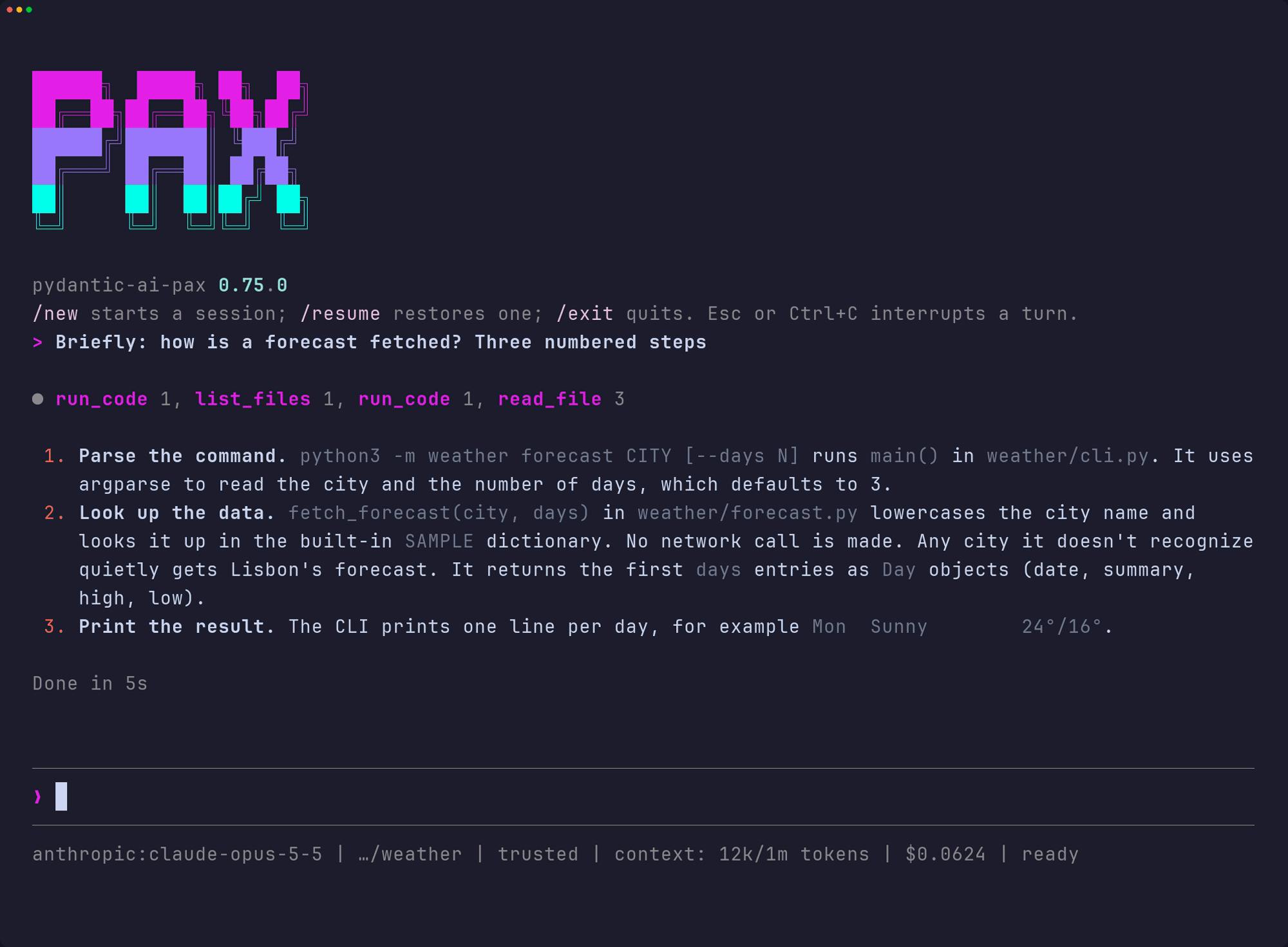
Pydantic launches Pax, a fully plugin-based terminal coding agent supporting custom Pydantic AI agent injection.
Pax is a terminal coding agent from the Pydantic team built on the idea that "even coding itself is a plugin." Its fully plugin-based architecture lets you replace or extend model invocation, tool integration, and coding logic, and it runs any model to avoid vendor lock-in. The `--agent` parameter injects custom Pydantic AI agents into Pax, making it both an out-of-the-box assistant and a host for custom agents. Terminal-first positioning fits native developer workflows and enables embedding in scripts and CI. It received 85 votes and ranked 4th for the day on Product Hunt—early traction with shallow discussion.
The Pydantic team has launched a terminal coding agent called Pax, and the product tagline gets straight to its design philosophy: "even coding itself is a plugin." The tool received 85 votes and 3 comments on Product Hunt, ranking 4th for the day in the Developer Tools and Artificial Intelligence categories.
Plugin Architecture: Putting Control Back in Developers' Hands
Pax's core differentiator is its "fully plugin-based" design. According to the official description, "every part is a plugin," meaning everything from model invocation and tool integration to the coding logic itself can be swapped out or extended as needed. For developers accustomed to deeply customizing their workflows, this design avoids the closed-off "black box" feel of traditional coding assistants.
Unlike many coding agents tied to a single model vendor, Pax emphasizes that it can "run any model." This feature is particularly valuable in today's fast-iterating model landscape—teams don't have to rebuild their entire toolchain just to switch models.
Pydantic and Pydantic AI
Pydantic is a widely used data validation library in the Python ecosystem; numerous frameworks such as FastAPI and LangChain rely on it for structured data validation and serialization. Pydantic AI is an agent development framework built on top of it, featuring type-safe tool calling, structured output, and a model-agnostic abstraction layer that lets developers define agent behavior and tools declaratively. This background helps clarify Pax's positioning: it is not a standalone product built from scratch, but rather the official flagship application of the Pydantic AI ecosystem. That's why the --agent parameter can directly reuse existing Pydantic AI agent definitions, and the plugin system naturally inherits the framework's type system and model abstraction capabilities.
Coding Agent
A coding agent refers to an LLM application that can autonomously read codebases, plan steps, call tools (reading/writing files, executing commands, running tests), and iteratively correct itself—distinct from code assistants that only perform completions. Its typical architecture includes a model layer, a tool layer, and an orchestration loop (agent loop); mainstream products like Claude Code and Cursor Agent are mostly end-to-end closed implementations. Pax's differentiation lies precisely in exposing all three layers as plugins, making model invocation, tool integration, and even coding decision logic replaceable—this is also the basis for the "shell and core separation" concept mentioned in this article.
The --agent Parameter: Drive It with Your Own Pydantic AI Agent
Pax offers an intriguing command-line parameter, --agent, which allows users to inject their own Pydantic AI agents directly into Pax to run. In other words, Pax itself can serve as a host environment, while the specific agent behavior is defined by the developer.
This "shell and core separation" approach makes Pax both an out-of-the-box coding assistant and a runtime container capable of hosting custom agents. For teams already using the Pydantic AI framework, migration costs are minimal.
Terminal-First: A Native Experience for Developers
Pax is positioned as "the official Pydantic AI coding agent, built for your terminal." Terminal-first means it naturally fits into developers' existing workflows without constantly switching between the IDE and a chat window. Combined with its plugin architecture, developers can embed it into scripts, CI pipelines, or local automation tasks—not just interactive conversations.
Terminal-first and CI Integration
Terminal-first tools use the command-line interface as their primary interaction mode, with plain-text-oriented output that can be composed into shell pipes, scripts, and continuous integration pipelines. Compared to IDE plugins or web chat windows, their advantages lie in being scriptable, capable of headless operation, and easy to use on remote servers or in containers. For Pax, this means the coding agent can be used not only for interactive conversations but also as a callable command within build, refactoring, or code review workflows, enabling team-level automation through plugin-based configuration.
Signals Worth Watching
With 85 votes and a 4th-place ranking for the day, the product has clearly gained some attention in the developer community, but the 3 comments also suggest that discussion depth remains shallow. For those tracking the evolution of coding agent architecture, Pax's plugin-based approach offers a reference sample that differs from mainstream closed-source solutions: when coding itself becomes a replaceable plugin, the boundaries of the agent will be defined by developers rather than vendors.
One-line Summary
Pydantic launches Pax, a fully plugin-based terminal coding agent that supports injecting custom Pydantic AI agents.
Paragraph Summary
Pax is a terminal coding agent from the Pydantic team, built around the core idea that "even coding itself is a plugin." It features a fully plugin-based architecture where model invocation, tool integration, and coding logic can all be replaced or extended, and it emphasizes support for running any model to avoid vendor lock-in. Its --agent parameter lets developers inject their own Pydantic AI agents into Pax, making Pax serve simultaneously as an out-of-the-box assistant and a host environment for custom agents. Its terminal-first positioning fits developers' native workflows and can be embedded into scripts and CI pipelines. The product received 85 votes and ranked 4th for the day on Product Hunt—early traction is evident, though discussion remains shallow.
Related articles

Nothing CMF Buds 2A Drops to $17.89 on Black Friday: A New Low for ANC Earbuds
Nothing CMF Buds 2A wireless earbuds Black Friday deal: just $17.89 on Amazon, about $11 off retail and a record low. ANC earbuds at an entry-level price.

When AI Creation Gets Accused of "Spitting": Hacker News Heats Up Over the Glaude Controversy
A Hacker News post, "Spitting in the Face of Glaude," sparks debate on AI creation transparency and attribution ethics. This analysis examines the blurred creator identity behind the controversy and offers practical advice for AI content production.

Akai Embraces Custom Firmware: MPC Sample 1.4 Lets Users AI-Program Their Sampler
Akai embraces the modding community with MPC Sample 1.4 firmware, supporting vibe-coded custom firmware and effects. We analyze the impact of this open strategy on music hardware and AI-assisted programming.