PDFtrack: Minimalist Multi-Camera Tracking via Geometric Voting

PDFtrack achieves SOTA-level multi-camera tracking using only geometric voting, no appearance features needed.
PDFtrack is an open-source multi-camera tracking project that models pedestrians as 3D cylinders and uses a geometric voting mechanism across camera views. By projecting hypotheses and scoring via IoU—without cross-camera association or appearance features—it achieves 96.6 3D MOTA on MMPTrack, surpassing SOTA. Its embarrassingly parallel architecture scales linearly with camera count.
From SORT to the Minimalist Philosophy of Multi-Camera Tracking
In single-camera object tracking, the classic algorithm SORT (Simple Online and Realtime Tracking) proved that "simple can be effective" with an extremely straightforward combination: just IoU matching plus Kalman filtering is enough to achieve smooth object tracking, without complex deep features or re-identification models.
SORT was proposed by Alex Bewley et al. in 2016, with a core design philosophy of achieving real-time multi-object tracking with minimal computational cost. The Kalman filter predicts a target's state in the next frame (including position, velocity, etc.), while the Hungarian algorithm optimally matches predicted boxes with detection boxes based on IoU (Intersection over Union). The subsequent DeepSORT added cosine distance metrics on appearance features, which improved identity preservation but significantly increased computational overhead. PDFtrack's approach returns to SORT's original spirit—proving that the constraining power inherent in geometric information has been underestimated.
Recently, a developer shared his personal project PDFtrack on Reddit, with a core idea that extends SORT's minimalist philosophy to the more challenging Multi-Camera Tracking scenario. The author's goal is clear: prove that in multi-camera settings, heavy cross-camera association and appearance features are likewise unnecessary to compete with SOTA (State-of-the-Art) models.
Multi-Camera Multi-Target Tracking (MCMT) is a core technical requirement in smart cities, intelligent surveillance, and sports analytics. Traditional methods generally fall into two camps: appearance-based methods that rely on Re-ID networks to extract visual features for cross-camera matching, and geometry-based methods that fuse detections from multiple cameras into a unified 3D coordinate system through multi-view geometry. The former is sensitive to lighting changes and occlusion; the latter requires precise camera calibration parameters and extensive matrix computations. Both approaches see computational costs grow rapidly with the number of cameras—exactly the bottleneck PDFtrack aims to break through.
What's most surprising is the results—on the MMPTrack dataset, PDFtrack is not only fast and structurally simple, but also surpasses current state-of-the-art methods on several key metrics.
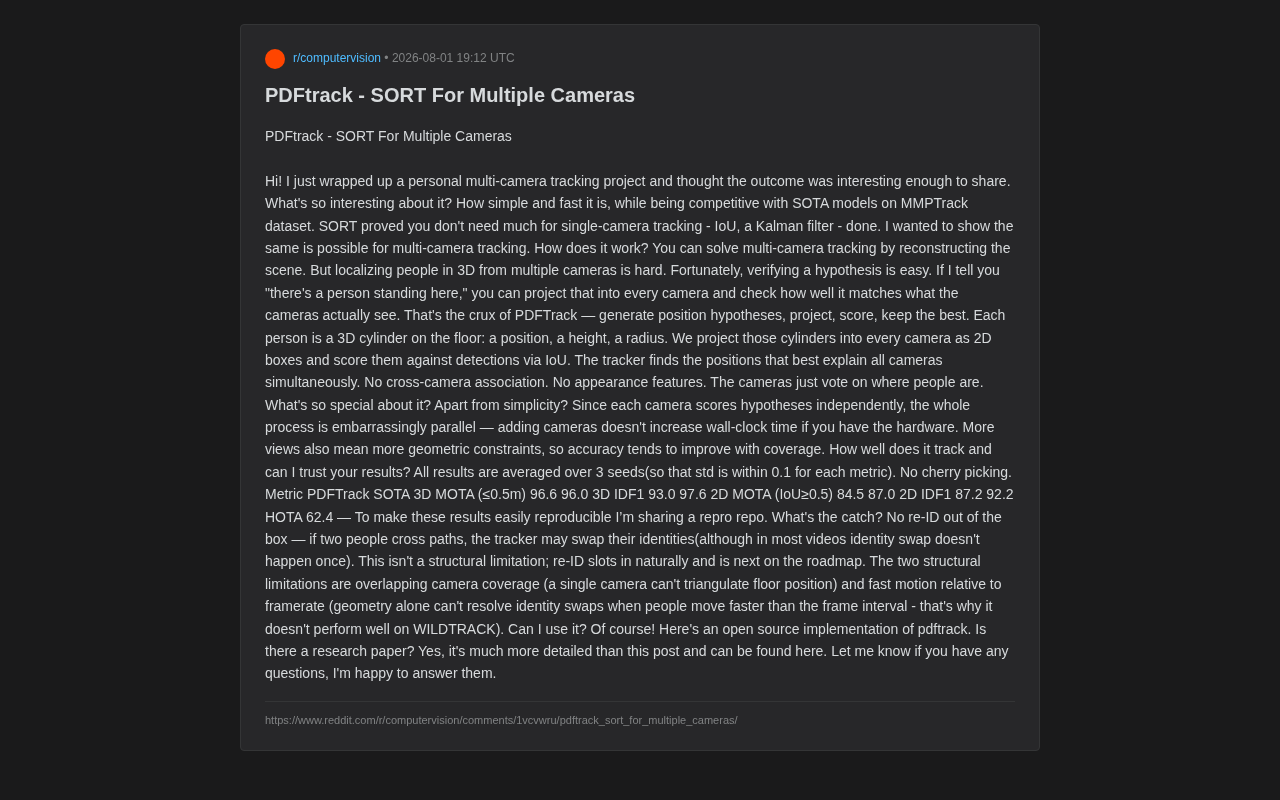
Core Idea: Don't Reconstruct the Scene, Just Verify Hypotheses
The traditional difficulty in multi-camera tracking lies in 3D localization: inferring each person's precise position in real 3D space from multiple camera views—a computationally expensive and error-prone process.
PDFtrack cleverly sidesteps this challenge. The author's key insight is: Reconstructing a 3D scene from scratch is hard, but verifying a hypothesis is easy.
Cylinder Voting Mechanism
Specifically, PDFtrack abstracts each person as a 3D cylinder standing on the ground plane—defined by just three parameters: position, height, and radius. Modeling pedestrians as 3D cylinders is a common simplification in computer vision—the projection silhouette of a standing human body does indeed approximate a cylinder. The advantage of this model lies in its minimal parameterization (ground position coordinates x/y, height h, radius r), keeping the hypothesis space manageable. PDFtrack can "bypass" full 3D reconstruction because it transforms the problem from "solving" to "verifying": the latter only requires projecting candidate cylinders onto each view's 2D plane using known camera intrinsic and extrinsic matrices, then computing the overlap between projected boxes and detection boxes. This is essentially an "analysis-by-synthesis" paradigm, with deep theoretical roots in computer graphics and inverse rendering.
The tracking pipeline can be summarized in four steps:
- Generate hypotheses: Propose position hypotheses like "someone might be standing here";
- Project: Project this 3D cylinder into every camera view to form 2D bounding boxes;
- Score: Match the projected 2D boxes against actual detections in each camera using IoU;
- Keep the best: Find the position combination that best explains all camera views simultaneously.
The essence of this mechanism is—no cross-camera association, no appearance feature extraction. Each camera is essentially "voting," collectively deciding where a person is actually standing. This is entirely consistent with SORT's approach of using only geometric and motion information.
Why PDFtrack Deserves Attention
Beyond its structural simplicity, PDFtrack has two highly attractive engineering properties.
Natural Parallelism
Since each camera scores position hypotheses independently, the entire pipeline is "embarrassingly parallel." "Embarrassingly parallel" is a technical term in parallel computing, referring to problems that require virtually no inter-task communication or synchronization—each subtask is completely independent and can run simultaneously on different processors. In PDFtrack, for any given position hypothesis, each camera independently computes the projection score from its own viewpoint, with no need to exchange intermediate results between cameras. This means whether deployed across multiple GPU cores or distributed across edge computing nodes, the system achieves near-linear scaling efficiency. This stands in stark contrast to methods requiring global graph matching or cross-camera feature fusion—whose communication overhead often grows super-linearly with the number of cameras.
This means that with sufficient hardware, adding more cameras doesn't increase actual runtime. This is a huge advantage for scenarios requiring large-scale surveillance network deployment.
More Coverage, Higher Accuracy
More viewpoints mean more geometric constraints. Therefore, contrary to the dilemma many methods face where "more cameras means harder coordination," PDFtrack actually improves in accuracy as camera coverage expands. This is a unique dividend of geometry-driven methods.
Benchmark Results: PDFtrack vs. SOTA Head-to-Head
The author emphasizes that all results are averaged over 3 random seeds (standard deviation within 0.1 for each metric), with no cherry picking, and provides a reproducible code repository.
Here is PDFtrack's comparison with SOTA methods on the MMPTrack dataset:
| Metric | PDFtrack | SOTA |
|---|---|---|
| 3D MOTA (≤0.5m) | 96.6 | 96.0 |
| 3D IDF1 | 93.0 | 97.6 |
| 2D MOTA (IoU≥0.5) | 84.5 | 87.0 |
| 2D IDF1 | 87.2 | 92.2 |
| HOTA | 62.4 | — |
MMPTrack is a benchmark dataset specifically designed for evaluating multi-person multi-camera tracking algorithms, providing synchronized multi-view videos, precise camera calibration parameters, and 3D ground truth annotations. Regarding evaluation metrics: MOTA (Multiple Object Tracking Accuracy) comprehensively measures the frequency of missed detections, false positives, and identity switches, serving as a holistic tracking accuracy metric; IDF1 focuses on measuring a tracker's ability to maintain correct identity labels, being particularly sensitive to re-identification after prolonged occlusion; HOTA (Higher Order Tracking Accuracy) is a more recently proposed balanced metric that simultaneously considers detection quality and association quality.
As shown, on the 3D MOTA metric measuring overall tracking accuracy, PDFtrack slightly surpasses SOTA with 96.6 vs. 96.0. On IDF1 (measuring identity consistency) and other metrics, it falls slightly behind—directly related to its current technical limitations. PDFtrack's strong MOTA but lower IDF1 precisely reflects its characteristic of "accurate localization but weak identity maintenance."
Limitations and Future Roadmap
The author doesn't shy away from the project's shortcomings, which makes the entire presentation more credible.
No Out-of-the-Box Re-ID Module Yet
Currently, PDFtrack has no built-in re-ID (re-identification). When two people cross paths, the tracker may swap their identity labels.
Re-ID (Person Re-Identification) refers to the technology of re-identifying the same person across different times or cameras. Modern Re-ID systems typically use deep convolutional networks (such as ResNet-50) to extract appearance embedding vectors, performing identity matching through cosine similarity or Euclidean distance. PDFtrack's current lack of this module means that when two people's trajectories cross in 3D space, purely geometric tracking cannot distinguish "who is who"—because near the crossing point, both position hypotheses are equally plausible. However, since PDFtrack already maintains stable 3D position estimates for each tracked target, Re-ID features only need to intervene as an auxiliary signal when ambiguity occurs, rather than being computed at every frame as in traditional methods—this opens possibilities for lightweight integration.
The author notes this isn't a structural deficiency—in most videos, identity swaps only occur once, and re-ID can be naturally embedded into the existing framework, which is the next step on the roadmap. This explains why it trails SOTA on the IDF1 metric.
Two Structural Limitations
Two limitations that cannot be easily circumvented:
- Overlapping coverage requirement: A single camera cannot triangulate ground positions, so the method relies on overlapping coverage from multiple camera viewpoints;
- Fast motion problem: When targets move faster than the frame interval allows, pure geometric information cannot resolve identity swaps. This is precisely why PDFtrack performs poorly on the WILDTRACK dataset—which contains motion that is too fast relative to the frame rate.
The WILDTRACK dataset was released by EPFL (Swiss Federal Institute of Technology in Lausanne), recording free pedestrian movement in an outdoor plaza at an extremely low frame rate of 2fps. At 2fps, pedestrians may move 1-2 meters between adjacent frames—far exceeding the inter-frame displacement in typical surveillance scenarios (usually 25-30fps). With such large frame intervals, Kalman filter position prediction errors increase dramatically, and spatial proximity-based association strategies can easily mis-match different nearby targets. This is the Achilles' heel of purely geometric methods—when the prediction radius of the motion model exceeds the inter-target distance, geometric constraints alone cannot resolve data association ambiguity.
Open Source and Research Value
The author has fully open-sourced PDFtrack, providing a research paper more detailed than the post, along with a dedicated repository for reproducing results.
For practitioners in computer vision and multi-object tracking, PDFtrack offers a highly inspiring paradigm: in an era dominated by deep learning features, it's worth revisiting the power of geometric constraints. It proves that the simple cycle of "hypothesize-project-score-keep" can rival complex end-to-end models under suitable multi-camera layouts. Once the re-ID module is added, this approach has the potential to become a practical choice for lightweight multi-camera tracking.
Key Takeaways
Related articles

AI Agent Permission Management: Why RBAC Is No Longer Enough
AI agents in production face failure modes RBAC can't cover: entity resolution errors, sub-agent permission escalation, and autonomous destructive actions. A deep dive into identity and permission governance challenges in the agent era.

EMNLP Findings Acceptance Probability Analysis: Interpreting ARR Reviews with 4/4/2 Scores
In-depth analysis of EMNLP Findings acceptance probability, interpreting ARR review scores of 4/4/2 with meta-score 3, rebuttal strategies, and submission advice for NLP researchers.

Can't Find the Cancel Button for Perplexity Pro? Here's How to Completely Turn Off Auto-Renewal
Can't find Perplexity Pro's cancel button? It's because PayPal hosts the billing agreement. Learn the complete steps to cancel auto-renewal through PayPal and manage AI subscriptions effectively.