Perplexity Integrates Plaid: AI Becomes Your Personal CFO
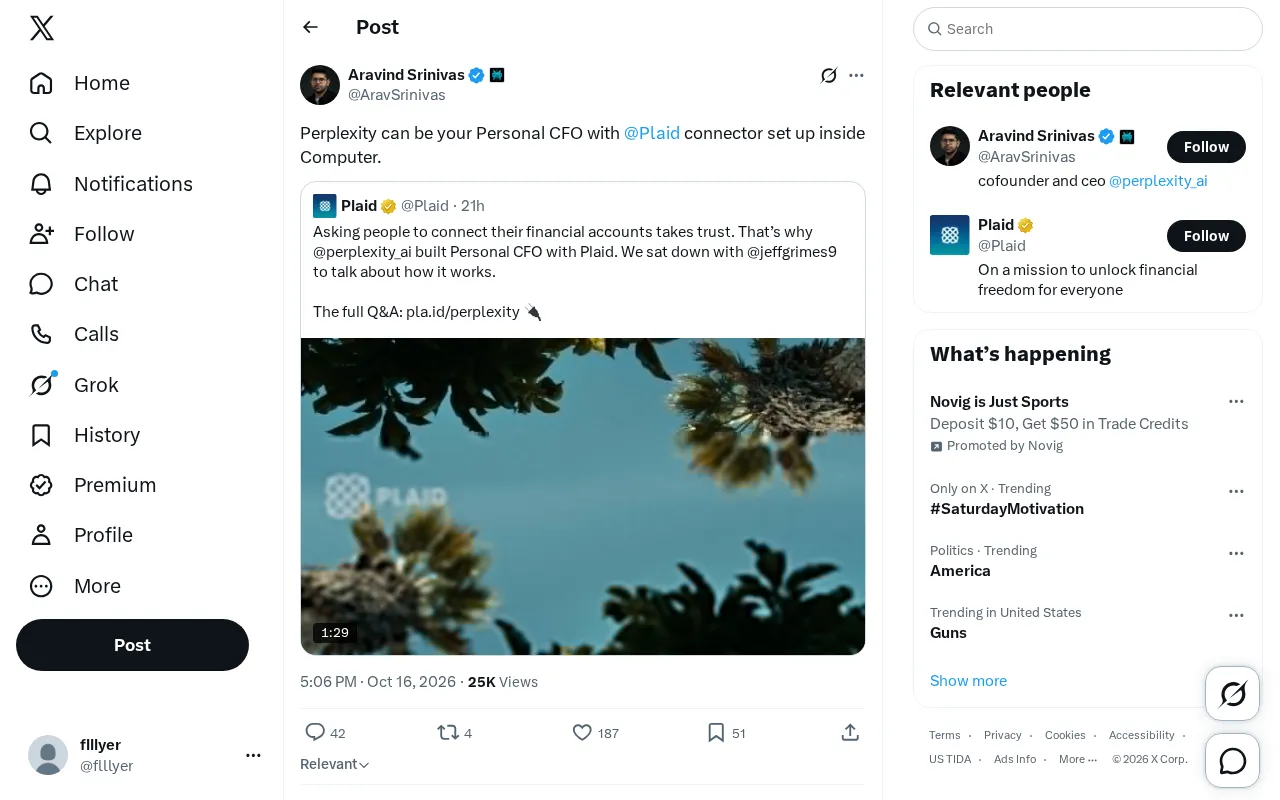
Perplexity integrates Plaid into Computer, letting AI read real account data and act as a personal CFO.
Perplexity announced that through its Computer feature it has integrated the Plaid connector, enabling the AI to read users' bank account, credit card, and investment account data and provide personal financial analysis and planning advice positioned as a "Personal CFO." The article unpacks the product logic: Computer, as a workspace that can invoke external tools, is the key vehicle for Plaid; Plaid handles standardized financial data aggregation, while Perplexity handles natural language interaction and reasoning, together lowering the barrier to personal finance management. It also notes that data privacy and trust design are key to adoption, with details like authorization transparency and data usage policies not yet public. The integration could shift competition in personal finance software from data connectivity to understanding and conversation, but liability boundaries and compliance for financial advice remain obstacles to scaling.
From Q&A Tool to Financial Manager: Perplexity's Ambition
Perplexity recently dropped a brief but information-dense announcement on X (formerly Twitter): by integrating the Plaid connector into its Computer feature, Perplexity can become your "Personal CFO." This means the AI assistant is no longer limited to answering questions and summarizing materials — it's starting to directly read your real financial data and, on that basis, offer analysis, planning, and decision-making advice.
This move deserves careful unpacking. Plaid is infrastructure in the financial data aggregation space, and a large number of personal finance apps and fintech products rely on it to connect bank accounts, credit cards, and investment accounts. By putting Plaid into Computer, Perplexity is essentially giving its AI a pair of eyes that can see your account transactions and asset structure.
What Computer Is and Why It's the Key Vehicle
To understand the significance of this integration, we first need to look at where Computer sits within Perplexity's product system. Computer isn't just a chat window — it's closer to a workspace that can invoke external tools and execute multi-step tasks. Integrating Plaid as a connector into Computer shows that Perplexity's approach is to have the AI work in an environment with "tools and data," rather than answering questions solely from the model's internal knowledge.
The immediate change this design brings is that users can ask the AI to complete specific tasks based on real account data — for example, breaking down recent spending patterns, comparing cash flow across different accounts, or generating a personal financial overview based on assets and liabilities. The AI's output shifts from "generic advice" to "judgments tailored to your personal situation."
The difference between Computer and the regular chat mode
Perplexity's conventional usage is a linear "ask-retrieve-answer" flow, where the model mainly relies on training knowledge and real-time search results to generate responses. Computer, by contrast, is a product form with an execution environment: it can load external tools (connectors), maintain context across multi-step tasks, and call third-party APIs to obtain structured data when needed. Think of it as an "AI agent workbench" — here the model doesn't just generate text but can plan and execute operations step by step.
The significance of this architecture is that the AI's capability ceiling is no longer determined solely by model parameters, but by the tools and data sources it can access. The Plaid connector is mounted precisely through this mechanism: once authorization is complete, Computer gains the ability to query account data, thereby turning a "general model" into a "model that knows your financial situation." This is also why the article emphasizes that Computer is the key vehicle, not Plaid itself.
The Capability Boundaries of the Plaid Connector
From a product logic perspective, the Plaid connector opens up three types of capabilities.
Real Data-Driven Analysis
The biggest pain point in personal financial analysis is fragmented data. Payroll cards, credit cards, savings accounts, and investment accounts are often spread across different institutions, and manual aggregation is both time-consuming and error-prone. Plaid's value lies in standardizing and aggregating this data, while Perplexity is responsible for interpreting and reasoning over the aggregated data. Only through this combination can the AI produce evidence-based conclusions like "your fixed expenses are too high a proportion" or "certain subscription costs are continuing to grow."
How Plaid works and data standardization
Plaid doesn't directly hold user funds; it plays the role of "authorization intermediary + data pipeline." Users select their bank in the Plaid interface and enter credentials (or authorize via OAuth redirect), after which Plaid retrieves account balances, transaction history, account types, and other data in read-only mode, converting it into a unified field format returned to the integrating party.
The value of this standardization lies in the fact that interface protocols, field naming, and transaction description formats vary enormously across banks. Without an intermediary layer, each institution would need to be integrated separately. Plaid absorbs these differences, allowing downstream applications to process information from hundreds of institutions using a single data structure. For Perplexity, this means it can obtain structured financial data directly consumable by the model — and have transaction records categorized into interpretable categories like income, dining, and subscriptions — without building its own bank-direct-connection team.
Natural Language as the Financial Interaction Interface
Traditional personal finance management tools require users to learn categorization rules, report structures, and budgeting models. After integrating Plaid, Perplexity can handle this translation work through conversation: users ask questions in everyday language, and the AI converts the question into queries and analysis of account data. For people unfamiliar with financial software, this greatly lowers the barrier to use.
From Analysis to Advice
The term "Personal CFO" points not just to reports but to decision support. Based on account data, the AI can discuss topics like budget allocation, savings pacing, and cash flow arrangements. It should be emphasized that the reliability of such advice depends on data completeness and model reasoning quality, and users should still treat it as a reference rather than professional financial advice.
Consistency Judgment Across Multiple Perspectives
The original source of this news is Perplexity's official post on X. The information itself is brief, with only one core fact: the Plaid connector has been set up in Computer, and Perplexity can serve as a personal CFO. Currently, no other independent sources have cross-verified the specific implementation details of this feature, so key questions — such as the scope of data permissions, supported account types, and whether it covers regions outside the US — still lack public information.
What can be confirmed is the direction: AI assistants are moving down from the "information layer" to the "data layer," and financial data is one of the most sensitive and valuable data layers. The appearance of Plaid as a connector shows that Perplexity has chosen to partner with mature financial data infrastructure rather than build its own bank-direct-connection system.
Privacy and Trust: An Unavoidable Threshold
Handing bank account data to an AI product raises direct user concerns. Plaid itself has relatively mature authorization and connection mechanisms in the financial data aggregation space, but how data is stored, how it's used by the model, and how long it's retained after entering Perplexity is a separate matter.
For Perplexity, the success of this product line depends not only on analytical capability but even more on trust design: whether the authorization process is transparent, whether users can disconnect at any time, whether data is used for model training, and whether permission granularity is sufficiently fine. Until these details are made public, "Personal CFO" is more of a directional promise than a finished product you can confidently use right away.
The compliance context of financial data aggregation
In the US, financial data access is primarily governed by the framework of Section 1033 of the Dodd-Frank Act, which requires financial institutions to open data access to third parties with user authorization and explicitly affirms that users have control over their financial data. Plaid's authorization model is built precisely on this regulatory trend: users actively authorize, can revoke at any time, and third parties receive only the data within the necessary scope.
But the compliance chain doesn't end at the connection stage. Once data enters Perplexity, what applies is the privacy policy and data processing agreement, not banking regulations. This means "Plaid compliance" does not equal "Perplexity compliance." What users need to pay attention to is Perplexity's own data retention period, whether data is used for model training, and whether the deletion mechanism is verifiable. This distinction is key to assessing the credibility of this feature.
Impact on the Personal Finance AI Landscape
If this kind of integration works, the competitive landscape of personal finance management software will be redefined. The core assets of traditional budgeting apps are data connections and categorization engines, while products like Perplexity push the competitive focus toward "understanding and conversation": whoever can better explain financial status in natural language and answer hypothetical questions gets closer to being the entry point for users' everyday decisions.
At the same time, limitations must be recognized. Financial advice involves liability boundaries, and if an AI's judgment leads to actual losses, responsibility attribution becomes very ambiguous. Product compliance design, disclaimers, and human fallback mechanisms will all be important factors in whether this approach can scale.
Liability and regulatory boundaries of AI financial advice
Personal financial advice is subject to dedicated regulation in many jurisdictions. For example, the US Investment Advisers Act has a clear definition of "investment advice," and providing personalized securities investment advice typically requires registration as an investment adviser; tax advice is also constrained by professional qualifications. If an AI product stays at the level of "information organization and general budget discussion," it is usually not considered investment advice; but once it outputs specific asset allocation or buy/sell judgments, it may cross regulatory red lines.
This is also the subtlety of Perplexity positioning itself as a "Personal CFO" rather than a "financial advisor": the former leans toward information aggregation and planning assistance, while the latter carries fiduciary responsibility implications. The product's design in wording, disclaimers, and output boundaries will directly affect its compliance risk and user expectation management.
Several Questions Worth Watching
What's worth observing next: whether the Plaid integration is open to all users or first to specific paid tiers; which countries and regions' financial institutions are supported; whether the AI's financial analysis includes data sources and calculation processes; and whether Perplexity will launch dedicated financial workflows around this capability. The answers to these questions will determine whether "Personal CFO" is marketing language or a genuinely usable product capability.
One-line Summary
Perplexity integrates Plaid into Computer, letting AI read real account data and act as a personal CFO.
Paragraph Summary
Perplexity announced that through its Computer feature it has integrated the Plaid connector, enabling the AI to read users' bank account, credit card, and investment account data and provide personal financial analysis and planning advice positioned as a "Personal CFO." The article unpacks the product logic of this integration: Computer, as a workspace that can invoke external tools, is the key vehicle for Plaid; Plaid handles standardized aggregation of financial data, while Perplexity handles natural language interaction and reasoning, and together they lower the barrier to personal finance management. At the same time, the article points out that data privacy and trust design are key to adoption, and details such as authorization transparency and data usage policies have not yet been made public. This integration could shift the competitive focus of personal finance software from data connectivity to understanding and conversation capabilities, but the liability boundaries and compliance issues of financial advice remain obstacles that must be resolved before scaling.
Related articles
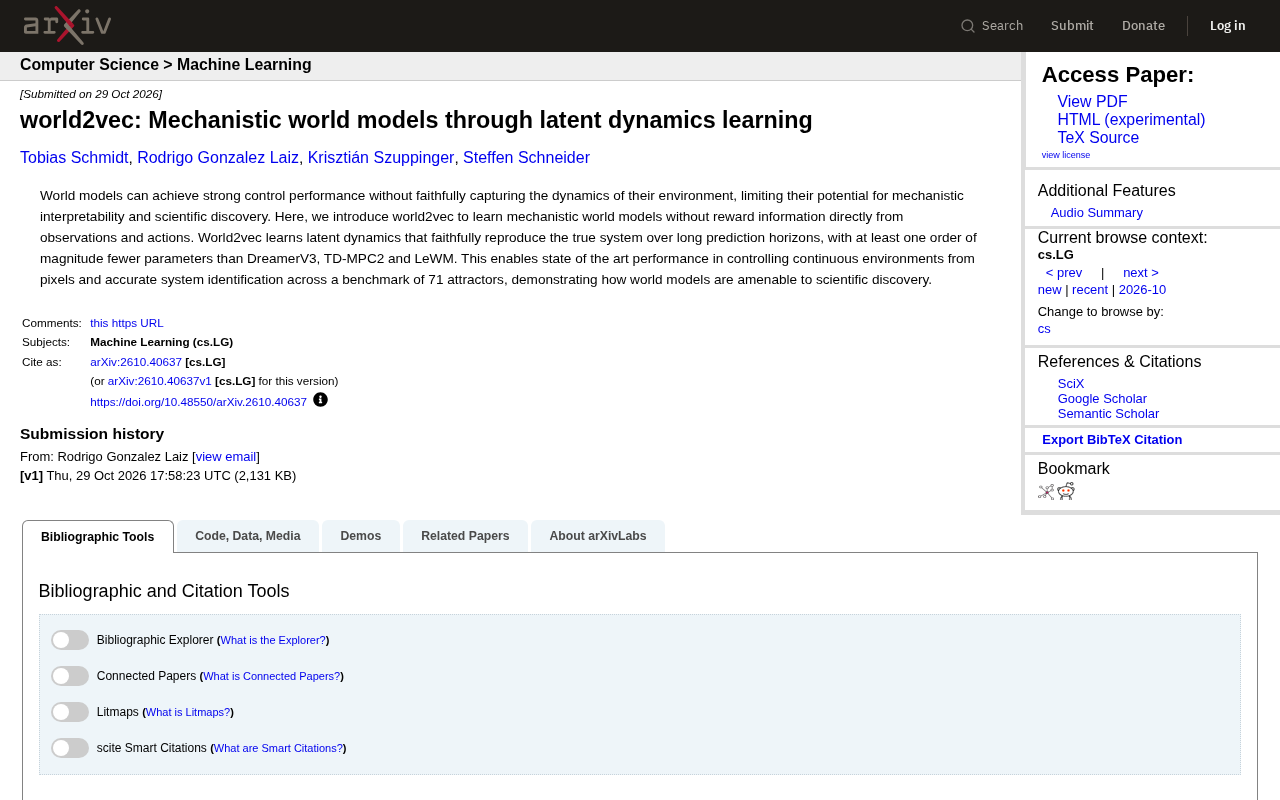
world2vec: Building Mechanistic World Models with Latent Dynamics Learning
world2vec proposes a reward-free method for learning mechanistic world models via latent dynamics, faithfully reproducing systems over long horizons with at least an order of magnitude fewer parameters than DreamerV3, TD-MPC2, and LeWM, and achieving accurate system identification on 71 attractor benchmarks.

A New KL-DRO Paradigm: Adaptive Scenario Generation Around a Learned Density Model
KL-DRO research proposes centering the KL ball on a learned density model instead of the empirical distribution, with adaptive scenario generation guiding sampling toward the worst case. Experiments show lower cost under distribution shift when records are scarce and the model can extrapolate, with comparable in-distribution cost.

ODE Samplers for Discrete Diffusion Models: Exponential Residual Flows Accelerate Generation
Discrete diffusion models lack deterministic ODE sampling? This article introduces Exponential Residual Flows (ERFs), which introduce continuous residual variables per token to construct piecewise ODEs for deterministic sampling and support consistency distillation acceleration. Superior to prior methods on code and text generation tasks.