Perplexity Teammates: Letting an AI Team Produce Product Marketing Videos End to End

Perplexity Teammates attempts end-to-end marketing video creation via multi-agent collaboration; the direction is notable, but details await verification.
Perplexity is extending from a search tool to an AI agent collaboration platform. According to a Twitter share, users can have Perplexity Teammates run a complete marketing studio that does end-to-end video creation for their product. Its core is multi-agent division of labor covering scripting, storyboards, assets, voiceover, and editing, rather than one-shot generation by a single model. This could greatly lower the cost and staffing barriers for small teams, but currently only a directional description exists; video quality, parameters, collaboration stability, and workflow controllability still need product verification.
From Search Tool to Marketing Studio: Perplexity's Ambition
Perplexity is trying to redefine the boundaries of the AI assistant. According to a share on Twitter, users can have Perplexity Teammates run a complete marketing studio that does end-to-end video creation for their product. This means that from ideation to final video delivery, the entire workflow can be driven by an AI team, rather than stopping at chat or search.
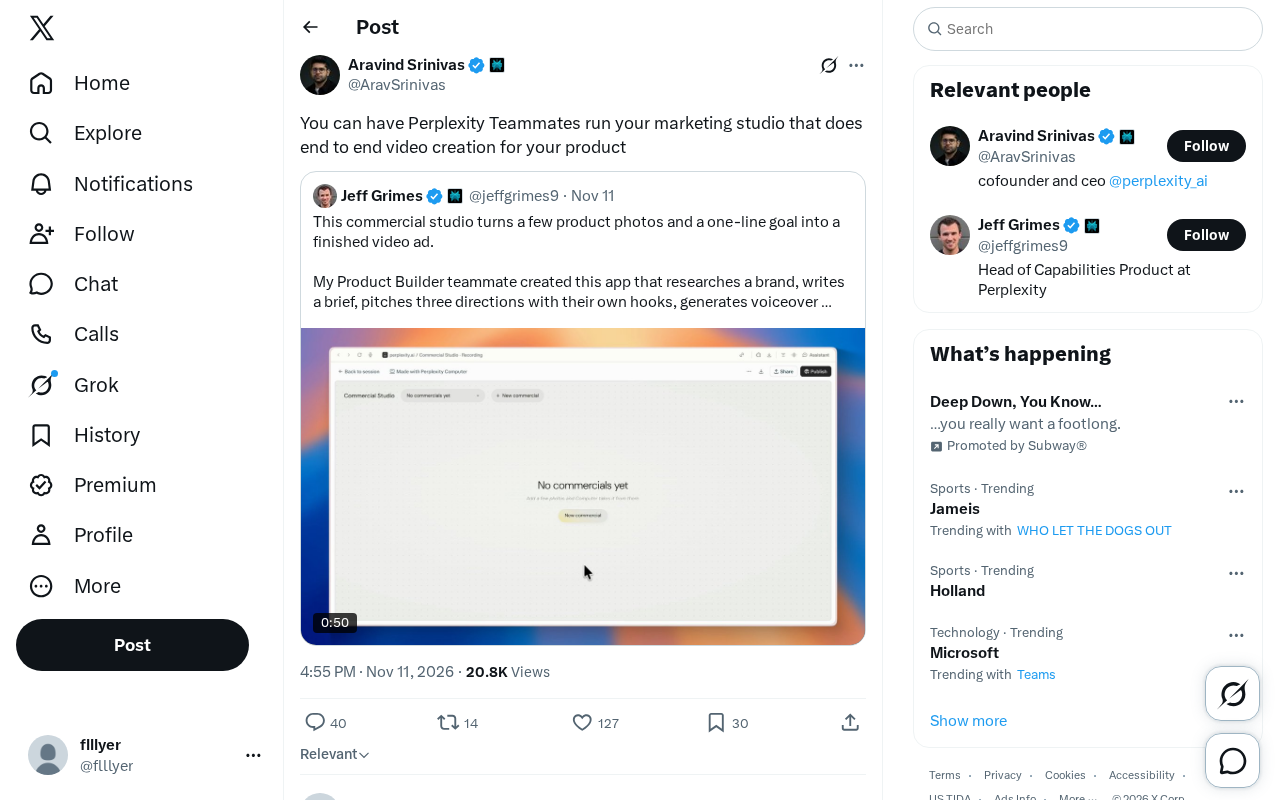
The key words in this information are "Teammates" and "end-to-end." Teammates implies a mechanism in which multiple AI agents work collaboratively, while end-to-end emphasizes coverage of the complete chain from planning to final cut. For product teams that need to continuously produce marketing assets, this capability points to an entirely new workflow paradigm—freeing the production of marketing videos from labor-intensive processes.
Why the Teammates Model Is Worth Watching
There is no shortage of AI video generation tools on the market, but most solve a single point problem: some excel at text-to-video, some focus on editing, and some concentrate on scripts. The differentiation of Perplexity Teammates lies in the concept of a "team"—it attempts to connect multiple stages into a system that can operate autonomously, where users only need to issue a goal and the AI agents handle the division of labor, scheduling, and execution.
This multi-agent collaboration approach is fundamentally different from one-shot generation by a single large model. Producing a marketing video involves multiple specialized stages such as scriptwriting, storyboard planning, asset generation, voiceover and music, and editing and compositing, each with different requirements for model capabilities. Having specialized agents each perform their own roles, coordinated by an orchestration layer, is in theory more controllable than having one general model shoulder the entire workflow, and it is also easier to optimize quality at individual stages.
Multi-Agent System is the foundation for understanding the Teammates model. It refers to a collaborative system composed of multiple AI agents with independent goals, roles, and tools: each agent is responsible for a type of subtask (such as scriptwriting or asset generation) and works cooperatively through message passing or shared context. Compared with one-shot generation by a single large model, a multi-agent system usually requires an orchestrator to assign tasks, aggregate results, and handle conflicts. The advantages of this architecture are that it enables specialized optimization by division of labor, parallel execution, and localized retries; the challenges lie in communication overhead among agents, task boundary definition, and control of overall stability. Marketing video production is naturally suited to multi-agent systems because its workflow can be decomposed into multiple specialized stages with clear upstream and downstream dependencies between them.
What End-to-End Video Creation Means
For product marketing, the pain point of video content has never been "we can't make it," but rather "it's too slow, too expensive, and not enough volume." When a product launches, it often requires multiple versions, platforms, and styles of video assets at the same time. If Perplexity Teammates can truly achieve end-to-end output, product teams would only need to provide product information, target audience, and style preferences to receive usable final cuts, which would drive the cost of asset testing and iteration down to extremely low levels.
To be objective, this share currently only provides a directional description and does not disclose specific parameters such as video quality, generation time, supported resolutions, or formats. Whether end-to-end can meet standards in real commercial scenarios still depends on whether the actual output reaches publishable quality. Marketing videos have high requirements for brand tone and visual detail, and whether AI-generated final cuts can withstand professional review remains a link that needs verification.
End-to-End in the AI context usually refers to a complete automated workflow from raw input directly to final output, with no manual intervention in between. In video creation scenarios, end-to-end means that users only need to provide product information, target audience, and style preferences, and the system can automatically complete scriptwriting, storyboard planning, asset generation, voiceover and music, editing and compositing, and exporting the final cut. It is important to distinguish that end-to-end does not equal high quality: it emphasizes the completeness of workflow coverage, while the generation quality at each stage still depends on the underlying model capabilities and post-processing strategies. In addition, a truly commercial-grade end-to-end workflow usually needs to retain human review and editing checkpoints; otherwise, it is difficult to meet brand tone and compliance requirements.
Potential Impact on Content Creation Workflows
If such tools mature, those most affected may not be professional video production teams, but rather small and medium-sized teams and independent developers who previously could not produce video at scale at all due to budget and staffing constraints. In the past, they could only do graphic and text marketing; now they have the opportunity to produce video assets at near-zero marginal cost.
For professional creators, the value of the tools is more about outsourcing repetitive, process-oriented work and concentrating energy on creative judgment and brand strategy. AI agents handle execution, while humans make decisions and calibrate tone. This division of labor has already appeared in the graphic and text field, and the video field is being pushed forward.
A Calm View: Right Direction, Details Still Needed
Perplexity entered through search Q&A and then extended into agent collaboration and content production; the logic is coherent—it possesses capabilities in information retrieval and task decomposition, making it naturally suited to serve as the orchestration layer of a multi-agent system. But a single tweet is not enough to prove that the product is already mature for commercial use.
What truly determines whether such tools can be adopted comes down to three questions: whether the generated videos are commercially usable, how stable multi-agent collaboration is, and how much control users have over the workflow. Marketing teams will not hand brand assets over to a black box; workflows that are editable, intervenable, and traceable are the real plus. This share opens up an imaginative space worth watching, and subsequent actual product capabilities will be needed to deliver on it.
Traceable Workflow refers to the system's ability to record and display each step of operation and intermediate output, enabling human users to review, edit, undo, and reproduce the entire generation process. For marketing teams, a traceable workflow is the foundation for trusting AI agent systems: the generation of brand assets must conform to tone guidelines, and if deviations occur, the team needs to know which stage the problem came from and be able to correct it in a targeted way. Multi-agent systems lacking traceability are often regarded as "black boxes" and struggle to pass internal compliance and quality control reviews, which is also one of the core obstacles facing most current AI video tools in commercial adoption.
One-line Summary
Perplexity Teammates attempts to use multi-agent collaboration to achieve end-to-end marketing video creation; the direction is worth watching, but details remain to be verified.
Paragraph Summary
Perplexity is extending from a search tool to an AI agent collaboration platform. According to a Twitter share, users can have Perplexity Teammates run a complete marketing studio that does end-to-end video creation for their product. Its core lies in multi-agent division of labor, covering scriptwriting, storyboards, assets, voiceover, and editing, rather than one-shot generation by a single model. This model is expected to greatly lower the manpower and cost barriers for small and medium-sized teams producing marketing videos, allowing graphic and text marketing teams to produce video assets at near-zero marginal cost. However, there is currently only a directional description; video quality, generation parameters, multi-agent collaboration stability, and workflow controllability still await verification through actual products. The article holds that the direction is right, but a single tweet is not enough to prove mature commercial readiness.
Related articles

Gemini 4 Neon Leak: A Potential Strong Contender Against Opus 5.5
A Hacker News thread suggests Gemini 4 Neon looks like an Opus 5.5 competitor. This article unpacks the product positioning behind this community signal, shifts in the top-model competitive landscape, and what it means for developers' model selection strategy.

Claude Fable 5.2's Self-Authored Short Film 'Fable' Sparks Discussion
A short film 'Fable,' credited to Claude Fable 5.2 for script, visuals, and directing, appears on Hacker News. This article analyzes the significance of full-pipeline AI creation, community reactions, and what it means for content creators.

Anthropic IPO Pricing: A Signal of AI Giants Going Public
Anthropic's IPO pricing draws attention. This article analyzes its potential impact on AI industry valuation, commercialization paths, and the competitive landscape, and highlights public-market expectations and challenges for AI companies.