Persistent Agent Template: An Open-Source Approach to Enterprise Intuition Engines

The persistent-agent open-source template centers on proactiveness, memory, and playbooks to explore paths for building persistent enterprise agents.
persistent-agent is an open-source template positioned as infrastructure for building 'enterprise intuition.' It addresses the problem of traditional AI assistants being one-off sessions that reset after interaction, proposing persistence mechanisms to let agents accumulate context. Built around three pillars—proactiveness, memory, and playbooks—plus enterprise connectors, it is released as open source and supports deployment on MDA, emphasizing auditability and customizability. The author views the template approach as pragmatic, though memory strategies and trigger conditions still require business-specific tuning.
From Weekend Project to Enterprise Intuition: Parsing the persistent-agent Template
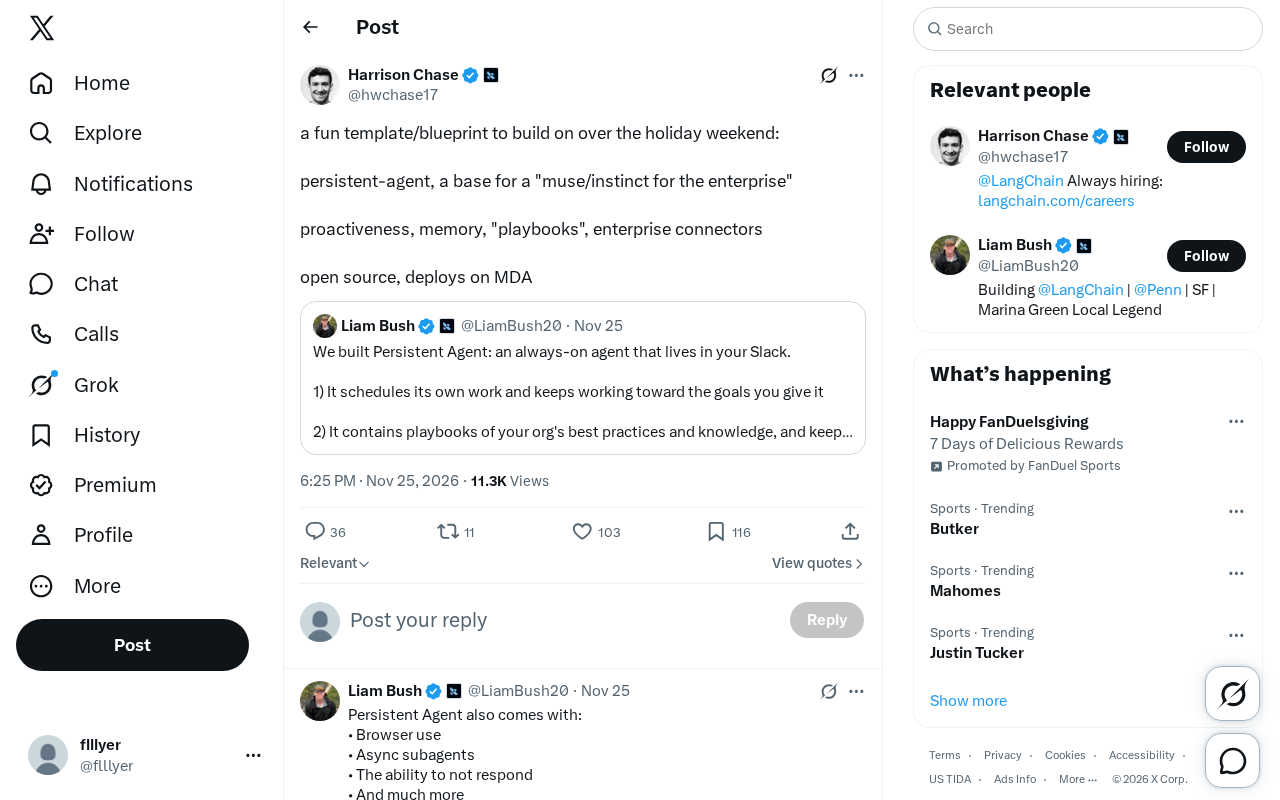
A developer recently shared an open-source template called persistent-agent, positioning it as the foundation for "enterprise intuition/inspiration." The project initially emerged as a "holiday weekend build project," but it touches on an important proposition: how to give AI agents persistent memory, proactiveness, and reusable behavioral patterns in enterprise environments.
Traditional AI assistants are often the product of one-off sessions—users ask questions, models answer, and everything resets when the interaction ends. persistent-agent attempts to break this pattern by using persistence mechanisms to let agents accumulate context and form a judgment foundation akin to human "intuition."
Core Features: Proactiveness, Memory, and Playbooks
According to the author, the template is built around three pillars:
Proactiveness: Agents no longer passively wait for instructions but can proactively initiate actions or suggestions based on existing state. In enterprise scenarios, this means the system can proactively remind, anticipate needs, and serve as more than just a query tool.
Memory: Through persistent storage, agents can remember historical interactions, preferences, and business rules. This is the prerequisite for forming "intuition"—without memory there is no context accumulation, and therefore no rapid judgment based on experience.
Playbooks: The author uses the term "playbooks" to describe reusable behavioral scripts or decision processes. This allows agents to execute according to preset logic in specific scenarios, reducing uncertainty in each decision.
Additionally, the template emphasizes enterprise connectors, i.e., the ability to interface with existing enterprise systems. This means persistent-agent is not an isolated chatbot but a component capable of connecting to business data flows and workflows.
Persistent agent refers to an AI agent that can maintain state, memory, and identity across multiple sessions. The opposite is a stateless agent, which starts from scratch with each interaction and retains no historical information. Persistence is typically implemented via an external storage layer (such as a vector database, key-value store, or relational database) that serializes and saves conversation history, user preferences, task state, etc., and retrieves and injects them into context in subsequent sessions. This concept is closely related to the LLM's context window limitation: since the number of tokens a model can process at once is limited, persistence mechanisms essentially externalize "long-term memory," retrieving it on demand through methods such as retrieval-augmented generation (RAG). In enterprise scenarios, persistence also involves engineering issues such as permission isolation, data retention compliance, and memory expiration policies.
Playbook in the agent context usually refers to a set of predefined behavioral scripts, decision trees, or tool invocation sequences used to guide an agent through an established process under specific trigger conditions. Unlike approaches that rely entirely on free-form model reasoning, it codifies domain experts' experience into reusable process templates, thereby reducing output uncertainty and hallucination risk. Playbook design draws on Runbooks in operations and Standard Operating Procedures (SOPs) in customer service, emphasizing auditability, version management, and composability. In practice, a playbook can be a prompt template, a state machine definition, or a workflow description orchestrating multiple tool calls. Its trigger conditions, exit conditions, and exception-handling branches need to be tightly aligned with business rules.
Open Source and Enterprise Deployment: MDA's Positioning
The project is released as open source and explicitly mentions "deploys on MDA." The specific meaning of MDA is not elaborated in the original information, but from context it points to some kind of deployment platform or runtime environment, emphasizing an out-of-the-box deployment experience.
The open-source strategy has practical significance here: enterprise intuition engines involve sensitive business logic and data, and closed-source solutions struggle to earn trust. Open source allows teams to audit code, customize memory strategies, and adjust connectors without vendor lock-in. For teams that want to build AI capabilities internally, such templates lower the barrier to building from scratch.
Enterprise connectors are the adaptation layer between agents and external systems, commonly in the form of API wrappers, database drivers, message queue subscriptions, and official SDKs for SaaS platforms. Their core role is to expose enterprise data sources and workflows—such as internal CRM, ERP, ticketing systems, and knowledge bases—to agents so they can read business state and perform write operations. Connector design needs to handle engineering details such as authentication and authorization (e.g., OAuth, service accounts), rate limiting, data masking, and error retries. In agent architecture, connectors often work in conjunction with tool use / function calling mechanisms: the model selects which connector to call based on task needs, and the connector handles actual execution and returns structured results. The quality of connectors directly determines whether agents can deliver value in real business operations.
The Value and Limits of the Template Approach
Turning an abstract concept like "enterprise intuition" into a replicable template is a pragmatic engineering approach. Developers do not need to rethink agent design at the architectural level but can fill in business logic on an existing skeleton. The lightweight positioning as a weekend project also indicates that it is not a complete product but a starting point.
However, templating also brings limitations. Memory strategies, proactiveness thresholds, and playbook trigger conditions all need to be adjusted according to specific business needs. Templates provide structure, not answers. To truly enable agents to form valuable "intuition," enterprises still need to invest in data quality and process mapping.
For developers who want to try their hand during the holidays, this project offers a clear entry point: start by connecting real data through connectors, gradually build the memory layer, then define playbooks, and finally observe whether the agent can produce proactive behavior beyond expectations. This may be the prototype of "enterprise intuition."
One-line Summary
"The persistent-agent open-source template centers on proactiveness, memory, and playbooks, exploring a path to building persistent enterprise agents."
Paragraph Summary
"persistent-agent is an open-source template positioned as infrastructure for building 'enterprise intuition.' It addresses the problem of traditional AI assistants being one-off sessions that reset after interaction, proposing persistence mechanisms to let agents accumulate context. The template is built around three pillars: proactiveness lets agents initiate actions based on existing state; memory retains historical interactions, preferences, and business rules through persistent storage; and playbooks provide reusable behavioral scripts to reduce decision uncertainty. In addition, enterprise connectors enable integration with existing business systems. Released as open source and supporting deployment on MDA, the project emphasizes auditability and customizability. The author considers the template approach pragmatic and lowering the barrier to building from scratch, but memory strategies, proactiveness thresholds, and playbook trigger conditions still require enterprises to adjust according to their business needs."
Related articles

Nothing CMF Buds 2A Drops to $17.89 on Black Friday: A New Low for ANC Earbuds
Nothing CMF Buds 2A wireless earbuds Black Friday deal: just $17.89 on Amazon, about $11 off retail and a record low. ANC earbuds at an entry-level price.

When AI Creation Gets Accused of "Spitting": Hacker News Heats Up Over the Glaude Controversy
A Hacker News post, "Spitting in the Face of Glaude," sparks debate on AI creation transparency and attribution ethics. This analysis examines the blurred creator identity behind the controversy and offers practical advice for AI content production.

Akai Embraces Custom Firmware: MPC Sample 1.4 Lets Users AI-Program Their Sampler
Akai embraces the modding community with MPC Sample 1.4 firmware, supporting vibe-coded custom firmware and effects. We analyze the impact of this open strategy on music hardware and AI-assisted programming.