PhotoBid: The Social Platform That Lets Communities Bid Photos Into the Spotlight

PhotoBid lets communities bid on photos to decide what gets exposure, replacing algorithms with collective stakes.
PhotoBid is a photo-sharing platform by creator Krish Khare that replaces algorithmic distribution with a community bidding mechanism — users actively stake on photos to influence their rankings, making attention flows a product of collective action rather than opaque algorithms. Positioned as "The Internet's Billboard," it aims to solve the age-old problem of quality content getting buried. However, the model carries real risks: if bidding is tied to resources, capital may outcompete content quality; cold-start pool sparsity and manipulation are added challenges. With only 7 votes on Product Hunt, it remains a very early experiment worth watching.
What PhotoBid Is Trying to Do
As photo-sharing platforms increasingly converge into near-identical experiences, a new product called PhotoBid has landed on Product Hunt with a somewhat bold mechanism: photos compete against each other for the spotlight. Its tagline is refreshingly blunt — The Internet's Billboard.
In simple terms, PhotoBid is a social platform where users post their best photos, but instead of passively waiting for an algorithm to surface them, those photos enter a competitive pool. Community members can "bid" on content they believe deserves more visibility, pushing it higher. Which photos rise, get noticed, and ultimately claim the spotlight is determined by the collective behavior of the community.
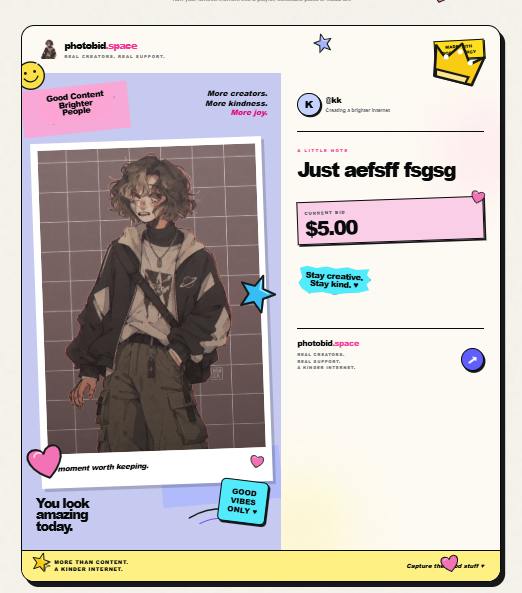
The product was built by creator Krish Khare and sits across three categories: Social Network, Social Media, and Photography. It currently ranks #20 on Product Hunt with 7 upvotes and 1 comment — by any measure, this is still extremely early days.
The Logic Behind "Bid to Surface"
PhotoBid's core differentiation lies in how it handles content distribution. Traditional photo platforms like Instagram rely on likes, comments, and recommendation algorithms to determine what gets seen. PhotoBid introduces a layer of "bidding" behavior — users don't just passively like content, they actively stake something on the photos they believe in, directly influencing their ranking and exposure.
The platform frames itself as a "billboard": anyone can put content up, compete for attention, and ultimately "win their place in the spotlight." This design shifts content distribution away from pure algorithmic control toward a gamified form of community consensus — who deserves to be seen is decided by participants taking action.
From a product philosophy standpoint, this mechanism is trying to solve a familiar problem on content platforms: quality content gets buried, and distribution feels opaque. By having the community explicitly "place bets," PhotoBid aims to make attention flows more visible and participatory.
The "community bidding decides exposure" concept isn't entirely new. Early Reddit used upvote/downvote mechanics to determine content ranking — fundamentally a community consensus-driven distribution system. Hacker News works similarly, with a time-decay function added to prevent older content from dominating indefinitely. More radical experiments came from the blockchain space — platforms like Steemit let users stake tokens to weight their votes, with larger token holders carrying more influence. That system ultimately drew heavy criticism for allowing wealth concentration to let a handful of "whales" control the rankings. PhotoBid's choice to center photography and use the "billboard" metaphor shares DNA with these predecessors, while facing the same fairness challenges that none have fully solved. Understanding this context helps in evaluating whether PhotoBid's mechanism truly charts new territory.
Opportunities and Risks
Turning content exposure into a competitive resource can genuinely boost user engagement — fighting for your favorite work's visibility feels more invested than a simple like. This gamified mechanic could drive strong early interaction and retention within a nascent community.
But the risks are equally clear. If "bidding" involves any form of value stake — whether virtual currency or real money — the system can easily devolve into whoever has more resources winning, rather than whoever has better content. That directly contradicts the stated goal of "letting great photos be seen." Beyond that, preventing vote manipulation, preventing ranking fraud, and building a competitive pool dense enough to be meaningful without a critical mass of users are all cold-start challenges that platforms like this can't sidestep.
Public information is limited at this stage — PhotoBid hasn't detailed the specific mechanics of bidding or its economic model. Those details will be decisive in determining whether this becomes a healthy attention marketplace or a ranking game easily captured by capital.
The "cold start problem" is especially lethal for bidding-based platforms. For the mechanism to function properly, it requires enough simultaneous active participants — with too few users, the competition pool is thin, rankings lack representativeness, and users feel neither the tension of competition nor the emergence of quality content. Retention collapses, creating a vicious cycle. Many early content platforms — including various token-incentivized decentralized social apps — have stumbled at exactly this stage. Common approaches to breaking through include: manually or semi-manually seeding ranking activity during the cold-start period, focusing on a single tight vertical community rather than a broad general audience, and designing low-friction "zero-cost" participation to reduce the barrier to entry. PhotoBid's current standing of just 7 votes on Product Hunt signals it's squarely in the window where it needs to answer this question.
An Early Experiment Worth Watching
PhotoBid represents an interesting product experiment within the photo-social space: using market-like, game-theoretic mechanics to redistribute attention. The idea has genuine novelty, but it comes bundled with the inherent challenges of that kind of mechanism design.
For practitioners and early adopters who follow social product innovation, it's worth adding to your watch list — not because it has proven anything yet, but because the question it's asking is real: in an age of information overload, how do we actually decide what deserves to be seen? PhotoBid's answer is "let the community bid on it." Whether that answer holds up will take time and far more users to find out.
Related articles

iPhone Duo Battery Life Tested: One Charge a Day Is Unavoidable, and the Large Screen Is the Culprit
iPhone Duo battery test: heavy use needs at least one charge a day, and about 30% remains after 6.5 hours of screen-on time. How often the large screen is unfolded is key; a MagSafe battery pack helps, and long-term degradation is also worth watching.

Kimi K3.1 Pro Open-Sourced: 2.8 Trillion Parameters Close In on Opus
Moonshot releases the open-source MoE model Kimi K3.1 Pro, with 2.8T total parameters and 104B activated, trailing Opus 5.5 by under 1 point on Terminal Bench 4.0.

Costco Tech Price Guessing: Are Monitors, Keyboards, Mice, and Bose Speakers Worth It?
A YouTube blogger guesses prices of Costco tech products: 2K 180Hz monitor, Logitech keyboard and mouse, Bose speaker, and CyberPower UPS, revealing warehouse-store selection and brand premium.