Pi Agent from Beginner to Practitioner: Build Your Own AI Office Agent

A four-day Pi Agent bootcamp on Bilibili covering Agent practice, frameworks, and careers.
The article introduces a four-day Pi Agent bootcamp tutorial on Bilibili. Pi Agent's GitHub stars rose from a few thousand to nearly 70,000 in 2026, reflecting fierce competition among open-source Agent frameworks. The bootcamp covers getting an Agent running, Deep Agent and Launch Pin, LLM career directions, and resume optimization. Completion benefits include project guides, interview notes, and Python courses.
In an era where AI office agents are rapidly becoming mainstream, how to build your own Agent workflow from scratch has become a concern for many developers. Recently, a series of tutorials centered on Pi Agent appeared on Bilibili, attempting to answer this question. Judging from the GitHub star trend, Pi Agent saw explosive growth in 2026, which also confirms its popularity.
The Rise of Pi Agent: From Slow Accumulation to Accelerated Explosion
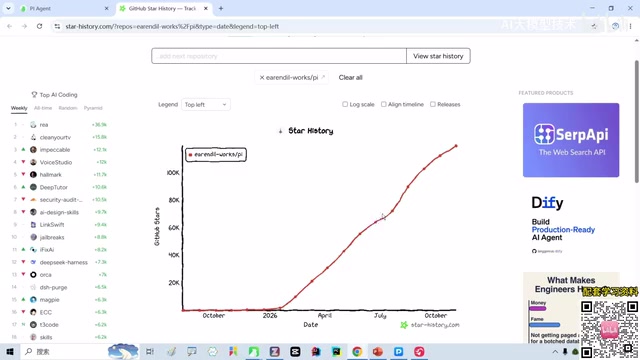
According to the GitHub Star History chart cited in the tutorial, Pi Agent's star growth can be roughly divided into several stages: slow growth during the early accumulation period, then an initial ramp-up phase where stars rose from a few thousand to about 20,000; followed by a sustained rise to nearly 70,000 stars, and it is currently still accelerating further.
The presenter mentioned that if you haven't heard of Pi Agent by now, it may mean you've fallen behind in keeping up with new AI technologies. He cited his recently recorded courses on Agent Scope, Codex, Guarder, and others as examples, explaining that the channels for obtaining the latest technical information are either continuously following the news or getting it through institutions.
This growth curve also shows that competition among open-source Agent frameworks has reached a fever pitch, and Pi Agent has attracted a large number of developers with its workflow design.
GitHub stars are a lightweight way for developers to express approval of open-source projects, and the growth curve is often used to observe a project's community popularity and adoption trends. Star History is a third-party visualization tool that scrapes historical data from the GitHub API and plots a project's star count over time as a line chart, making it easy to compare the growth pace of different projects. Note that star count does not equal production usage or code quality; it reflects attention and传播 effect more than anything. Explosive growth is sometimes driven by external factors such as course promotion and social media传播. Therefore, when interpreting star curves, one should combine them with indicators such as commit activity, Issue discussions, and documentation completeness for a comprehensive judgment.
Four-Day Bootcamp: From Running an Agent to Career Q&A
This tutorial is organized as a four-day bootcamp, covering multiple levels from technical practice to career planning.
Day 1: Get Your Own Agent Running
According to the video introduction, the goal of the first day is to help students get their own Agent running. This is the starting point of the entire learning path, emphasizing hands-on practice rather than pure theoretical explanation.
Day 2: Deep Dive into Deep Agent and the Launch Pin System
The second day's course is taught by Teacher Wu, focusing on Deep Agent as the foundation and explaining related content in the Launch Pin system. For students who have already gotten the basic process running, this day begins a more systematic framework study.
Deep Agent usually refers to an agent architecture with multi-step reasoning, task decomposition, and tool-calling capabilities. Compared with single-turn Q&A agents, it emphasizes a closed loop of planning, memory, and execution, and can handle complex office tasks spanning multiple systems or data sources. Launch Pin (also referred to in the text as Launch in Long Graph) is a workflow orchestration system built around such agents, involving mechanisms such as organizing task nodes into a directed graph, managing context passing, and state persistence. Understanding graph-structured orchestration helps developers string scattered tool calls into reusable, debuggable processes, which is also a direction that current open-source Agent frameworks are racing to invest in.
Day 3: LLM Positions and Career Directions
The third day turns to career directions. The presenter mentioned that many students are concerned about what LLM-related positions actually exist and whether studying is a waste of time. Especially for fresh graduates, or developers currently doing Java or frontend who plan to switch roles, it is often unclear what to learn first and what to learn next. The course will sort out topics such as fine-tuning and algorithms that interviewers may assess, helping students find the right direction and avoid detours.
LLM-related positions can be roughly divided into several categories: algorithm/research roles focus on model training, fine-tuning, and evaluation; application/engineering roles focus on building deployed systems such as RAG and Agents based on APIs or open-source models; data and annotation roles are responsible for corpus construction and quality control; and product and operations roles connect technology with business scenarios. Fine-tuning refers to continuing training a pretrained model with domain data to adapt it to specific tasks; algorithm interviews often assess fundamentals such as Transformer architecture, attention mechanisms, loss functions, and distributed training. For developers switching roles, it is usually recommended to first fill gaps in Python and deep learning fundamentals, then choose an application deployment direction based on their own engineering background, rather than blindly chasing research positions.
Day 4: Resumes, Projects, and Personalized Q&A
The fourth day addresses more practical issues, such as resume optimization, insufficient project experience, and interview transitions. The presenter mentioned that some students reported that their resumes "went into the void and never got a reply," and others lacked real enterprise project packaging. The course will provide actionable solutions for different groups (including older learners and those with zero foundation).
Completion Benefits and Learning Incentives
The bootcamp has a check-in mechanism, requiring students to attend class every day and screenshot their check-in in the group, recording the learning process as a form of work trace. Students who listen to all four days of courses and complete the check-ins can obtain eight benefits, including:
- Project summaries and project guides to help students write practical projects into their resumes;
- Launch in Long Graph-related interview crash notes from the LLM interview class;
- An interview bible covering high concurrency, LLMs, big data, and more, said to be compiled by the teachers;
- A rapid course and Python introductory course for zero-foundation students.
The presenter specifically pointed out that for zero-foundation students, Python is the prerequisite language for building LLM applications, while both Java and Python may need to be mastered for long-term development.
Notes and Learning Advice
The entire course is accompanied by notes, transcribed verbatim by Teacher Shen. The presenter suggests that students find the assistant in the comments section to get the notes, first building a preliminary impression through the notes, and then attending class with questions, which will be more effective.
A Rational View: Choices Behind the Hype
Pi Agent's star growth does reflect the popularity of open-source Agent frameworks, but whether a tutorial can truly help students "build their own AI office agent" still depends on personal practical investment. The four-day bootcamp covers a complete chain from running the process and learning the framework to career Q&A, and is a reference entry point for developers who want to quickly understand the Pi Agent workflow. However, the career directions, resume packaging, and other content mentioned in the course are more auxiliary in nature; real capability accumulation still requires continuous hands-on practice.
For readers interested in going deeper into Agent development, it is recommended that, in addition to following the course, they directly read Pi Agent's official documentation and source code, and try to implement it in actual office scenarios, so that the workflow in the tutorial can truly be internalized as their own skills.
One-line Summary
A four-day Pi Agent bootcamp tutorial on Bilibili covering Agent practice, framework learning, and career Q&A.
Paragraph Summary
The article introduces a four-day bootcamp tutorial on Bilibili centered on Pi Agent. In 2026, Pi Agent's GitHub stars rose from a few thousand to nearly 70,000 and continue to accelerate, reflecting fierce competition among open-source Agent frameworks. On the first day, the bootcamp helps students get their own Agent running; on the second day, Teacher Wu explains Deep Agent and the Launch Pin system; on the third day, it sorts out LLM positions and career directions; and on the fourth day, it provides solutions for practical issues such as resume optimization and insufficient project experience. The course has a check-in mechanism, and completing it grants eight benefits including project guides, interview crash notes, an interview bible, and a zero-foundation Python course. The author suggests that students first get the notes to build a preliminary impression before attending class, and points out that the tutorial is only an entry point; true mastery still requires reading official documentation and source code and implementing practice in real scenarios.
Related articles

Nothing CMF Buds 2A Drops to $17.89 on Black Friday: A New Low for ANC Earbuds
Nothing CMF Buds 2A wireless earbuds Black Friday deal: just $17.89 on Amazon, about $11 off retail and a record low. ANC earbuds at an entry-level price.

When AI Creation Gets Accused of "Spitting": Hacker News Heats Up Over the Glaude Controversy
A Hacker News post, "Spitting in the Face of Glaude," sparks debate on AI creation transparency and attribution ethics. This analysis examines the blurred creator identity behind the controversy and offers practical advice for AI content production.

Akai Embraces Custom Firmware: MPC Sample 1.4 Lets Users AI-Program Their Sampler
Akai embraces the modding community with MPC Sample 1.4 firmware, supporting vibe-coded custom firmware and effects. We analyze the impact of this open strategy on music hardware and AI-assisted programming.