Pipit: Open-Source Offline AI Universal Search for Android with Sub-50ms Response

Pipit is an open-source offline AI search engine for Android with OCR and natural language photo search.
Pipit is a fully open-source, 100% on-device AI search engine for Android, addressing the conflict between native search that only recognizes file names and cloud search that requires uploading private data. It uses Google ML Kit for deep OCR search of PDFs, receipts, and screenshots, and quantized LiteRT multimodal models for natural language photo album search. A unified search bar covers seven domains with all processing done locally, fully offline, and claimed sub-50ms latency. Source code and APK are on GitHub, though challenges remain around quantization accuracy loss, unclear indexing overhead, and unspecified latency test conditions.
When Phone Search Is Still Stuck in the File Name Era
Our smartphones hoard almost every aspect of our digital lives: thousands of photos, scanned receipts, work PDFs, voice memos, even the door access codes tucked away in some corner. Yet the native search experience is often frustrating—it only recognizes semantically meaningless file names like IMG_20240914.jpg or Scan_Doc_09.pdf. Cloud photo search, on the other hand, is smart but requires you to upload private files to remote servers.
Developer sanjay434343 posted a project called Pipit 🐦 on DEV Community, aiming to break this dilemma: a fully open-source, 100% on-device AI universal search engine for Android.
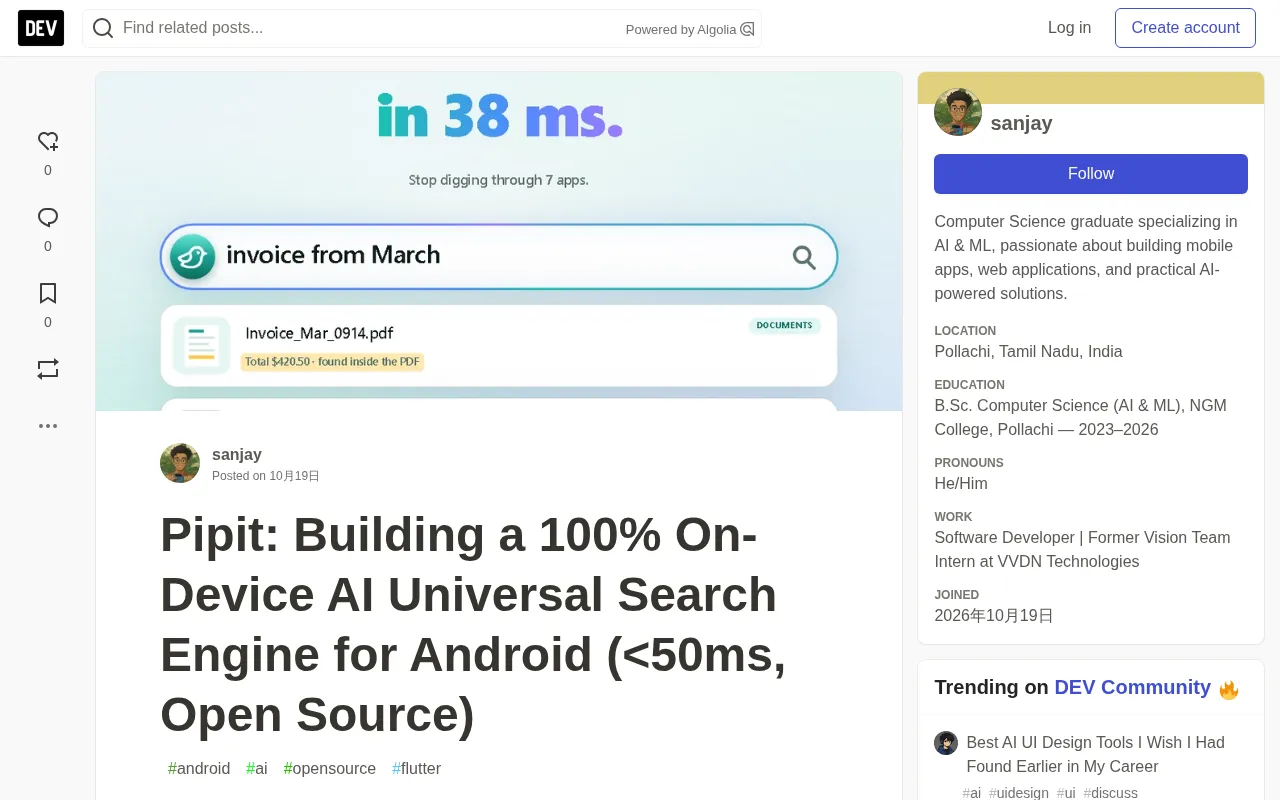
Core Capabilities: Putting Semantic Search Inside Your Phone
What makes Pipit most appealing is that it compresses search tasks that would normally require cloud compute down onto local chips. According to the project description, it offers the following key features:
Deep Content OCR: Searching Inside Files
Using on-device Google ML Kit, Pipit can perform OCR text recognition on PDFs, receipts, and screenshots, searching the actual text inside files rather than just file names. This means you can directly search for "last month's rent" instead of trying to remember what that PDF was called.
OCR (Optical Character Recognition) is a technology that converts text in images into editable, searchable text. Traditional OCR mainly relies on convolutional neural networks and sequence recognition models, working well on clear printed text but prone to errors on handwriting and low-quality scans. Google ML Kit is a mobile machine learning SDK provided by Google; its text recognition module supports on-device offline operation without uploading images to the cloud, making it suitable for privacy-sensitive scenarios. In Pipit, OCR is not only used to extract text but also to build a searchable text index, enabling users to search the contents of PDFs, receipts, and screenshots using natural language rather than being limited by file names.
Semantic Visual Search: Finding Photos with Natural Language
Pipit supports searching your photo album with plain descriptions—for example, typing "yellow vintage car" or "handwritten grocery list." This relies on multimodal models understanding image content rather than traditional tag or metadata matching.
Multimodal models refer to neural networks capable of processing and understanding multiple data types such as text and images simultaneously. In visual search scenarios, these models typically use contrastive learning (e.g., CLIP architecture) to map images and text into the same semantic vector space, so that text descriptions like "yellow vintage car" can be directly matched against image content by similarity. Unlike traditional album search that relies on manual tags or EXIF metadata, multimodal models can understand objects, scenes, and even handwritten text in images, enabling more natural retrieval. Pipit deploys quantized multimodal models on the phone, meaning inference is fully localized, though model accuracy and speed are jointly affected by the degree of quantization and chip compute power.
Unified Search Bar: Seven Domains in One Place
Photos, PDFs, messages, contacts, videos, audio, apps—seven domains are integrated into a single search entry point. Users no longer need to open different apps to search separately, reducing the friction of cross-app retrieval.
100% Offline and Air-Gapped Operation
Pipit emphasizes "Zero cloud, zero tracking." All processing is done on the phone's chip via quantized Google LiteRT multimodal models, and the app can even run fully air-gapped. For privacy-sensitive users, this is the biggest selling point.
Quantization is a common model compression technique that reduces the numerical precision of neural network weights and activations (e.g., from 32-bit floating point to 8-bit integers) to shrink model size, lower memory usage, and accelerate inference. For running multimodal models on phones, quantization is almost essential because original models are often hundreds of MB or even several GB. Google LiteRT (formerly TensorFlow Lite) provides toolchains such as post-training quantization and quantization-aware training, supporting efficient execution on CPU, GPU, and NPU. However, quantization introduces some accuracy loss; the higher the compression rate, the lower the model's recall on fine-grained recognition tasks, which is one of the core trade-offs for on-device AI search.
Sub-50ms Latency
Through local Vulkan GPU/NPU delegate acceleration, Pipit claims search latency is kept under 50 milliseconds. If this figure can be consistently reproduced on mid-range devices, it would significantly outperform cloud solutions that require network round trips.
Vulkan is a cross-platform, low-overhead graphics and compute API widely used on Android for general-purpose GPU computing. Through Vulkan delegates, machine learning inference frameworks can offload some operators to the GPU, leveraging its massive parallelism to accelerate model computation. NPU (Neural Processing Unit) is a hardware unit in phone SoCs specifically designed for neural network inference, typically offering better energy efficiency than CPU and GPU. Pipit claims to achieve sub-50ms search latency using Vulkan GPU/NPU delegates, but actual performance depends heavily on whether the device supports the corresponding delegate backend, whether all model operators are covered, and the size of the index. Different chip vendors vary widely in their support for LiteRT delegates, which is also a major challenge for cross-device compatibility.
Open-Source Strategy and Accessibility
Pipit's source code and release APK are both hosted on GitHub (github.com/sanjay434343/Pipit). Open source means security auditing, community contributions, and secondary development become possible, and it lowers the trust barrier for users wary of "black-box AI."
From a technical standpoint, the project relies heavily on Google's ML Kit and LiteRT (formerly TensorFlow Lite) ecosystem, which provides some assurance for cross-device compatibility but also means model size and hardware acceleration capabilities are limited by the scope of Google's toolchain support.
Challenges Worth Noting
Despite its appeal, Pipit still faces several practical issues. First, the quality of semantic visual search depends heavily on the accuracy of quantized models; on lower-end devices with higher compression rates, recall may suffer. Second, building indexes for seven domains takes time, and the duration and battery cost of the initial full scan have not been disclosed in the original article. Third, the test conditions for the 50ms latency claim (device model, photo library size) are unclear, so real-world experience may vary.
These are precisely why the developer is publicly seeking feedback, criticism, and ideas—for an early-stage open-source project, community validation is more valuable than marketing numbers.
Summary
Pipit represents a clear technical trend: AI search is moving from the cloud down to the edge. As privacy, latency, and offline availability become essential requirements, attempts like Pipit—stuffing multimodal models into phones and delivering them as open source—are worth the attention of Android users and developers alike.
One-line Summary
Pipit is an open-source offline AI search engine for Android with OCR and natural language image search.
Paragraph Summary
Pipit is a fully open-source, 100% on-device AI search engine for Android, designed to resolve the conflict between native search that only recognizes file names and cloud search that requires uploading private data. It uses Google ML Kit for deep OCR search of PDFs, receipts, and screenshots, and leverages quantized LiteRT multimodal models to support natural language photo album search. A unified search bar covers seven domains—photos, PDFs, messages, contacts, videos, audio, and apps—with all processing done on local chips, fully offline operation, and claimed sub-50ms latency. Source code and APK are available on GitHub, but the project still faces challenges such as quantization accuracy loss, unclear initial indexing costs, and unspecified latency test conditions. The developer is openly soliciting community feedback.
Related articles
world2vec: Building Mechanistic World Models with Latent Dynamics Learning
world2vec proposes a reward-free method for learning mechanistic world models via latent dynamics, faithfully reproducing systems over long horizons with at least an order of magnitude fewer parameters than DreamerV3, TD-MPC2, and LeWM, and achieving accurate system identification on 71 attractor benchmarks.

A New KL-DRO Paradigm: Adaptive Scenario Generation Around a Learned Density Model
KL-DRO research proposes centering the KL ball on a learned density model instead of the empirical distribution, with adaptive scenario generation guiding sampling toward the worst case. Experiments show lower cost under distribution shift when records are scarce and the model can extrapolate, with comparable in-distribution cost.

ODE Samplers for Discrete Diffusion Models: Exponential Residual Flows Accelerate Generation
Discrete diffusion models lack deterministic ODE sampling? This article introduces Exponential Residual Flows (ERFs), which introduce continuous residual variables per token to construct piecewise ODEs for deterministic sampling and support consistency distillation acceleration. Superior to prior methods on code and text generation tasks.