Pixel Office: An AI Agent Team in a Pixel Office — A New Open-Source Management Experience
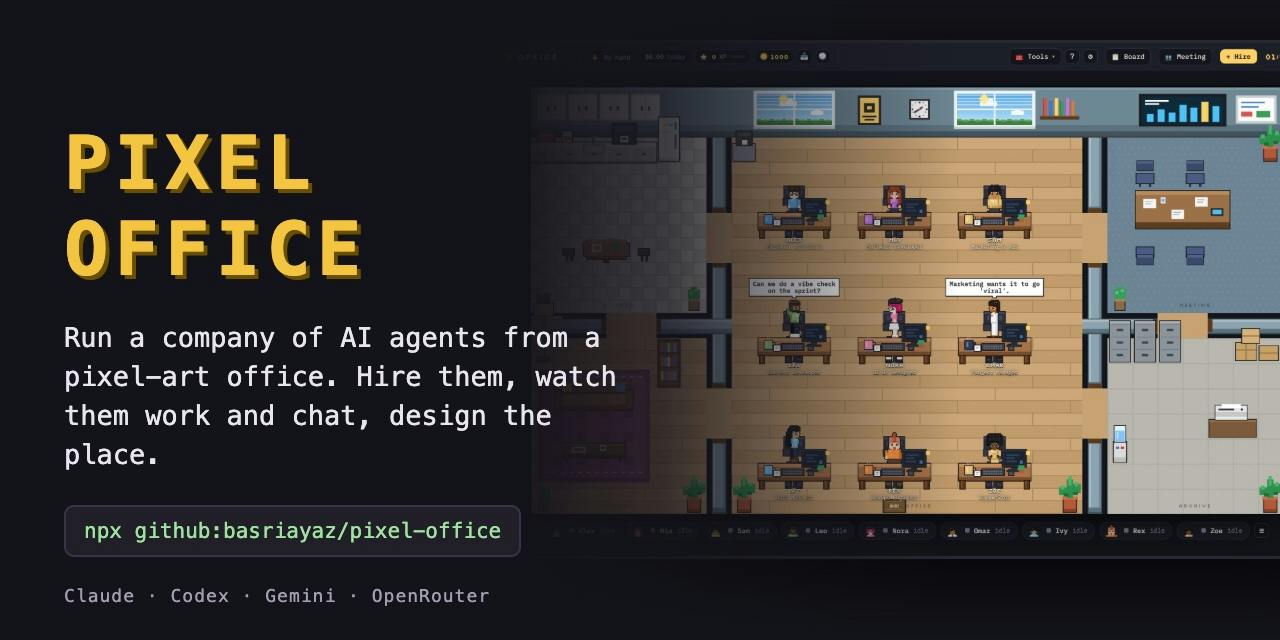
Pixel Office turns AI agents into pixel office employees with open-source local operation and visual collaborative management.
Pixel Office is an open-source AI agent management tool that transforms chat-box-style agent interaction into a pixel-style office space: each employee is a real agent (supporting Claude, Codex, Gemini, OpenRouter) with independent roles, memory, skills, and permission levels, making work, approval, and completion status clear at a glance. It offers a role creator for hiring, a task board for assigning work, agent-to-agent messaging for collaboration, and coins from completed tasks to decorate the office. It runs locally with one command using your own API keys. It received 70 upvotes on Product Hunt at launch, but community feedback is scarce and stability remains unverified.
Most agent tools are just a chat box, but Pixel Office builds a "place": every employee is a real AI agent (supporting Claude, Codex, Gemini, or OpenRouter), each with its own role, memory, skills, and permission level. At a glance you can see who is working, who needs approval, and who has completed their tasks. Hire employees through the role creator, assign work on the task board, let agents message each other, and decorate the office with coins earned from completed work. It's open source, runs with a single command, and works entirely on your local machine using your own keys.
From Chat Box to Pixel Office: A Visual Revolution in Agent Management
Managing AI agents with a "chat box" is like managing an entire company with a terminal window — low information density and opaque status. The core idea of Pixel Office is to make the agent team concrete as a pixel-style office space. Each agent becomes a character in the office with its own identity profile, including role definition, memory, skills, and permission level. This spatial design makes team status clear at a glance: who is processing a task, who is stuck in the approval step, and who has delivered results — no more digging through logs or constantly switching between conversation windows.
More importantly, agents can message each other. This means Pixel Office is not just a tool for "humans managing agents" but also supports an "agents managing agents" collaboration model — one agent can delegate subtasks to another, forming workflows. For complex projects that require multi-role collaboration, this native collaboration mechanism is far more efficient than manually chaining multiple chat sessions together.
Agent-to-agent messaging refers to multiple AI agents directly passing tasks, results, and requests to each other as structured messages without human intermediation. Its essential difference from "a person copying and pasting between multiple chat windows" is that messages carry explicit senders, receivers, and task context, and can be orchestrated into delegate—execute—report chains. In implementation, this usually relies on a shared message bus or state store, and it must prevent infinite delegation loops, message storms, and permission overreach. This is also the core dividing line between multi-agent systems and single-agent assistants — the former tests coordination protocols rather than the capability of a single model.
Role Creation and Task Board: A Lightweight but Complete Management Loop
Pixel Office provides a complete management toolchain. Hiring is done through the "role creator" — you can set each agent's name, role, skills, and permission boundaries. The permission-level design is especially noteworthy: different agents are granted different scopes of operation, reducing the risk of agents overstepping their authority and giving the approval process clear trigger conditions. Task assignment happens through a task board, similar to kanban tools. Each task can be assigned to a specific agent, and when the agent completes it, they earn "coins," which can then be used to decorate the office — a gamified positive loop that ties team growth to visual feedback.
This design expands "agent management" from simply issuing instructions into a complete loop that includes role definition, permission control, task tracking, and incentive feedback. According to the Product Hunt product page, the tool received 70 upvotes at launch and ranked 14th for the day, categorized under open source, developer tools, artificial intelligence, and GitHub.
Agent permission levels draw on the access-control ideas of traditional systems: defining for each agent the tools it can call, the data range it can read and write, and the upper limit of operations it can perform autonomously; actions beyond the boundary must be handed over for human approval. This is especially critical in multi-agent collaboration, because agents delegate tasks to each other, and a single permission overreach can be amplified along the delegation chain. A common tiering approach is four levels — "read-only — can suggest — can execute with confirmation — can execute autonomously" — combined with an approval queue to form a human-in-the-loop. The finer the permission design, the higher the degree of automation but also the greater the configuration cost; in practice, settings are often made by role rather than agent by agent.
Local Operation and Open Source: Data Sovereignty and Cost Control
Pixel Office adopts an open-source model, runs on a local machine with a single command, and uses the user's own API keys to call models such as Claude, Codex, Gemini, or OpenRouter. This choice brings two direct benefits: first, all conversations and data stay local and do not pass through third-party servers, making it friendlier for privacy-sensitive scenarios; second, users settle directly with model providers, avoiding intermediary markups and making the cost structure more transparent.
For developers, open source means they can review the code themselves, customize role behavior, or integrate internal tools. The one-command startup threshold is also low enough for quickly experimenting with multi-agent workflows. However, it is worth noting that local operation means you need to manage key security and environment dependencies yourself, which may pose a certain barrier for non-technical users.
OpenRouter is a unified interface platform that aggregates APIs from multiple large model providers. Developers only need one set of keys and an OpenAI-compatible calling format to switch between or fall back among hundreds of models such as Claude, GPT, Gemini, and Llama. For multi-agent tools, its value lies in model substitutability: the same agent role can try different models at low cost and compare their performance differences in role-playing, tool calling, and long context, without having to integrate a separate SDK for each vendor. The tradeoff is that requests pass through OpenRouter as an intermediary, which conflicts with the localization positioning in this article that "data does not pass through third parties"; privacy-sensitive scenarios need to evaluate whether to connect directly to official APIs.
Practical Scenarios and Limitations of Multi-Agent Collaboration
Pixel Office's form suits several scenarios: development projects that need to process multiple subtasks in parallel, content production pipelines that require role division, and experimental research that hopes to observe agent collaboration behavior. The agent-to-agent messaging mechanism allows tasks to flow autonomously, reducing manual intermediation.
Limitations also exist. Currently, the product has only 1 review on Product Hunt, with very few community feedback samples, so long-term stability and the actual efficiency of multi-agent collaboration still need more user validation. In addition, although the pixel-style decoration system is fun, it may seem redundant to users pursuing pure efficiency. Although the model support list covers mainstream options, the performance differences of different models in role-playing and tool calling require users to tune themselves.
Overall, Pixel Office repackages AI agent management in a spatial and gamified way, turning "invisible agents" into a "visible team." Its open-source and local-operation positioning make it attractive in development scenarios sensitive to privacy and cost. For developers who want to try multi-agent collaboration, this is an experimental tool worth watching.
One-line Summary
Pixel Office turns AI agents into pixel office employees, with open-source local operation and visual collaborative management.
Paragraph Summary
Pixel Office is an open-source AI agent management tool that transforms traditional chat-box-style agent interaction into a pixel-style office space: every employee is a real agent (supporting Claude, Codex, Gemini, OpenRouter), with independent roles, memory, skills, and permission levels, making work, approval, and completion status clear at a glance. It provides a role creator to hire employees, a task board to assign work, agent-to-agent messaging to form collaboration flows, and coins earned from completed tasks to decorate the office, forming a management loop from hiring to delivery. The tool runs locally with a single command and uses your own API keys, balancing data privacy and cost transparency. At launch it received 70 upvotes on Product Hunt and ranked 14th for the day, but there is very little community feedback, and stability and collaboration efficiency remain to be verified.
Related articles

Gemini 4 Neon Leak: A Potential Strong Contender Against Opus 5.5
A Hacker News thread suggests Gemini 4 Neon looks like an Opus 5.5 competitor. This article unpacks the product positioning behind this community signal, shifts in the top-model competitive landscape, and what it means for developers' model selection strategy.

Claude Fable 5.2's Self-Authored Short Film 'Fable' Sparks Discussion
A short film 'Fable,' credited to Claude Fable 5.2 for script, visuals, and directing, appears on Hacker News. This article analyzes the significance of full-pipeline AI creation, community reactions, and what it means for content creators.

Anthropic IPO Pricing: A Signal of AI Giants Going Public
Anthropic's IPO pricing draws attention. This article analyzes its potential impact on AI industry valuation, commercialization paths, and the competitive landscape, and highlights public-market expectations and challenges for AI companies.