Pixelle-Video Open Source Tutorial: Deep Dive into the AI Fully Automated Short Video Engine with 14K Stars
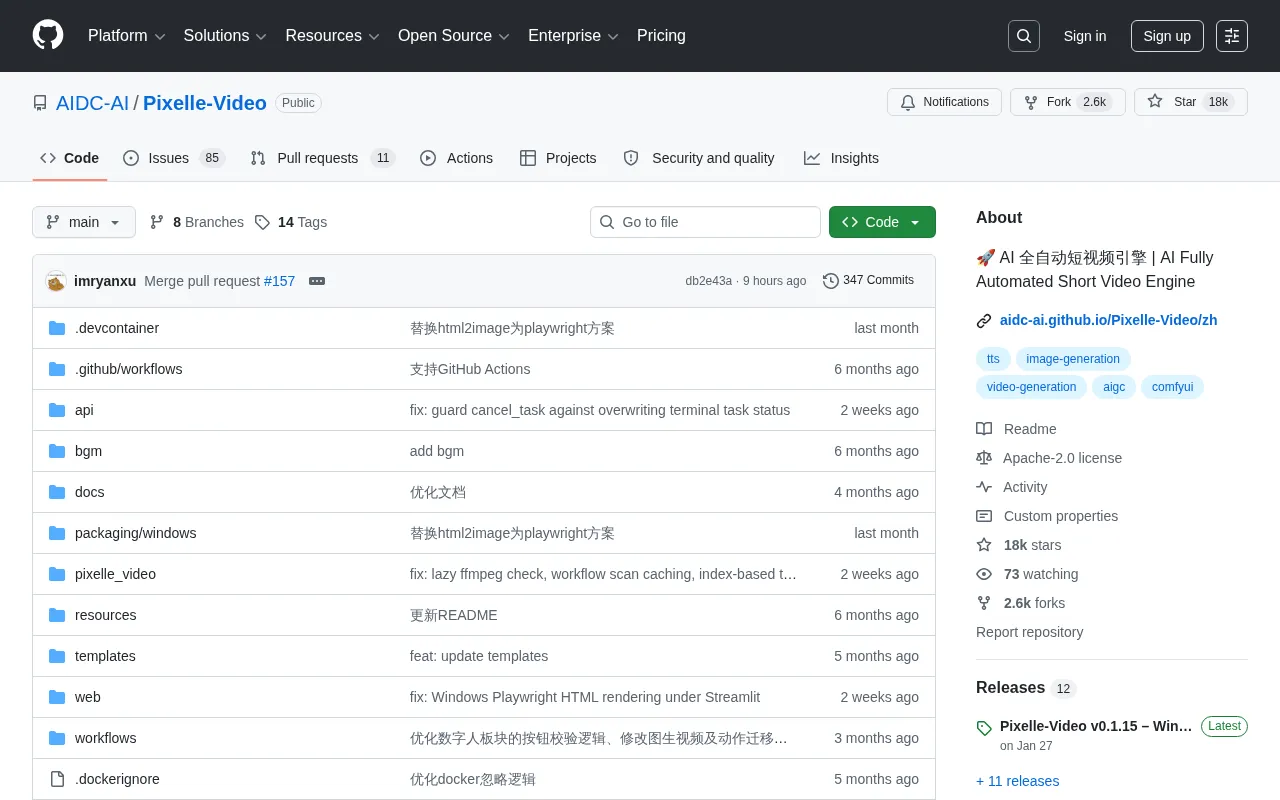
Pixelle-Video is an open-source AI engine that automates the entire short video production pipeline end-to-end.
Pixelle-Video is an open-source AI fully automated short video engine developed by the AIDC-AI team, with 14,000+ Stars on GitHub. It connects every stage — script generation, visual composition, voiceover, music, and subtitles — through AI technologies including LLMs, Diffusion Models, and TTS, allowing users to input just a topic and automatically receive a finished video. Built on Python, it's suitable for content creation, e-commerce marketing, and online education, representing the industry shift from point tools to full-pipeline AI video automation.
Pixelle-Video Project Overview
In an era flooded with AI video generation tools, an open-source project called Pixelle-Video is rapidly gaining traction on GitHub. Built by the AIDC-AI team, this "AI fully automated short video engine" has garnered over 14,000 Stars and 2,000+ Forks shortly after launch — a clear testament to how desperately the developer community wants automated AI video production tools.
Pixelle-Video's positioning is straightforward — hand over the entire process from creative ideation to finished video to AI, freeing short video production from dependence on professional editing skills and extensive manual work.
Why Pixelle-Video Deserves Your Attention
A Fully Automated Short Video Production Pipeline
Anyone who's made short videos knows how tedious the traditional workflow is: writing scripts, sourcing assets, editing clips together, recording voiceovers, adding subtitles and background music... every step demands time and energy. Pixelle-Video's approach is to use AI to connect all these steps, building a fully automated production line from input to output.
The "fully automated" capability here is technically known as End-to-End automation — meaning users only need to provide the initial input (such as a topic), and the system automatically completes all intermediate steps to directly output the final product, with no manual handoff needed between stages. In Pixelle-Video's pipeline, each stage is powered by corresponding AI technologies: script generation relies on Large Language Model (LLM) text creation capabilities; visual composition may involve Diffusion Models or image retrieval and synthesis techniques; the voiceover stage leverages TTS (Text-to-Speech) technology to convert text scripts into natural, fluent voice narration; subtitle generation and timeline alignment require the coordination of ASR (Automatic Speech Recognition) and text processing. These AI capabilities, originally scattered across different tools, are integrated by Pixelle-Video into a unified pipeline.
In practice, you may only need to provide a topic or a brief text description, and the system will automatically handle everything from script generation, visual composition, voiceover and music, all the way to final video output. The appeal of this end-to-end automation for content creators, marketing teams, and small businesses is obvious to everyone.
Python-Based Technical Architecture
The project uses Python as its primary development language — the most mainstream choice in the AI field. Python dominates AI not just because of its clean syntax and gentle learning curve, but more critically because it has the most comprehensive AI toolchain in the entire tech ecosystem. PyTorch is the most popular deep learning framework in both academia and industry, providing flexible tensor computation and automatic differentiation capabilities, serving as the core infrastructure for training and deploying neural network models; Transformers (maintained by Hugging Face) is a pre-trained model library integrating tens of thousands of open-source large language models, vision models, and multimodal models, allowing developers to call cutting-edge models like GPT, LLaMA, and Stable Diffusion with just a few lines of code.
Beyond AI model-layer tools, video production involves extensive multimedia processing. Pixelle-Video likely relies on FFmpeg at its core — the industry-standard audio/video processing tool capable of handling video encoding/decoding, format conversion, audio-video merging, subtitle burning, and virtually all other multimedia operations. Python can conveniently leverage FFmpeg's capabilities through wrapper libraries like moviepy and ffmpeg-python. This combination of "AI models + multimedia processing toolchain" constitutes the typical technical architecture for AI video generation projects.
If you have some Python background, understanding the project architecture, doing custom development, or even integrating it into your own business systems won't be too difficult.
What the Community Buzz Tells Us
Behind those 14,000+ Stars and 2,000+ Forks, several signals are worth noting:
- Real market demand exists: AI short video automation isn't a false need — it's a genuine use case widely recognized by developers and creators
- Project quality stands up to scrutiny: So many people willing to Star and Fork indicates that Pixelle-Video holds its ground in both technical strength and practical value
- A secondary development ecosystem is forming: High Fork counts mean many developers are already exploring and extending this project
Pixelle-Video Application Scenarios
Content Creator Video Production
For content creators who need to produce short videos at high frequency, Pixelle-Video can dramatically compress production costs. Whether it's educational explainers, trending news, or product review videos, the AI automation engine can multiply output efficiency.
Enterprise Marketing and E-commerce Promotion
Short video is already the core content format for e-commerce and digital marketing. According to industry data, short video ads typically achieve user engagement rates several times higher than image-text ads, and on platforms like Douyin, Kuaishou, and TikTok, daily consumption of product short videos reaches billions of views. However, the core pain point for enterprises lies in batch production — an e-commerce store with hundreds of SKUs would need massive investments of manpower and time to create differentiated short video assets for each product using traditional methods.
This is precisely the problem that Programmatic Video technology aims to solve: through templates and AI automation, automatically converting product data (images, specifications, selling point copy) into deployable video assets. The emergence of fully automated engines like Pixelle-Video further lowers the barrier — enterprises no longer need dedicated video production teams, and production cycles can shrink from hours to minutes. Of course, batch generation also brings challenges around content homogeneity and platform moderation. Finding the balance between efficiency and content quality remains a problem to solve in real-world implementation.
Online Education and Corporate Training
Educational institutions and corporate training departments can leverage tools like this to quickly transform text materials and training documents into video courses, lowering the barrier to producing quality educational content.
Traditional online course production (such as videos on MOOC platforms) typically involves course design, slide creation, screen recording or studio filming, post-production editing, and subtitle proofreading — a 10-hour course from planning to launch often takes weeks or even months. The maturation of Text-to-Video technology is reshaping this workflow — teachers only need to prepare text lectures or knowledge point outlines, and AI can automatically generate teaching videos complete with visuals, narration, and subtitles. While AI-generated educational videos still can't fully replace real instructor recordings in terms of expressiveness and interactivity, for standardized knowledge delivery scenarios (such as corporate compliance training, product operation guides, and foundational knowledge education), they can already significantly improve content production efficiency, compressing production cycles from weeks to hours.
AI Video Generation Industry Trends and Reflections
Pixelle-Video's popularity is no accident — it reflects several key shifts happening in the AI video generation space:
- From point solutions to full-pipeline platforms: The market is no longer satisfied with singular AI video generation capabilities (like Sora or Kling) — it demands comprehensive solutions covering the complete production workflow
- Open source fills market gaps: Commercial AI video tools often come with hefty price tags; open-source projects let more individual developers and small teams access cutting-edge technology
- Automation levels keep rising: Users don't just want AI assistance — they want truly "fully automated" systems that minimize human intervention
To understand Pixelle-Video's differentiated positioning, it helps to map the current technical landscape of AI video generation. Mainstream tools on the market today can be roughly divided into two categories:
The first category is "AI Video Generation Models", with representative products including OpenAI's Sora, Kuaishou's Kling, Google's Veo, and Runway Gen-3. The core capability of these tools is generating video footage directly from text prompts, with the underlying technology primarily based on Diffusion Models — a generative AI architecture that transforms random noise into target images or videos through a gradual denoising process. Diffusion models first achieved breakthroughs in image generation (e.g., Stable Diffusion, DALL-E), then were extended to video generation by modeling frame-to-frame coherence along the temporal dimension to produce dynamic footage. The advantage of these tools lies in high-quality visual generation, but they essentially only solve the "generating visuals" step and don't cover the complete video production workflow including scriptwriting, voiceover, subtitles, and editing.
The second category is the "Full-Pipeline Video Production Engine" that Pixelle-Video represents. It doesn't necessarily train its own video generation model but rather orchestrates and integrates multiple AI capabilities (text generation, image/video generation, speech synthesis, etc.) into a complete automated production line. This "orchestration-based" architecture is more aligned with actual video production needs.
In the competition between open source and closed source, commercial tools (like Sora, Runway) typically offer more polished user experiences and higher generation quality, but come with high price barriers and limited flexibility; open-source solutions (like Pixelle-Video, as well as previously active community projects like MoneyPrinterTurbo) win on customizability, zero cost, and transparency. As open-source large language models (like LLaMA, Qwen) and open-source image/video generation models (like Stable Diffusion, CogVideoX) continue to improve, the actual results of open-source full-pipeline video engines are rapidly approaching commercial solutions — this is an important backdrop for why Pixelle-Video has achieved such high community engagement.
Of course, fully automated video generation still faces significant challenges in visual quality control, creative expression depth, and copyright compliance. But as a rapidly iterating open-source project, Pixelle-Video's future development is worth following closely.
Summary: Who Should Use Pixelle-Video
Pixelle-Video represents an important evolutionary direction for AI short video production tools: full-pipeline automation. Its rapid rise validates real market demand for this type of tool.
- Developers: This is a high-quality open-source project worth deep research and contribution
- Content Creators: It could become your powerful assistant for boosting video output efficiency
- Enterprises and Marketing Teams: Costs and timelines for batch video production may be dramatically reduced
Project URL: github.com/AIDC-AI/Pixelle-Video
Related articles
 Tutorials
ChatGPT Plus Subscription Guide: Are GPT-5.5, image-2, and Codex Worth the Upgrade?
A detailed look at ChatGPT Plus features — GPT-5.5, image-2, and Codex — with a Plus vs Pro comparison and a complete step-by-step subscription guide for users outside the US.
 Tutorials
Harness AI Engineering in Practice: Using Claude Code to Master Enterprise-Level E-Commerce Development
Deep dive into Harness AI Engineering: master enterprise e-commerce development with Claude Code using the Rules, Skills, Wiki, and Changes framework.
 Tutorials
Cursor + Codex Dual-IDE Collaboration: A Practical Methodology for Open-Source Project Customization
A complete methodology for open-source project customization based on real-world experience, detailing the Cursor+Codex dual-IDE workflow, seven-stage process, MVP validation, and AI source code reading techniques.