Playground: A New Platform for Creating and Playing Custom Games with AI

Playground is an experimental UGC game platform letting everyday users create, play, and share their own games.
Playground is an experimental game platform built around a complete create–play–share loop, enabling non-professional users to participate in game creation. It uses a UGC model where creators and consumers overlap heavily, giving the platform self-sustaining growth potential. The "experimental" label signals incomplete features and an uncertain roadmap — early adopters can get in early but should be aware of platform risk. Success will ultimately depend on how intuitive and expressive the creation tools are, and whether a positive community ecosystem can take hold.
What Is Playground
Playground is a brand-new experimental game platform designed to let anyone create, play, and share custom games. Unlike traditional gaming platforms, Playground lowers the barrier to creation even further — aiming to merge "playing games" and "making games," two activities that have traditionally belonged to entirely different groups of people, into a single product.
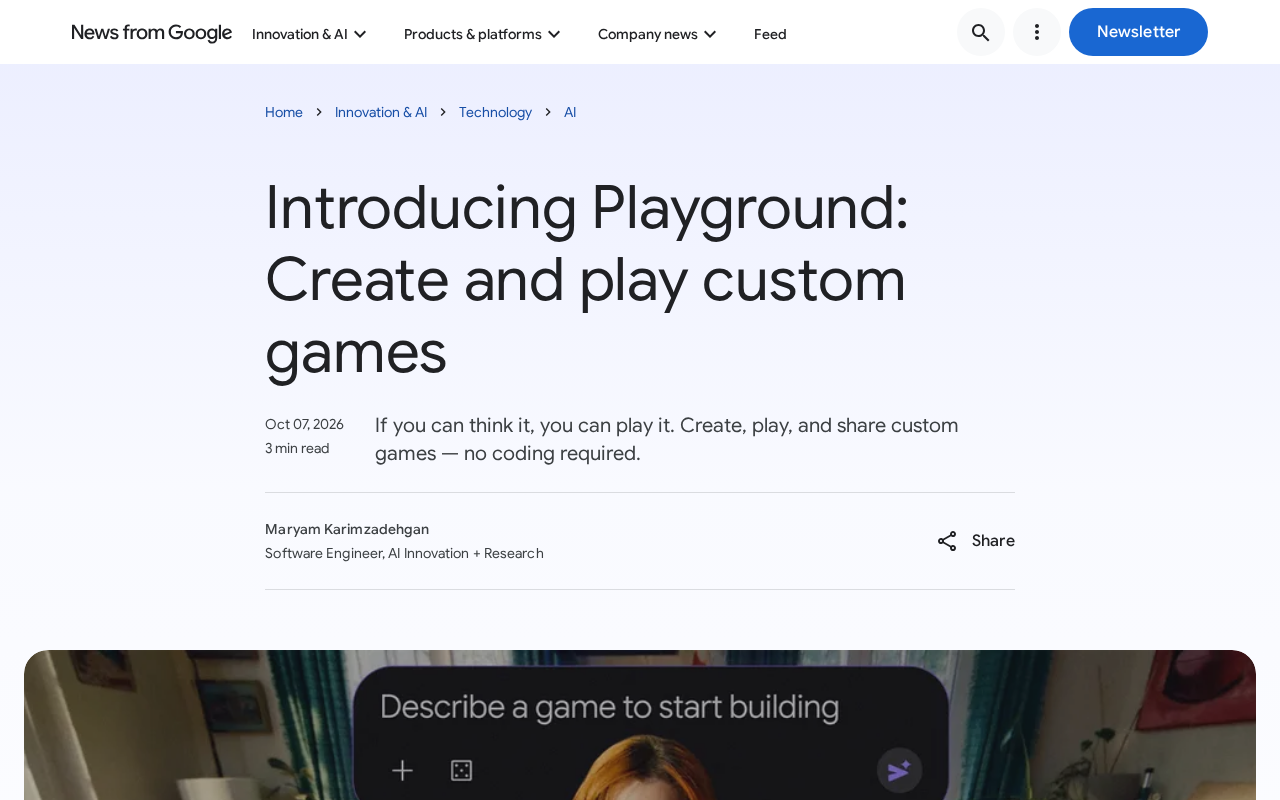
According to the official description, Playground is currently in an experimental stage, which means it reads more like an exploratory product direction than a fully polished commercial offering. The platform's three core verbs — create, play, share — essentially sketch out the complete loop it wants to build.
The Create–Play–Share Loop
Playground's design philosophy breaks the user experience down into a clear, linear journey. Users aren't just content consumers — they can also be content creators. This combination of UGC (User Generated Content) and instant playability gives the platform real self-sustaining growth potential: the more people create, the richer the playable content; and the richer the content, the more users it attracts — some of whom will then try their hand at creating something themselves.
This kind of "create to share, share to spread" model is hardly new in the current wave of AI tools. Whether it's generative images, text, or code, lowering the barrier to creation has consistently been the core strategy for driving platform engagement. Playground extends this logic into the gaming space, aiming to transform game development from the domain of professional studios into a lightweight experience that everyday users can participate in.
Successful UGC precedents include Roblox and Dreams (PS4/PS5). Roblox allows players to build games using Lua scripting and a built-in editor — the platform now hosts tens of millions of player-created games and has developed a complete virtual economy. Dreams, meanwhile, offers more professional-grade visual creation tools, but its steeper learning curve has kept its community relatively small. Both cases reveal a fundamental tension in UGC game platforms: the more powerful the creation tools, the steeper the learning curve tends to be — and once that curve gets too steep, the promise of "anyone can make a game" becomes hard to deliver on. For Playground to break through this bottleneck, it will likely need AI-assisted generation mechanisms to bridge the gap between creative capability and accessibility.
What the "Experimental" Label Actually Means
It's worth paying attention to the fact that the platform is officially labeled "experimental." This typically signals a few things: features may be incomplete, the direction of future updates is uncertain, and the platform could undergo major changes — or even shut down — based on user feedback at any time.
For early adopters, this is both an opportunity and a risk. The opportunity lies in experiencing a new approach to game creation before the crowd arrives, and in building influence within a community that hasn't yet reached saturation. The risk is that any creative work you invest could be affected by platform changes. It's best to treat Playground as an exploratory tool rather than a long-term creative infrastructure you depend on.
What This Means for the Game Creation Ecosystem
If Playground can genuinely lower the barrier to game creation low enough, it's addressing a market with enormous potential. Traditional game development spans multiple professional disciplines — art, programming, design — and a platform that lets non-professional users get started quickly has the opportunity to unlock a vast amount of long-tail creativity.
From an industry perspective, platforms like this tend to succeed or fail based on two factors: whether the creation tools are intuitive enough while still being expressive, and whether the community ecosystem can establish a positive feedback loop. Playground's publicly available information is still fairly limited, and the specific boundaries of its creation capabilities, sharing mechanisms, and community scale all remain to be seen.
The concept of "long-tail creativity" draws from Chris Anderson's long tail theory, introduced in 2004: the aggregate of niche, low-frequency demand in a market can potentially exceed the scale of a handful of popular hits. Applied to games, traditional distribution channels — due to their high cost barriers — can only support a small number of big-budget titles. But once the cost of creation approaches zero, niche experiences that commercial development would never greenlight — a text adventure rooted in a specific cultural context, or a rule variant that only circulates in a small community — suddenly have a chance to be made and find their audience. This is the underlying logic behind why platforms like itch.io have accumulated such large libraries of niche work over time. If Playground can push technical barriers even lower than itch.io, it could theoretically activate a far broader base of non-developer creators — though it would also need to grapple with uneven content quality and the increased difficulty of designing effective discovery mechanisms.
Closing Thoughts
Playground represents a product philosophy worth watching — combining game creation and consumption into a single experience, with sharing as the engine for growth. As an experimental platform, what it shows right now is more of a direction than a complete form. For those following AI creative tools and UGC gaming ecosystems, it's worth keeping an eye on whether Playground can deliver on its promise through future iterations.
Related articles

Why Does the Tesla Roadster Need to Fly? A Deep Dive into Musk's Wild Demo
Tesla's Roadster launch showed wall-climbing, upside-down driving, and flying stunts—but The Vergecast notes the demo car may lack a battery, the Rocket version is invite-only and not street-legal, and the website terms don't guarantee delivery. After nine years of delays, why does this car still need to exist?

AI Is Not a Replacement: Human-AI Collaboration Through the Lens of Factory Root Cause Analysis
Starting from factory root cause analysis, this article explains how AI accelerates evidence chain construction rather than replacing human experts, exploring the pragmatic implementation logic and business value of 'AI supporting people rather than replacing them.'

AI Agent Decision Auditing: Building an Evidence Chain in Regulated Workflows
Starting from a Reddit discussion, this article analyzes three core issues in AI agent decision auditing within regulated workflows: what fields audit records should contain, how to handle feedback latency for erroneous decisions, and how to continuously calibrate LLM judge consistency with human judgment.