Pocketty: An iPhone SSH Terminal That Notifies You When an AI Agent Gets Stuck

Pocketty is an iPhone SSH terminal that alerts you when an AI Agent gets blocked, preventing silent automation stalls.
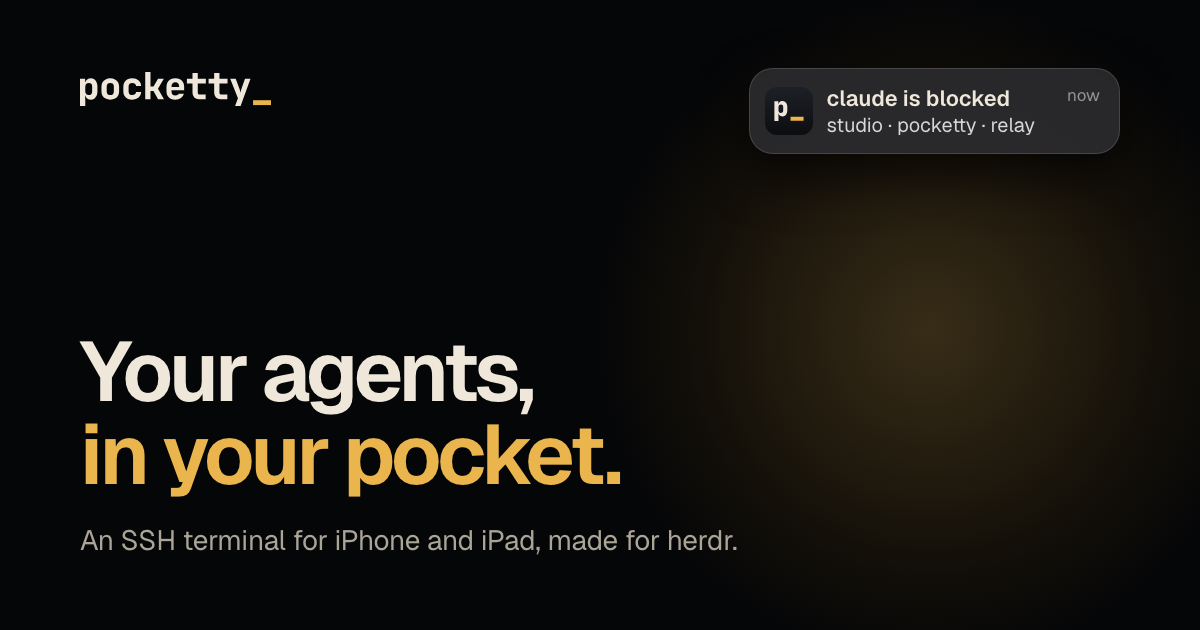
Pocketty is an iPhone SSH terminal built for the AI Agent era. Its core differentiator: when an AI Agent running in a remote session stalls while waiting for human confirmation, it proactively pushes a notification rather than waiting for the developer to return to their screen. As tools like Claude Code become widespread, long-running automated tasks silently blocking mid-run are a real efficiency drain. Pocketty combines mobile SSH with async push alerts to match a new working style — start a task, step away, get called back when needed. However, the product is extremely early-stage with minimal community traction, and key details around blocking detection accuracy, tool compatibility, and security remain undisclosed.
A Mobile Terminal Built for the AI Agent Era
A new tool called Pocketty has appeared on Hacker News's Show HN section, billing itself as "the iPhone SSH terminal that alerts you when your agent is blocked." That positioning cuts straight to a genuine pain point for today's developers: more and more people are handing off coding, operations, and even data analysis tasks to automated AI Agents — but these Agents don't always run smoothly from start to finish.
When a long-running Agent stops and waits for user confirmation, permission grants, or help recovering from an error, the developer often has no idea. You may have stepped away from your computer to handle something else, while the task on the other end of the terminal is silently stalled at an interactive prompt, burning time. Pocketty aims to solve exactly this "invisible wait" problem.
Core Capabilities: SSH + Intelligent Alerts
Based on the product description, Pocketty's functionality breaks down into two layers.
Mobile SSH Terminal
The foundation is an SSH client running on iPhone. This category of tool isn't new — mature apps like Termius and Blink Shell already exist on iOS, letting developers connect to remote servers, run commands, check logs, and restart services from their phones. The value of a mobile SSH terminal lies in anytime, anywhere access — the ability to respond quickly to production issues even when you're out and about.
SSH (Secure Shell) is an encrypted network protocol that allows users to securely control another computer remotely over an unsecured network. For developers and operations engineers, SSH is the standard way to connect to cloud servers, VPS instances, or machines on a private network. The challenges of mobile SSH clients include: inefficient input on a small-screen keyboard, frequent disconnections when switching networks (WiFi to cellular), iOS system restrictions on keeping background processes alive, and secure storage of SSH private keys. Termius and Blink Shell have done extensive work to address these constraints — the former focuses on multi-device cloud sync, while the latter is known for supporting the Mosh protocol (an SSH alternative that maintains sessions across network switches). Pocketty has no clear advantage at the basic SSH level; its differentiation is entirely staked on the higher-level capability of blocking detection.
Agent-Aware Blocking Detection
Pocketty's real differentiator is the second layer: when an AI Agent running in a connected session enters a "blocked" state, it proactively pushes a notification to you. In other words, it doesn't passively wait for you to check the terminal — it actively pulls you back when the Agent needs human intervention.
This design reflects a new way of working: a developer kicks off an Agent task, then goes off to do something else, relying on notifications to manage their attention rather than sitting in front of a screen. For automated workflows that run for tens of minutes or even hours, this kind of asynchronous "call me when you need me" interaction genuinely fits how people actually work.
An AI Agent is an AI system capable of autonomously planning steps, calling tools, and executing multi-turn operations to accomplish complex goals. Prominent examples include Anthropic's Claude Code, GitHub Copilot Workspace, and automated pipelines built on frameworks like LangChain and AutoGen. Unlike single-turn AI assistants, Agent tasks often run for minutes or hours, autonomously reading and writing files, calling APIs, and executing terminal commands along the way. "Blocking" typically occurs when an Agent encounters an operation requiring human confirmation — such as overwriting an existing file, requesting additional permissions, handling ambiguous input, or hitting an unexpected error — at which point the Agent pauses and outputs an interactive prompt in the terminal, waiting for the user to type a response. If the developer isn't at their screen, this wait can extend indefinitely, completely negating the time savings of automation.
Why This Direction Deserves Attention
As Claude Code, various coding Agents, and automation scripting tools become more widespread, "human-in-the-loop interruptions" are becoming an underappreciated efficiency drain. Agents aren't fully autonomous — they still need human decisions at critical junctures: whether to overwrite a file, whether to execute a risky operation, how to handle ambiguous input. If these interruption points go unnotified, the entire benefit of automation gets eaten up by time spent waiting.
Pocketty packages "blocking detection + mobile push notifications" into a productized loop, targeting this emerging but very real gap in the tooling landscape. It's not trying to replace the desktop development environment — it's filling in the missing piece of "how do you stay in control of an Agent after you walk away from your computer."
Current Limitations and Observations
It's worth noting objectively that this product is still in a very early stage. At the time of its Hacker News post, it had received only 8 upvotes and 0 comments, with limited community response and no real-world user feedback to draw from.
Several key questions remain unanswered by the available information:
- Accuracy of blocking detection: How does Pocketty determine that an Agent is "blocked"? Is it based on pattern matching in terminal output, recognition of specific interactive prompts, or does it require integration on the Agent side? This directly determines the rate of false positives and missed alerts.
- Compatibility scope: Which Agent tools and frameworks does it support? Is it generic terminal output monitoring, or has it been specifically adapted for certain tools?
- Security: How are SSH credentials managed, and is the push notification pipeline secure? These questions are critical for any operations tool, but the original information provides no details.
Reliably monitoring terminal output on iOS presents real technical challenges. iOS's background execution policy is extremely strict for third-party apps: once an app moves to the background, the system tightly limits how long it can maintain network connections and run computational tasks — typically only a brief Background Execution window of around ten seconds. To sustain continuous SSH session monitoring and trigger push notifications when specific output appears, one viable approach is a server-side relay: forwarding terminal output to Pocketty's cloud service, where pattern matching is performed and results are pushed to the device via APNs (Apple Push Notification Service). This architecture means SSH traffic would pass through a third-party server, dramatically raising the bar for security and privacy — which explains why "how SSH credentials are managed and whether the push pipeline is secure" are the most pressing unanswered questions right now.
Summary
Pocketty is a product with a narrow focus but sharp directional instincts. It has identified a specific, genuine pain point in the growing adoption of AI Agents — the absence of notifications when an Agent gets blocked — and attempts to fill that gap with a combination of mobile SSH and proactive push alerts.
For developers who rely heavily on automated Agents, the concept behind this kind of tool is worth keeping an eye on. But the product itself is still early-stage, and its actual detection reliability, compatibility, and security all remain to be proven. It reads more like a signal pointing toward a future way of working than a mature solution: as we increasingly collaborate with Agents, "attention management" and "interruption notifications" will become an indispensable part of the developer toolchain.
Related articles

Amphibious Transforming Drone: Beyond 100x Power Savings, What Are the Real Needs?
Is the amphibious transforming drone just a gimmick? Starting from the 100x power difference of the M4 Morphobot, explore real application scenarios and thesis topic ideas, analyzing boundary conditions where pure drones and pure ground robots both fail.

Warhound Raises $200 Million: Genetically Engineered "War Dogs" Paired with Anduril Gear
Warhound raises $200M, backed by Ben Lamm and Palmer Luckey, to genetically engineer dogs for military and law enforcement use and equip them with Anduril gear. This article analyzes its technology direction, funding logic, and ethical controversy.

Claude API Comes to Google Cloud: IAM Integration and SDK Access Guide
Anthropic hosts the full Claude API on Google Cloud with IAM-controlled permissions and unified billing. This guide covers the Vertex AI and Anthropic-hosted entry points, IAM role configuration, and SDK access.