Daily AI News · October 5th Evening Edition: OpenAI Shake-ups and the MCP Ecosystem
Daily AI News · October 5th Evening Ed…
Monday October 5th, 2026 evening edition — AI news roundup plus deep-dive on today's hot topics
Monday October 5th, 2026 evening edition — AI news roundup plus deep-dive on today's hot topics
There's a lot happening in the AI world today — from OpenAI internal moves to all kinds of new dev tools.
Here's what we're covering today. First, how to run AI Agents on the cheap. Second, should you train a classifier or just use a zero-shot model. Third, Laravel MCP 1.0 hits stable. Fourth, Java is now a real option for production-grade AI Agents. Fifth, OpenAI's personnel and feature changes, plus news on Opus 5.5. And sixth, DeepSeekAd's new client, DSH.
That's quite a lot.
Alright, let's do a quick run through the news first, then we'll go deep on the big OpenAI stuff.
First up, there's a YouTube video asking what the cheapest way to run AI Agents actually is, and it uses Higgsfield as a comparison point.
The core idea is to swap out heavy infrastructure for something lighter, and bring down the inference cost of running Agents.
This topic is super hot right now. People are realizing that once Agents are actually running, cost becomes the biggest roadblock. The more inference calls you make, the faster the bill climbs.
Higgsfield is on the AI video generation side — using it as a comparison is basically saying that heavy cloud platform pricing just doesn't work for high-frequency Agent use cases.
So at the end of the day, it's about finding alternatives that can cut inference costs. That direction makes a lot of sense — if Agents are going to be commercial, costs have to come down before you can scale.
Second, there's a thread on Reddit's deeplearning board about a very practical question: should you train your own classifier, or just use a zero-shot model like JEV or Laya?
I love how grounded this discussion is. And I love the conclusion — don't treat it as either-or. Treat both as tools for different stages of a project.
Early on when you have no labeled data, go with zero-shot to validate quickly. Once you've got some weak supervision signals, use those outputs to build a training set, then migrate to a dedicated classifier — and your costs drop.
Hold on — you're saying use zero-shot outputs as weak supervision? That's basically using the model to label itself, right? Can you trust the accuracy?
Yeah, there's definitely noise. But the key is the cost is nearly zero, and the noise can be managed through filtering and a small amount of human review. It's way cheaper than hiring people to label from scratch.
Good one to keep in mind. Third, there's an Arabic-language YouTube video about using AI to automate four types of tasks. The audience is Arabic speakers — and that tells you AI tool adoption is spreading well beyond English-speaking communities.
That's actually a really positive signal. AI tool content isn't just being made by English-speaking communities anymore. More multilingual tutorials and examples means the ecosystem reaches a lot more people.
Now let's talk about two dev-side stories, both related to MCP. First up, Laravel MCP 1.0 has officially hit stable.
Basically it turns your Laravel app into an AI toolbox — AI Agents can directly call the features inside your app. For PHP developers, this is a huge deal.
The MCP ecosystem is expanding fast. It used to be mostly Python and Node. Now Laravel is at 1.0, which means PHP developers are seriously getting on board with the Agent tooling direction.
Then there's another one — Spring AI plus MCP, building production-grade AI Agents in Java. Put these two together, and it really feels like MCP is becoming a cross-language standard.
Exactly. Java's enterprise ecosystem is massive — Spring is everywhere in big companies. With Spring AI plugging in, even legacy enterprise systems now have a path to connect with AI Agents.
MCP landing as a protocol layer across different language ecosystems matters more than any single company shipping an SDK. Once things are standardized, Agents can actually talk to each other.
Totally agree. Alright, that's the news roundup — now let's dig into the big stories from today. There's a lot happening on the OpenAI front.
There's a morning briefing post on Bilibili that got a ton of engagement — it covers a few things all at once. Starting with the feature change: some GPT Plus users noticed the five-hour usage cap is gone.
If this rolls out to everyone, that's genuinely meaningful for Plus users. That five-hour window was really frustrating — heavy users were constantly hitting the limit.
Right, and they did it quietly — no official announcement. So it's still unclear if this is a full rollout or just an A/B test for some users.
Honestly, this silent rollout style is pretty on-brand for OpenAI lately. No big fanfare, just quietly open it up for some people, see what the data says, then decide whether to go wider.
But the bigger story is something else — OpenAI's head of safety resigned, and their statement explicitly said the company's culture is broken.
That's a really strong statement. When your head of safety quits and goes on record saying that — that's not a minor thing.
Your instinct is right, this is worth paying close attention to. Quite a few people have left OpenAI's safety team over the past couple years, and each time the story is basically the same — commercial pressure is squeezing out safety as a priority.
And it's not just about this one person leaving. The head of safety role is literally the company's public credibility on safety. When that person publicly says the culture is broken, it damages external trust in OpenAI.
But that creates a contradiction, right? On one hand, GPT Plus is lifting limits — more user-friendly. On the other, the safety team is bleeding out. It kind of feels like they're trading user experience for internal safety culture.
This tension isn't new. It's been there since OpenAI made the shift from nonprofit to commercial. It's just gotten a lot more visible lately.
And think about it — they're under real competitive pressure from Anthropic and Google. After Claude Fable 5 came out, OpenAI's capability lead isn't as clear-cut as it used to be.
So under heavy commercial pressure, safety becomes the thing you're willing to compromise on. Okay, what about the Google side — what's the deal with Opus 5.5 launching on AI Studio?
The Opus 5.5 here is referring to a new version of Anthropic's Claude Opus series, now accessible through Google Cloud's AI Studio or a related entry point — but only for Pro and Ultra subscribers.
Another flagship-tier exclusive. It really feels like the best models are increasingly locked behind premium tiers, and regular users are stuck with whatever's one generation behind.
That's just the industry trend right now. Inference costs haven't dropped low enough, so flagship models have to use tiered pricing to cover costs. Once costs drop another order of magnitude or two, regular users might actually get to touch the best models.
Alright, let's talk about another big one. DeepSeek released a new client called DSH — full name DeepSeek Harness. There are videos on Bilibili about it, saying it starts up really fast, has a split chat-and-task dual-mode design, and it's MIT licensed.
DSH is an interesting name — Harness means to control or leverage something. The dual-mode design is pretty practical: separating chat mode from task mode lets you optimize for different use cases.
Fast startup sounds like a small thing, but anyone who's used one of those heavy clients knows how jarring it is to wait five or six seconds every time you cold-launch it.
Yeah, client experience has been a constant complaint. And MIT open source means developers can just fork it and modify it — community contributions will move way faster than a closed-source alternative.
Wait, doesn't DeepSeek already have an official client? What's the relationship between DSH and the official one?
DSH looks like a community or third-party open-source client — not from DeepSeek officially. Kind of like all those third-party clients that wrapped the OpenAI API back in the day.
The value of a third-party client is that it can do things the official client won't or hasn't gotten around to yet. That task mode, for example, sounds like it has Agent workflows built right in.
That actually reminds me of what we talked about before — using Claude to auto-generate a meal plan and order on Walmart. Both are about embedding AI into a specific task flow.
Same direction, yeah. The difference is DSH is a general-purpose client framework, while that meal automation thing is a deep custom build for one specific scenario. Lower barrier to entry with DSH, but more depth with the custom approach.
Now let's talk about the OpenAI developer experience team's piece on how to use Dot and Codex together. That one got a fair amount of traction too.
Dot is OpenAI's personal AI assistant product, and Codex everyone knows — it's for code generation. Using them together is really about bridging natural language interaction with code execution inside your everyday workflow.
So you tell Dot what you want to do, it calls Codex to write the code and run it? That pipeline sounds really smooth.
That's roughly it. The fact that the developer experience team is specifically talking about this means they're intentionally guiding users to combine these two products — not use them separately.
This is really OpenAI doing product portfolio integration. Any single tool has a ceiling, but if you can get users to use multiple OpenAI products inside one workflow, retention gets a lot stronger.
So to wrap up today's deep-dive topics — OpenAI had good news and bad news at the same time: features are opening up, but the safety culture is under scrutiny. DSH fills a gap in the DeepSeek ecosystem on the client experience side. And Dot plus Codex is OpenAI doing product integration.
Yeah, if I had to sum it all up in one sentence: the core tension in AI products right now is the growing rift between the pace of commercialization and safety culture — while every player is racing to stitch their tool chains together and lower the barrier for users to get started.
That nails it. Alright, that's a wrap for today — see you tomorrow.
See you tomorrow.
Related articles
 Tech Frontiers
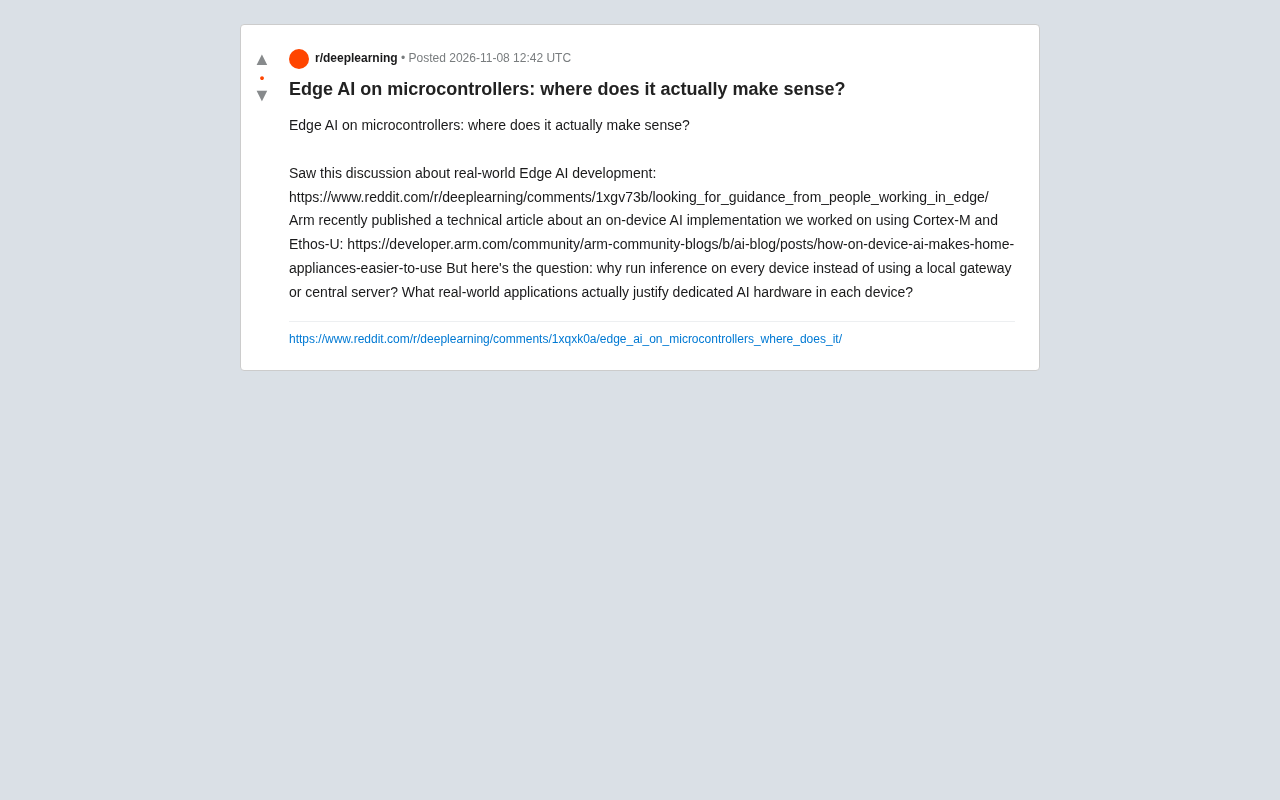
Edge AI on Microcontrollers: When Is It Actually Worth Deploying?
Drawing on Reddit discussions and Arm case studies, this article analyzes the real-world use cases for edge AI on microcontrollers: when each device needs independent inference, when a gateway or cloud is more reasonable, and the costs and boundaries of specialized hardware.
 Tech Frontiers
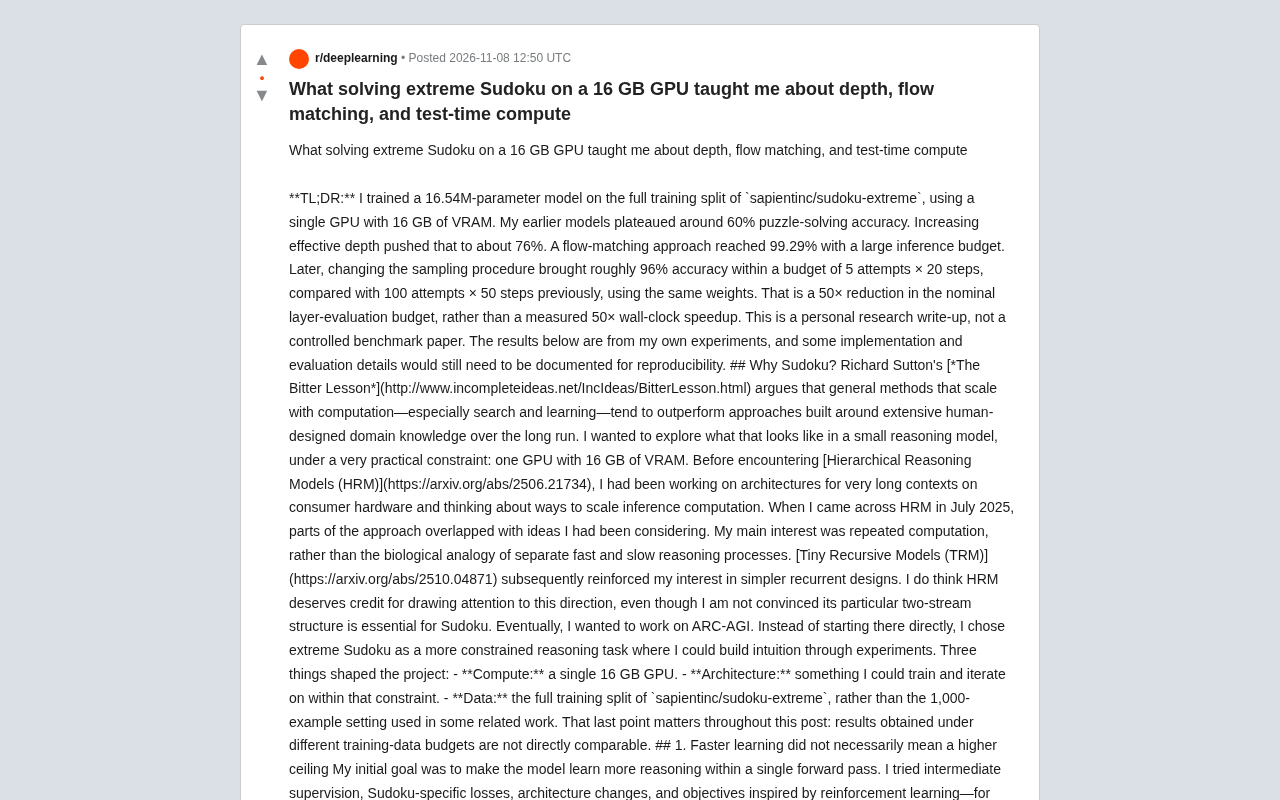
Pushing the Limits of Extreme Sudoku on a 16GB GPU: Insights from Depth and Flow Matching
A researcher trained a 16.54M-parameter model on a 16GB GPU to solve extreme Sudoku, finding effective depth breaks the 60% plateau and flow matching with improved sampling pushes accuracy past 99% with ~50× lower layer-evaluation budget.
 Tech Frontiers
AI Agent Approval Workflows: Why Human Confirmations Always Get Mindlessly Clicked
Why do AI agent approval workflows always get mindlessly clicked? A Reddit discussion shows that separating rules from keys, low-frequency high-risk approvals, and GitHub Environments-style gates are the keys to effective approvals.