Daily AI News · October 9th Midday Edition: Vibe Coding's Million-Dollar Goal and Android Open-Source Agent
Daily AI News · October 9th Midday Edi…
Friday October 9th, 2026 midday edition — AI news roundup plus deep dives on the hottest topics
Friday October 9th, 2026 midday edition — AI news roundup plus deep dives on the hottest topics
Lots of fresh stuff in the AI world today — from Agent debugging to DIY hardware hacks, plus a few videos blowing up on Bilibili. Pretty interesting lineup.
Here's what we're covering today: one, three classic Agent failure modes; two, that satirical dishwasher AI short film; three, turning an old monitor into a desk lamp; four, Edi Life OS, a self-hosted dashboard; five, the historical lesson of Spanish silver; six, the Vibe Coding million-dollar goal series; and seven, the Android open-source Agent called Whale Girl.
Quite a mixed bag today.
Yeah, we'll run through the first half quickly, then dig into the two big topics. Alright, let's get into the first segment.
First up — there's a Reddit post getting a lot of traction lately, specifically about three classic AI Agent failure modes. The author is a developer who put together a failure recovery testing checklist.
The three scenarios are: an external write times out and you don't know if the operation actually went through; a zombie process comes back when you thought it stopped; and scope creep on authorization, where a preview approval turns into a production deployment.
These three scenarios are classic distributed systems problems — they just get way more complicated inside an Agent. At least with distributed systems you can roll back. If an Agent fails halfway through, what does it decide to do next? That gray area is where things get really dangerous.
The idempotency mechanisms and operation reconciliation mentioned in the post — those are all mature engineering solutions. But the problem is a lot of Agent developers have zero background in distributed systems. They jump straight into business logic and basically treat the Agent like a smart script.
Hearing that, I'm realizing a lot of people building Agents really are just stacking prompts with no real fault tolerance design. This post is basically telling everyone — Agents have reached the stage where you need to take the engineering seriously.
Exactly. Getting the task done is step one. Recovering from failure is step two. Most people stop at step one and think that's enough — but honestly, they're nowhere near done.
Alright, the second one's pretty fun. There's a satirical YouTube short called Dishwasher ChatGPT, where an AI assistant is helping wash a fork, and the whole thing just keeps spiraling in complexity until it ends up invoking the Navier-Stokes equations and the Millennium Prize problem.
That one really hit home. There's even a bit about burning through too many tokens and needing a sponsor just to keep the reasoning going. That detail is painfully real. The mismatch between inference costs and the actual value of the task — that's a genuine problem for a lot of AI products right now.
Right, you're spending a ton of compute to solve a problem that never needed to be that complicated. That's actually a pretty serious conversation at the product level.
How well the capability matches the use case matters way more than how capable the model is. This satirical short actually makes that point really clearly — just in an extremely exaggerated way.
Next up, there's a DIY project on the r/robotics subreddit where someone took an old broken Dell monitor apart, pulled out the backlight LED module, and turned it into a desktop fill light.
The core insight is really clever — an LCD monitor is actually two separate systems. The liquid crystal imaging layer and the backlight system are independent. A broken screen doesn't mean the backlight is broken too. And backlight output is super even, which makes it great for shooting fill light.
I love this. Beyond the upcycling aspect, the disassembly process itself is a great hardware learning exercise. The one thing to watch out for is matching the right driver power supply to the backlight LED strips — it varies a lot by model, and wiring it wrong can fry things.
Yeah, the author flagged the electrical safety stuff too. Alright, fourth item — there's a project on Hacker News called Edi Life OS. It's a self-hosted personal life dashboard that pulls together your calendar, tasks, health data, and finances all in one place.
What makes it stand out is the built-in MCP server — that's Model Context Protocol — which lets AI clients like Claude directly read your personal data and interact with it based on permissions.
Really interesting direction. It's turning AI from a general-purpose chatbot into a personal assistant that actually knows your habits — while keeping all your data local. It's local-first plus AI-native access combined, and that's a trend that's really starting to take shape.
The barrier right now is that you have to self-deploy, which is way too high for most regular users. But the direction is right. Once this model proves itself and someone packages it into a one-click installer, the audience gets a lot bigger.
Last news item is a bit of a left turn — a YouTube video about the history of Spanish silver has been making the rounds. The gist is that in the 16th and 17th centuries, Spain extracted massive amounts of silver from South America and actually ended up poorer because of it.
Classic resource curse. The silver mines were too easy to exploit, so Spain had no incentive to build capital markets or a banking system. They just funneled the money into religious wars. Meanwhile the Dutch and the English used financial innovation to build structural competitive advantages.
That actually sounds a lot like some companies in the AI space — sitting comfortably behind a moat, collecting easy money, while never actually building real underlying capabilities.
That analogy works for me. The ability to turn wealth into sustainable productive capacity — that's what actually matters. Doesn't matter how much silver you have if your institutions can't keep up.
Alright, that's it for the news. Now let's dig into the two hottest topics. First up — that YouTube series Vibe Coding to a Million. He's on day 237 now, and ARR has crossed two hundred fifty thousand dollars.
The premise is one person using Vibe Coding — that style of talking to an AI while writing code — to build up to one million dollars in annual revenue. He's getting close to a quarter of the way there and still posting updates.
I've watched a few episodes — it feels very real. He's not showing off a perfect product. He's documenting every day, hitting bugs, getting stuck on features, then slowly pushing through with AI help. That transparency is a big part of why the series took off.
But do you think this model is actually replicable? Two hundred fifty thousand ARR sounds decent, but he's still a long way from a million — and he's already on day two hundred thirty-seven.
The replicability question needs to be broken down. On the technical side, Vibe Coding genuinely has lowered the bar for indie developers. But on the business side — finding a niche you can charge for, getting the product out there — that has very little to do with whether you can use AI.
So you're saying AI solved the productivity problem, but not the hardest part of building a startup?
Exactly. Building it and selling it are two different things. The real value of this series isn't just showing off Vibe Coding — it's showing how one person handles product, operations, and sales all at once with no team. That documentation is worth more than the code itself.
Hold on though — you said AI hasn't solved the hardest part. But I think AI is actually changing how hard that part is. He's using video to build an audience, and video is itself a content product. AI plays a role in how he distributes and spreads that content too.
That's an angle I hadn't thought of. He turned the process of building a product into content itself — that's a smart meta-strategy. The audience isn't just watching the product. They're watching how this person works with AI. That content is building trust and an audience at the same time.
And the fact that he's made it to day two hundred thirty-seven says a lot. Most people quit after two weeks. The core value of this series might actually be proving what persistence looks like — and the AI angle might be secondary.
Fair point, I'll give you that. But I still think the million-dollar goal is more of a content hook than a realistic forecast. Look at his current growth curve — hitting a million would require a pretty serious acceleration.
That's true. But even if he never hits a million, the documentation itself already has value. To sum up — the real significance of the Vibe Coding series is that it maps out the full path for indie development in the AI era. The technical barrier is lower, but business judgment and consistent execution are still the core variables.
I'm with you on that. Alright, next topic — the Whale Girl Agent on Bilibili. Android open-source Agent, over eleven hundred interaction points. That's really high.
Right — DSHA Whale Girl. It's an open-source Agent that can actually operate an Android phone's interface. The whole point is that it takes action — real tapping, swiping, filling out forms — not just chatting.
This direction has been getting a lot of momentum lately. Running an Agent on a phone that directly controls the OS interface — that's a critical step toward embedding AI into users' actual workflows. Most of the work has been on the PC side, and open-source mobile projects like this are still pretty rare.
Where do you think the open-source angle really matters here? Android is already an open platform — why is open-sourcing the Agent causing this much of a reaction?
A few reasons. First, the development barrier for mobile Agents is higher than PC — you need to understand Android's accessibility framework, UI tree parsing, all of that. Having a working open-source project basically lays the groundwork for everyone who comes after.
Second, Chinese users do so much on their phones — WeChat, Alipay, basically every app is mobile-first. PC Agents can't touch any of that. So this direction is especially valuable for developers here.
That really resonates with me. So many workflows only happen on mobile, especially anything involving WeChat. PC Agents just can't reach that. If Whale Girl can reliably control Android interfaces, the number of use cases is enormous.
But stability is a massive challenge. Android fragmentation is brutal — different manufacturers' ROMs have totally different restrictions on accessibility permissions. The same code might work perfectly on a Xiaomi and completely break on a Huawei.
So right now these projects are mostly about proving basic feasibility, not delivering a stable commercial product?
Yeah, at this stage it's mainly about validating the path. But look at the response on Bilibili — eleven hundred interaction points, and tons of comments asking how to get it running and how to modify it. That tells you the developer community demand is real. This isn't hype.
And the fact that this kind of video is blowing up on Bilibili means the topic has spread beyond pure tech circles. VTubers, digital content creators — those communities are starting to ask whether Agents can help them automate their day-to-day operations.
That's a sharp observation. The audience for mobile Agents is way broader than for PC Agents. PC Agents still feel like developer tools. Once mobile Agents work reliably, they're talking directly to everyday users in everyday scenarios.
There's also another video blowing up on Bilibili around the same time — the one from Dafeiyu, 'Boss, I open-sourced you upstairs too.' Over a thousand interaction points. This kind of content turning workplace relationships or personal personas into AI characters has suddenly been popping up everywhere.
I think two things are happening at once there. On one hand, open-source AI roleplay projects are getting more polished. On the other hand, content creators in China have figured out that this kind of content spreads really well. The technical feasibility and the content creation demand both lined up at the same time.
To wrap up the deep dive — the Android open-source Agent direction is fundamentally about extending AI capabilities into real mobile use cases. It's still in the phase of proving basic viability, but developer demand is real. This is a space worth watching closely.
When you step back, today's stories all point to the same thing. For Agents to actually land in the real world — whether that's handling distributed failures on a server or tapping through a phone interface — engineering reliability is the hurdle you simply can't skip.
That's a great note to end on. Alright, that's all for today — see you tonight.
Related articles
 Tech Frontiers
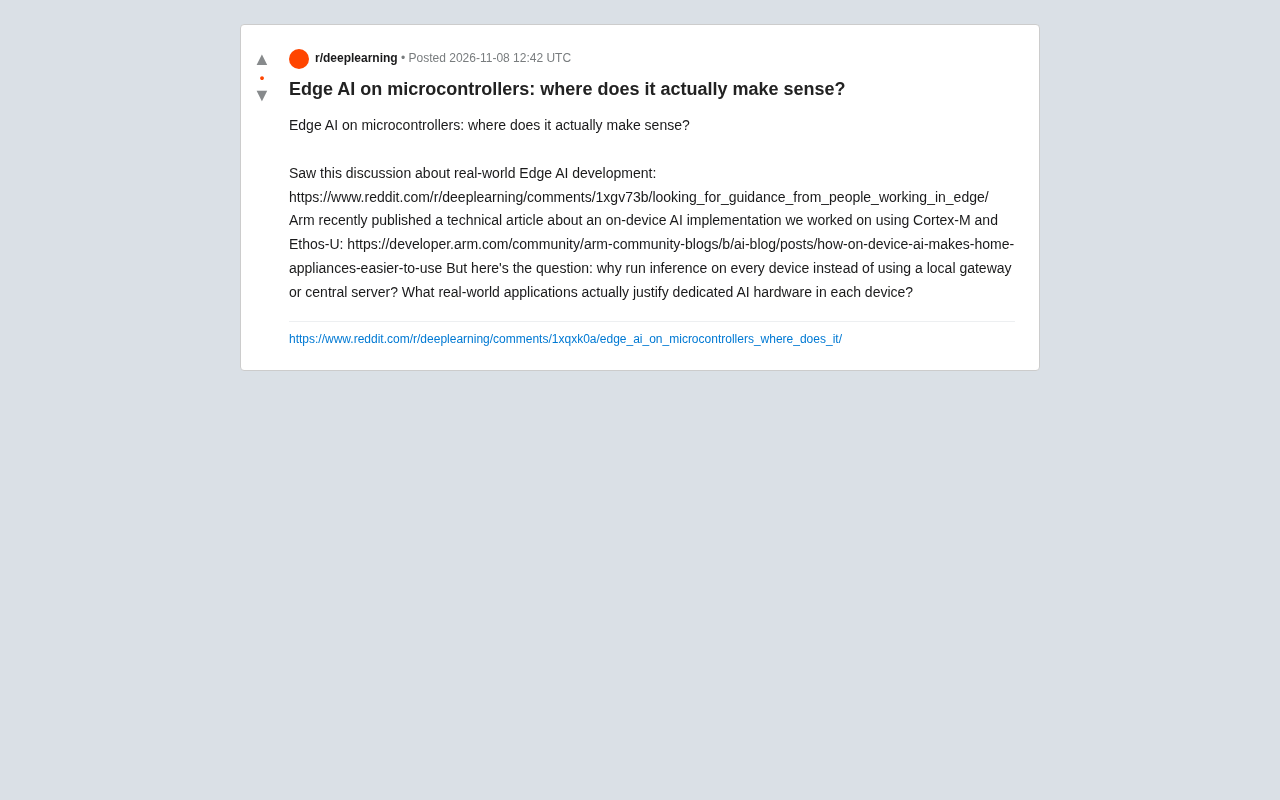
Edge AI on Microcontrollers: When Is It Actually Worth Deploying?
Drawing on Reddit discussions and Arm case studies, this article analyzes the real-world use cases for edge AI on microcontrollers: when each device needs independent inference, when a gateway or cloud is more reasonable, and the costs and boundaries of specialized hardware.
 Tech Frontiers
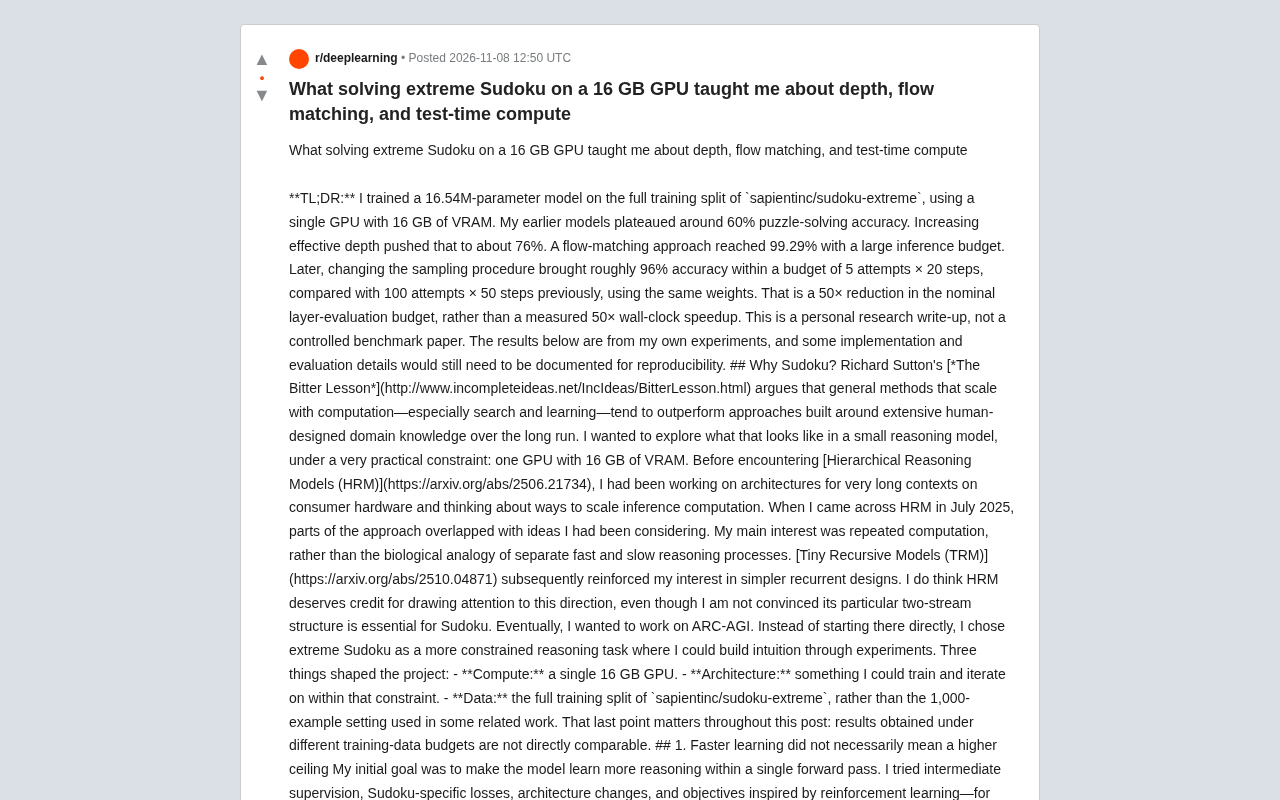
Pushing the Limits of Extreme Sudoku on a 16GB GPU: Insights from Depth and Flow Matching
A researcher trained a 16.54M-parameter model on a 16GB GPU to solve extreme Sudoku, finding effective depth breaks the 60% plateau and flow matching with improved sampling pushes accuracy past 99% with ~50× lower layer-evaluation budget.
 Tech Frontiers
AI Agent Approval Workflows: Why Human Confirmations Always Get Mindlessly Clicked
Why do AI agent approval workflows always get mindlessly clicked? A Reddit discussion shows that separating rules from keys, low-frequency high-risk approvals, and GitHub Environments-style gates are the keys to effective approvals.