Daily AI News · October 11th Morning Edition: GPT-6 Series Reviews & DeepSeek V5 Rumors
Daily AI News · October 11th Morning E…
Sunday October 11th, 2026 morning edition — AI news roundup plus deep-dive discussion on today's hottest topics
Sunday October 11th, 2026 morning edition — AI news roundup plus deep-dive discussion on today's hottest topics
The AI world is just exploding with news today — an actor going head-to-head with Amazon, Nvidia in acquisition talks, and a new GPT-6 family member that's all over the internet.
Here's what we're covering today: first, Nicolas Cage refusing to sign an AI licensing deal. Second, rumors that Nvidia is looking to acquire Reflection AI. Third, SpaceX wanting to become a telecom carrier. Fourth, an O(N log N) attention mechanism. Fifth, an experiment replacing Softmax with the quantum Born rule. Sixth, front-end capability reviews of GPT-6 Luna and Sol. And finally, the word on the street that DeepSeekAd V5 is coming soon.
Yeah, today's packed.
Alright, let's go through the news one by one.
First up — there's an article on HN linking to a Variety report saying Hollywood actor Nicolas Cage refused to sign Amazon's AI licensing agreement. His exact words were that he's not an, quote, AI-friendly actor.
So this AI licensing agreement basically lets the studio capture your face and your voice to train models or create a digital double. Cage flat-out said no.
And you've got to keep in mind what makes Amazon different here. It's not just a studio — it's also AWS and an AI developer. So the incentive to collect these rights goes way beyond what a typical production company would have.
Cage can say no because he has the leverage to do it. But what about your average actor? Studios can bury a single line in a contract and most people sign it without even noticing.
Right, and that's exactly the problem. The 2023 Hollywood strike had AI replacement as one of its core demands, and that fight is still very much ongoing — it's just moved off the picket line and into contract terms.
And digital likeness law is still a complete mess — no real industry standards either. The real battle is happening at the union negotiation table and in the legislature, not through individual celebrity statements.
Alright, on to the second story. The FT is reporting that Nvidia is in talks to acquire US open-model startup Reflection AI, though the deal isn't done yet.
This move actually makes a lot of sense. Nvidia dominates compute, but what it really wants is vertical integration — models plus software plus hardware all together. With its own open-model team, it can do deep optimization specifically for its own GPU architecture.
But open models have a core identity — they're supposed to be neutral and community-driven. If Nvidia acquires them, can that openness actually survive?
That's the central tension. Look at Meta's Llama — open, but with conditions. Whether Nvidia would have any incentive to stay truly open after an acquisition is a real question. But regardless of whether this deal happens, the trend of top compute companies pushing into the model layer is already very clear.
Then there's another interesting one — there's a YouTube video talking about SpaceX wanting to become a telecom carrier. Basically SpaceX is looking to run a direct-to-device satellite wireless carrier business.
It sounds super cool, but telecom has three major hurdles: infrastructure cost, device compatibility, and user retention. The video mentions how Sprint went all-in on WiMAX and died, while T-Mobile turned things around through user experience. Every single layer is life or death.
And SpaceX would be stacking satellite network costs on top of ground network costs, while also dealing with promotional counterattacks from existing carriers. And honestly the worst part is — once you're a carrier, you inherit all the negativity people have toward the telecom industry. Monthly fees, speed complaints, churn rates — it's all out in the open.
Yeah, the mystique of a space company colliding with all the everyday frustrations of a phone carrier — that's a pretty big gap. The ambition is real, and so are the challenges.
Alright, two more technical stories to quickly run through. A developer posted on Reddit saying they built an attention mechanism called ALHR that brings standard Transformer complexity down from O(N squared) to O(N log N), claiming 97% accuracy on the MQAR benchmark.
The idea is to organize keys using a static binary tree, where each query only accesses a subset of keys along the tree path, with a learnable routing function on top. Conceptually it has value — but there's no paper, no open-source code, and no reproducible comparison experiments. We need to see the code before we can say anything.
Then there's an even weirder one, also on Reddit — someone replaced the Softmax in Transformer attention with the Born rule from quantum mechanics. Basically taking the squared modulus of the dot product of Q and K, then normalizing. They claim the model trains just fine.
Mathematically it actually holds up. The Born rule and Softmax both produce normalized non-negative weights, but they handle extreme values in completely different ways. Just the fact that it trains at all is worth documenting, because a lot of replacement schemes die on optimization stability. But this is still proof-of-concept stage.
Okay, that's the news. Now let's go deeper on the two topics that have been blowing up on Bilibili lately — the new GPT-6 family members, and the DeepSeek V5 rumors.
Starting with GPT-6. Two videos have gone viral on Bilibili recently — one reviewing GPT-6 Luna with nearly 44,000 engagement points, and another reviewing GPT-6 Sol with 24,000. Both are part of the GPT-6 family, but they're positioned completely differently.
Right, these are two different members within the GPT-6 lineup. Luna is described as a bit mediocre but insanely cheap, while Sol is called a conservatively updated, high value-for-money workhorse model. Those two descriptions together are actually pretty interesting.
Hold on — when they say mediocre, do they mean low capability, or just limited in features?
Based on the review content, Luna was mainly put through a comprehensive front-end capability test — things like code generation and UI understanding. The mediocre label probably refers to average performance on more complex tasks, but the price is extremely low.
Sol is positioned more like a solid workhorse model. The phrase conservatively updated is key — it means OpenAI didn't take risks with Sol. They went for stability and predictability.
I love the workhorse framing. It's not about breaking the ceiling — it's about showing up every single day, doing the job reliably, not screwing up, and keeping costs low.
And think about the product portfolio logic here. OpenAI's strategy is getting clearer — push the flagship higher end, while building out a tiered price ladder in the mid-to-low range. Luna is cheap, Sol is high value, and combined with o3 and o4-mini from before, the whole matrix is looking really complete.
It's a lot like cloud service SKU strategy. Different price points for different use cases, so enterprise users can buy exactly what they need without defaulting to the flagship for everything.
But here's the really important part — the price signal. Luna being called insanely cheap suggests the entry-level price point for the GPT-6 family might be lower than most people expected. That's a very direct pricing pressure signal for the whole industry.
Right — just two days ago we were talking about Claude Haiku 5.5 on Amazon Bedrock being priced 75% lower than the previous generation. And now GPT-6's low-end is also going cheap. This price war is getting more and more intense.
This actually reflects a structural shift. Model capability is already good enough for a lot of tasks. So the competition is moving toward cost and reliability. Whoever can build a good-enough model at a low price point is going to dominate the enterprise market.
So is this good or bad for everyday developers?
What do you think? If API prices keep dropping, developers can run way more tasks at way lower cost — that's a good thing, right?
Obviously good. But my worry is — if everyone's in a price war, will companies start cutting R&D? Cheaper, but capability stalls out?
That's a fair concern, but right now the major players are still increasing R&D spending. The price drops are mostly coming from better algorithmic efficiency and lower inference costs — not from spending less. So for now, this cycle is still running in a positive direction.
Alright, let's get into the second topic — the DeepSeek V5 rumors. There's a Bilibili video with 35,000 engagement points, and the core claim is that DeepSeek went down late at night, and someone drew a parallel between that outage and the similar downtime before GPT Astra launched, speculating that V5 might be dropping soon.
The reasoning goes like this: before a major launch, servers are under unusual pressure — internal testing or pre-release traffic runs can cause outages. The GPT series had similar pre-launch downtime. So DeepSeek going down is being read as a signal.
Come on, that's a huge leap. Outages happen for all kinds of reasons — traffic spikes, infrastructure issues — it could be anything. Saying V5 is coming just because of one outage? That's a really weak chain of evidence.
You're right, that part is definitely over-reading it. But the video does mention that third-party tools including commandcode confirmed anomalies in direct API calls to the official endpoint — that detail is slightly more concrete than just a front-end outage.
So it wasn't just the front end going down — the API layer had anomalies too? That is a bit different. API-layer issues are actually closer to infrastructure-level stress.
Right, but I still want to be clear — this is speculation. There's no official information at all. DeepSeek has never followed a normal release schedule anyway. They could just suddenly drop it out of nowhere.
If V5 is actually coming, where do you think we'll see the biggest improvements? What are DeepSeek's core strengths right now?
DeepSeek has always had two main strengths. One is extreme training efficiency — getting close to top-tier model performance with far fewer compute resources. Two is their open strategy — releasing model weights to the developer community, which has created really strong ecosystem stickiness.
If V5 is going to break new ground, I'd guess reasoning capability and multimodal are the directions. Those are the two areas where the V4 series is relatively weak, and also where the whole industry is competing the hardest right now.
And think about the timing — OpenAI is pushing price on GPT-6, Anthropic is going low-cost with Haiku 5.5. If DeepSeek V5 drops right now with open weights on top of that, the pricing impact on the industry would be massive.
That's exactly why this rumor is blowing up on Bilibili. It's not about the outage itself — it's that everyone's waiting for a new variable to come in and shake up the current landscape.
But there's a funny contradiction here. People are out here rooting for DeepSeek to come disrupt things, while also using GPT-6's cheap models. Either way, the real winners are probably developers and enterprise users.
That contradiction isn't really a contradiction though. The fiercer the competition, the lower the prices and the better the capabilities — and developers win every time. Multiple players duking it out while users pocket the savings — that's the single most certain conclusion you can draw from this whole AI arms race.
To wrap up today's deep dive — GPT-6's Luna and Sol show that OpenAI is using tiered pricing to fight the price war, and the DeepSeek V5 rumors show the market is waiting for a new disruptor to enter the game. Whoever moves first, the trend of falling inference costs is unstoppable.
That's the bottom line. The competition in model capability is shifting to a competition in cost efficiency. Whoever can build something good enough at a low price point — they win the next stretch of this market.
Alright, that's a wrap for today — we covered a lot, hope it was worth your time. See you at noon!
Related articles
 Tech Frontiers
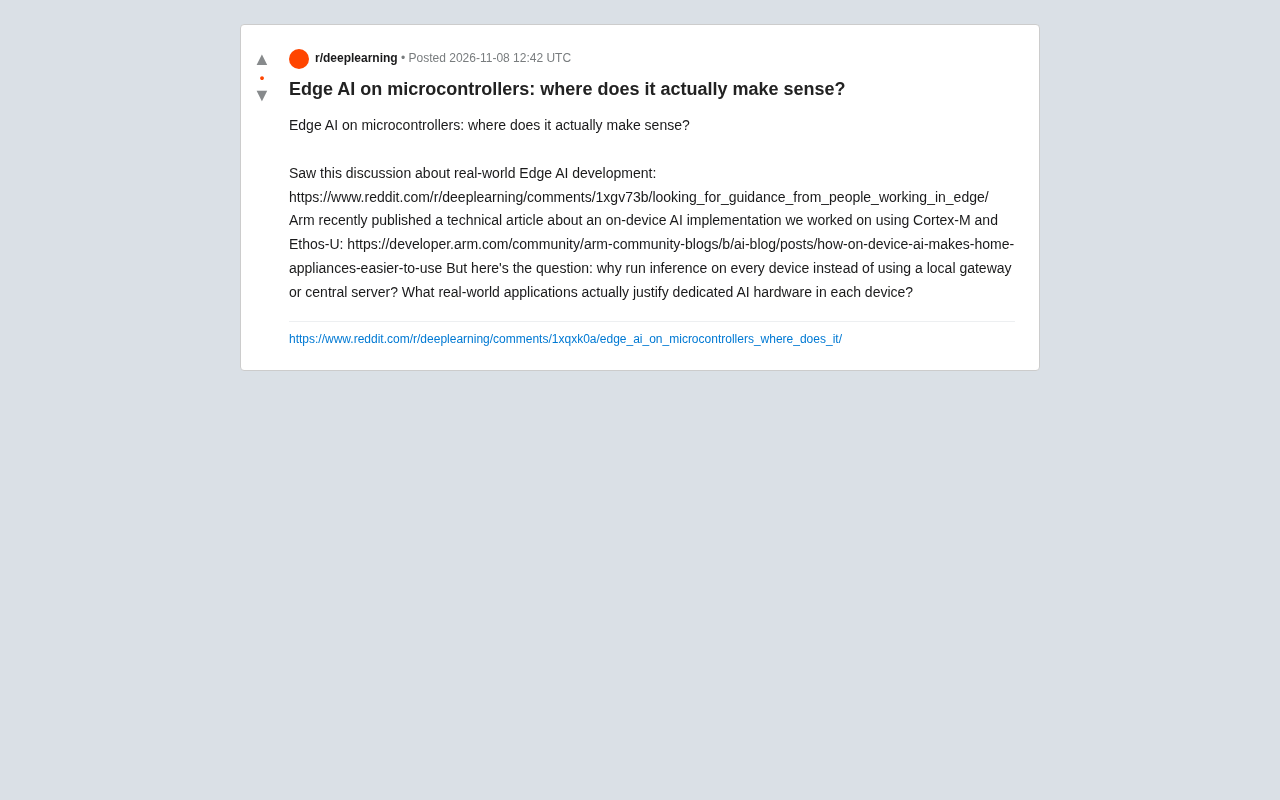
Edge AI on Microcontrollers: When Is It Actually Worth Deploying?
Drawing on Reddit discussions and Arm case studies, this article analyzes the real-world use cases for edge AI on microcontrollers: when each device needs independent inference, when a gateway or cloud is more reasonable, and the costs and boundaries of specialized hardware.
 Tech Frontiers
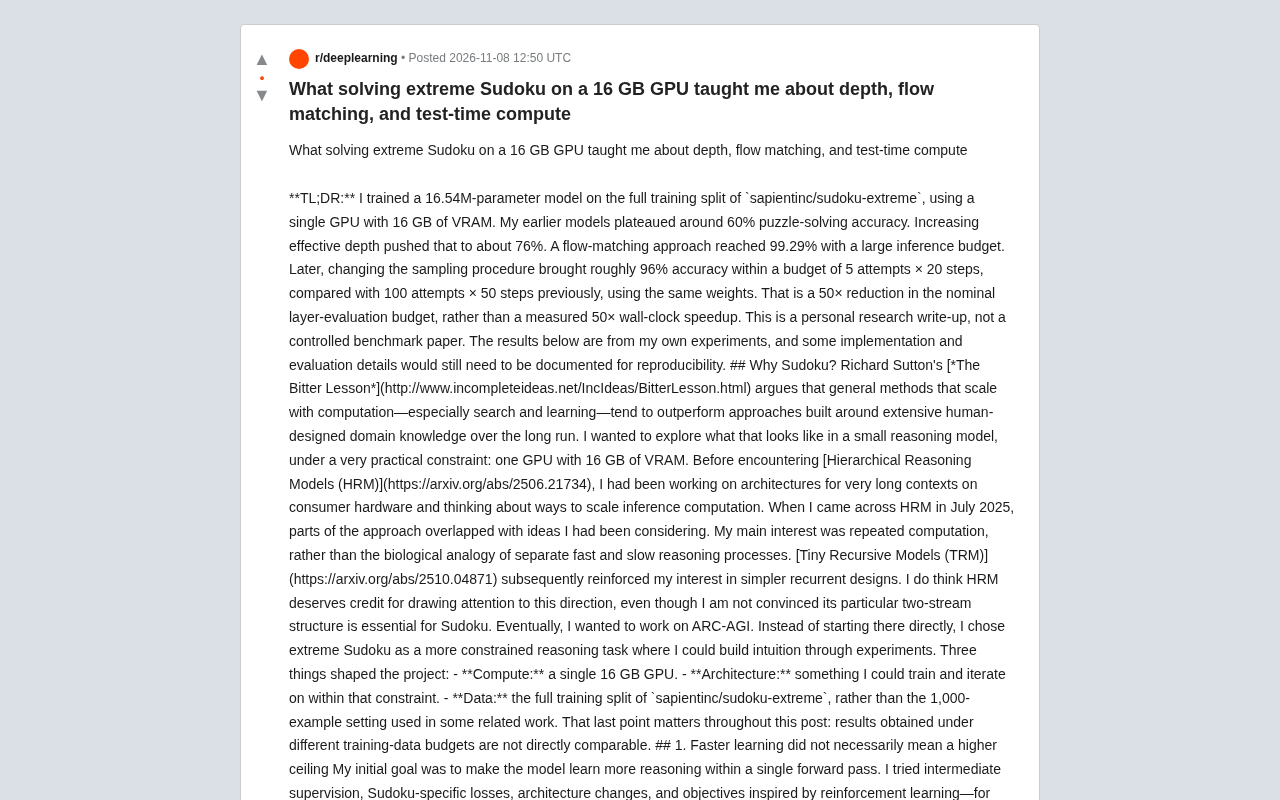
Pushing the Limits of Extreme Sudoku on a 16GB GPU: Insights from Depth and Flow Matching
A researcher trained a 16.54M-parameter model on a 16GB GPU to solve extreme Sudoku, finding effective depth breaks the 60% plateau and flow matching with improved sampling pushes accuracy past 99% with ~50× lower layer-evaluation budget.
 Tech Frontiers
AI Agent Approval Workflows: Why Human Confirmations Always Get Mindlessly Clicked
Why do AI agent approval workflows always get mindlessly clicked? A Reddit discussion shows that separating rules from keys, low-frequency high-risk approvals, and GitHub Environments-style gates are the keys to effective approvals.