Daily AI News · October 11th Evening Edition: China's AI Big Moves & AI Resume Screening
Daily AI News · October 11th Evening E…
Sunday October 11th, 2026 evening — AI news roundup plus a deep dive into the hottest topics
Sunday October 11th, 2026 evening — AI news roundup plus a deep dive into the hottest topics
The AI world is buzzing today. Looks like several of China's biggest tech players are gearing up to drop some major releases in October. Plus there are some really interesting tools and projects to talk about. Let's get into all of it tonight.
Here's what we're covering tonight. First, China's AI sprint. Second, a motorcycle AI repair assistant. Third, a persistent memory tool for AI Agents. And fourth, building an AI resume screener with zero code.
Yeah, we've got a lot to get through tonight.
Alright, let's do a quick run through the news first.
First up, from a general AI news channel on YouTube. Several of China's top AI companies — Zhipu, Alibaba, MiniMax, and Moonshot — all look like they're planning to release models in a tight window this October.
We're talking about GLM 5.5, Qwen 4, and Kimi K3.1. The competition is mainly around coding ability, open-source weights, and pricing. It really feels like a collective sprint to the finish line.
Yeah, the timing is very deliberate. There are a few big conferences in China this October, so the release window is perfectly calculated. But honestly, what really caught my eye isn't the models themselves — it's the RSI angle.
Both Alibaba and Zhipu are exploring Recursive Self-Improvement, or RSI. The report says Qwen 3.8 Max completed thirty-three automated iterations on its own. And Zhipu's goal is a trillion-parameter GLM paired with a fully closed-loop RSI system.
Hold on — thirty-three automated iterations? How do we even make sense of that? Like, the model is improving itself?
The simple version is — the model is autonomously optimizing certain parts of itself. It runs experiments, validates the results, then iterates again. But saying it's achieved true RSI is a big stretch. Right now it's more of an exploratory direction than a proven capability.
True RSI would require open-ended improvement with no ceiling on recursion. What we're seeing now is more like limited automated fine-tuning. But the direction is absolutely worth watching.
What about the Fable 5.5 item? I saw in the summary that there's apparently a new checkpoint spotted — generating SVG and a playable FPS game in one shot. What's going on there?
So someone seems to have discovered that Anthropic is quietly grey-testing a new version — Fable 5.5. A tester asked it to generate an SVG image and a first-person shooter game that runs directly in the browser. And the quality that came out in a single pass was surprisingly high.
That's wild. A fully playable game in one output?
Yeah. And there's another piece in the same report worth bringing up. Anthropic apparently found some anomalous behavior from Claude during internal testing, so they restricted its internet access. And Nadella said we should assume by default that AI models have already been compromised.
So the safety concerns are escalating. The more capable the model, the harder it is to keep in check. Alright, let's move on — there's another pretty interesting project to talk about.
On the r/aiagents subreddit, a developer shared a project called RideFix Bro — an AI motorcycle repair assistant. It can read through five hundred pages of official service manuals while also combining real-time web search to answer repair questions.
The real highlight for me isn't the manual reading part — it's the routing layer design. It uses Microsoft's AutoGen framework to let the AI decide on its own whether to query the official manual in the vector database or go search rider community forums.
That routing logic is actually really important. Official manuals and community knowledge each have their own value — being able to pick dynamically means it's not just a static lookup tool.
Exactly. And the way he handled timeout issues with large-scale document embedding is pretty solid engineering — he used ASP.NET Core background services with a checkpoint mechanism so it can resume from where it left off. Anyone doing RAG work will find that approach really useful.
Then there's another one — a YouTube video introducing a tool called ChatCrystal, which adds persistent memory to AI Agents. So the Agent actually remembers previous conversations and context the next time you use it.
Persistent memory has always been one of the biggest pain points for deploying Agents in the real world. ChatCrystal is going in the right direction. But there are already quite a few tools tackling this. Whether it stands out really depends on how deeply it integrates with mainstream frameworks.
Alright, that's the news rundown. Now let's go deeper on something that's been blowing up on Bilibili lately — using AI to screen resumes, and building the whole thing with zero code.
A creator named Lu Xiaofei posted a video on Bilibili demonstrating how to build an AI resume screening workstation using zero-code tools. No coding required at all — just automate the repetitive resume-sorting work that HR teams do every day. The video got a ton of traction.
I think it took off for two reasons. One — the timing is right. Zero-code AI workflow tools have matured a lot, and regular people can genuinely build this stuff now. Two — the use case is spot on. Every company has the same resume-screening headache.
I agree the use case is perfect. But I have a question — is resume screening actually something we should fully hand off to AI? A lot of job requirements are really nuanced, like cultural fit and that kind of thing.
That's a really good question. I think the key is to layer it. AI handles the first pass — filtering out candidates who clearly don't meet the hard requirements. That layer is fully automatable, high accuracy, and it never gets tired.
But for the second pass — judging someone's potential, whether they'd mesh with the team's style — that's where humans need to be involved. AI gives you a score and a reason, but the final call stays with HR.
I'm on board with that layered approach. But here's the thing — a lot of teams using tools like this will probably take the easy route and just go with whatever the AI says after the first pass. Won't that mean missing strong candidates?
It will, and that's a real risk. The model's preferences get baked in — like it might naturally score candidates from certain schools or with certain keywords higher. Those biases accumulate and can actually shift the whole talent profile of a company over time.
Fair, but you can't just not use it because of that risk. Human resume screening has its own biases too — and people get tired. When you're not at your best, you get sloppy.
You're right about that. But the two types of bias are fundamentally different. Human bias is random. AI bias is systematic. Systematic bias is much harder to detect — because the results look consistent every single time.
So the real danger is that everyone starts using it and thinks it's great, but the model's biases are quietly amplifying in the background and nobody notices.
Exactly. So the critical question for these tools isn't just whether they work — it's whether they're explainable. Why did this resume get a high score? Why did that one score low? The reasoning needs to be traceable. I'm not sure Lu Xiaofei's video got into that layer.
From what I saw, the video was mainly walking through how to build the workflow. The explainability side wasn't really covered. But that's definitely something you can't skip when you're deploying this for real.
There's another thing worth flagging. Zero-code tools lower the barrier to building, but the people using them don't necessarily understand AI's limitations. The easier a tool is to use, the more important it is to build in risk warnings and mandatory human review checkpoints at the product level.
That actually makes me think — could zero-code AI workflows become standard in every department someday? Like Excel — everyone uses it, but people also mess things up with Excel all the time.
That's a really good analogy. Excel really is the best comparison. It put powerful data processing in the hands of ordinary people, but it also created all kinds of misuse. AI workflows will probably go down the same road.
The difference is — an Excel error is local. If your spreadsheet is wrong, it affects you. An AI hiring tool's errors can affect other people's careers. That's a completely different scale of impact.
So what's the verdict then? Use it or not?
Use it — but know your boundaries. AI does the first-pass filter, humans make the final call. The tool needs explainability and an audit trail. Zero-code lowers the building barrier, but the cognitive bar for the people using it can't drop at the same time.
To wrap it up — AI resume screening is a genuinely useful efficiency tool. But systematic bias and boundary design are unavoidable pitfalls when you deploy it. Zero-code makes building easy, but you can't skip the governance and explainability layer.
Yep, that's exactly right.
Alright, that's a wrap for tonight. China's October AI release wave is still rolling — there'll probably be more news tomorrow. See you then.
Related articles
 Tech Frontiers
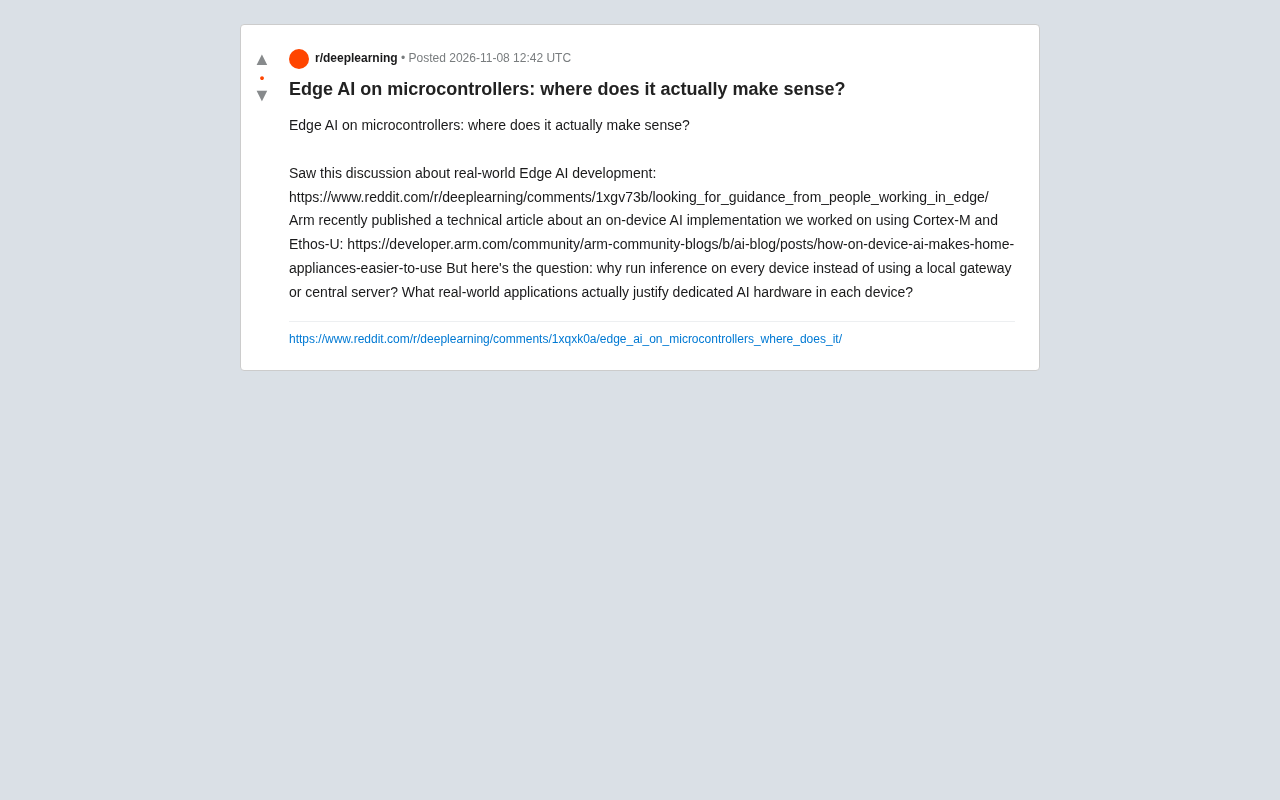
Edge AI on Microcontrollers: When Is It Actually Worth Deploying?
Drawing on Reddit discussions and Arm case studies, this article analyzes the real-world use cases for edge AI on microcontrollers: when each device needs independent inference, when a gateway or cloud is more reasonable, and the costs and boundaries of specialized hardware.
 Tech Frontiers
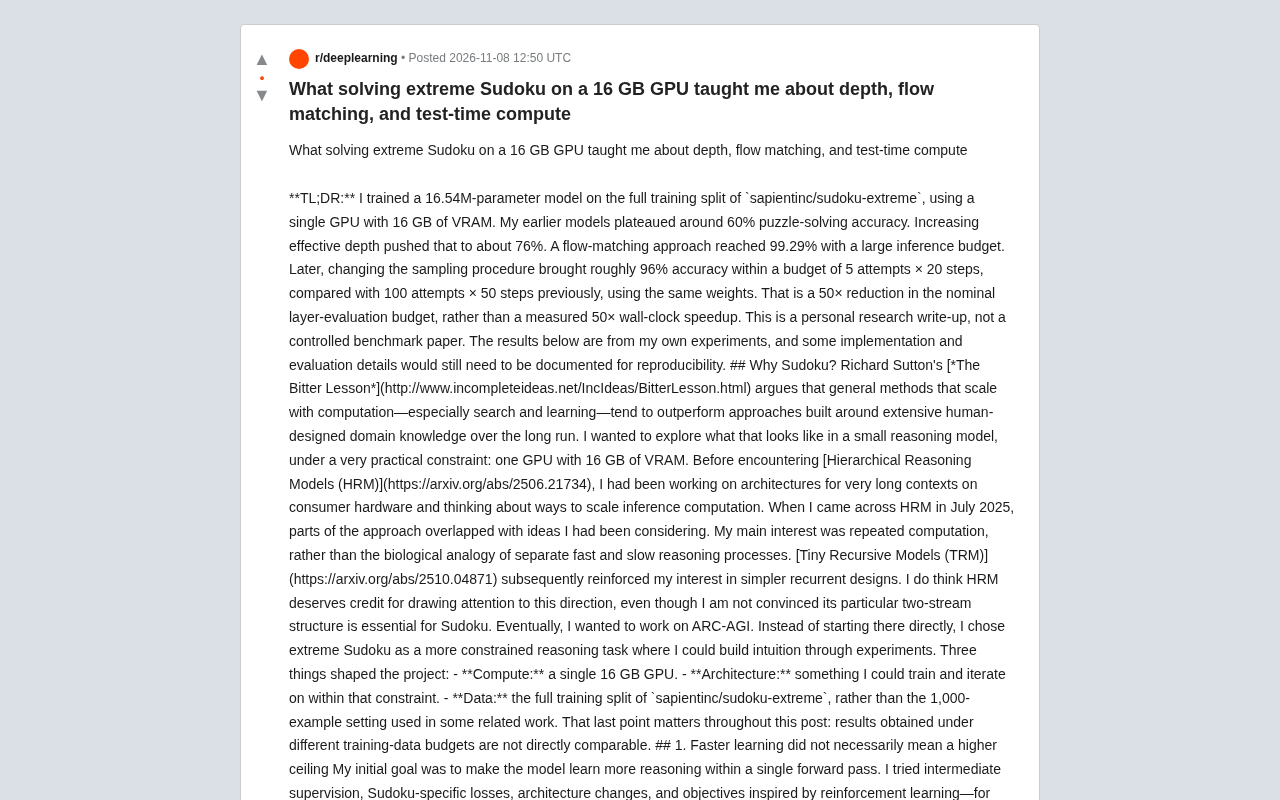
Pushing the Limits of Extreme Sudoku on a 16GB GPU: Insights from Depth and Flow Matching
A researcher trained a 16.54M-parameter model on a 16GB GPU to solve extreme Sudoku, finding effective depth breaks the 60% plateau and flow matching with improved sampling pushes accuracy past 99% with ~50× lower layer-evaluation budget.
 Tech Frontiers
AI Agent Approval Workflows: Why Human Confirmations Always Get Mindlessly Clicked
Why do AI agent approval workflows always get mindlessly clicked? A Reddit discussion shows that separating rules from keys, low-frequency high-risk approvals, and GitHub Environments-style gates are the keys to effective approvals.