Daily AI News · October 21 Morning Edition: MOSS Image Gen & Gemini in Cars
Daily AI News · October 21 Morning Edi…
October 21, 2026 (Wednesday) Morning Edition — AI news roundup + deep dives on hot topics
October 21, 2026 (Wednesday) Morning Edition — AI news roundup + deep dives on hot topics
Lots of new stuff in AI today — hardware, cloud services, in-car assistants, and an open-source image gen model, all in one go.
Today we're mainly covering a few things: first, refurbished Logitech mice on sale; second, Vercel's WebSocket is now generally available; third, Gemini is coming to cars; fourth, a SaaS access review checklist. For deep dives, we've got two: the MOSS-Image open-source image model, and that 500-episode Agent tutorial on Bilibili.
Yeah, pretty packed.
Let's start with the news, one by one.
First one, from The Verge: Logitech's G Pro X2 Superstrike wireless gaming mouse — the official refurbished version is 35% off on Logitech's eBay store. This mouse is interesting — it doesn't have a traditional physical microswitch click. It uses a vibration motor to simulate that clicking feel.
That's a pretty rare approach for a mouse. Using haptic feedback instead of mechanical structure — the upside is adjustable feel, the downside is it's expensive and hard to repair.
Right, and the article says it's already considered last-gen, but the core selling point is still unique. So refurbished is good for trying it out and lowering the risk.
But one heads-up: it's on eBay, not the official store. If you're buying from outside the US, you'll need to figure out cross-border warranty yourself.
Second one, more for developers. Vercel announced WebSocket support for Functions is now generally available. It went into public beta at the end of June, and since then the CDN has handled 300 million connections — steady 15 million a day.
Those numbers show it's handling production load. The key is billing — in Active CPU mode, you only pay when actually processing messages, so idle heartbeats don't burn CPU.
So it basically lowers the cost barrier for long-connection apps. And with native support, you don't need third-party services like Pusher or Ably anymore.
Exactly, the architecture gets a lot simpler. AI chat, streaming, real-time multiplayer apps — all directly benefit.
Third one, from TechCrunch: Google is bringing Gemini's Personal Intelligence feature into cars — it can pull from Gmail, Calendar, Maps, YouTube and other personal data to answer questions.
In-car voice assistants used to just execute simple commands. Now it can combine your schedule and route to give context-aware answers — huge difference in experience.
But here's my question: when you're driving and let the assistant read your emails, where's the privacy line?
That's the double-edged sword. Personalized data is the ecosystem moat — it raises switching costs — but control over cross-service data access is a very real issue. And they haven't said when it launches or which car models will support it.
So the competition in in-car AI has shifted from 'can it understand you' to 'does it understand you well enough.'
Next, two more for enterprise IT, from the WorkOS blog. One is about SaaS access reviews — it says enterprises now have over a hundred SaaS apps, permissions are scattered everywhere, and after someone leaves or changes roles, nobody can confirm the permissions were actually revoked.
That problem is so real. The article gives a four-step framework: reconcile, document, remediate, verify. For reconciliation, use in-app data as the authoritative source, compare against IdP accounts, and first flush out orphan accounts and over-provisioned access.
For documentation, it emphasizes locking in who made the decision and the business justification — otherwise you won't pass SOC 2 or ISO 27001 audits. And remediation needs a single owner — collective responsibility means nobody's responsible.
Finally, verification means pulling a fresh permission snapshot to confirm the changes actually took effect. This whole process is basically turning access management from verbal promises into an auditable evidence chain.
Last one, also from WorkOS — about the difference between employee identity and customer identity. One is centrally managed by IT, focused on security and compliance; the other is led by the product team, focused on conversion and experience.
The key is that in B2B software these two identity types collide on the tenant permission model. The article suggests sharing the underlying identity infrastructure, but keeping policy layers separate — don't force them into one.
One line really stuck with me: identity is the projection of organizational boundaries into software.
Alright, that's the news. Now let's get into the deep dives — starting with a really hot domestic open-source image gen model on Bilibili.
MOSS-Image — the title is pretty bold, saying a domestic open-source image model has broken through. 5B parameters, impressive Chinese long-text and poster layout performance, and potentially deployable locally on a single RTX 4090.
5B parameters is quite restrained for an image gen model. I'd say its real selling points are two: Chinese long-text understanding, and poster layout.
Why those two specifically?
Because those are exactly the weak spots of many open-source image models. They handle English prompts fine, but fall apart on long Chinese sentences — and layout is a chronic problem, with text getting all blurry.
So it's basically targeting the hardest scenarios. And running on a single 4090 — that must be a big draw for developers.
Huge. Think about it — local deployment means your data never leaves, you can tweak freely, and the cost of validating vertical use cases drops dramatically. That's a must-have for teams building design tools or e-commerce posters.
But I saw another voice in the Bilibili comments — saying you should look at real test cases, don't get carried away by the title.
That's a fair reminder. The demo images are definitely cherry-picked. The real test is complex layouts plus long text — run dozens of images in a row and see how stable it is.
So do you think it blowing up right now is a coincidence?
No. First, there's the domestic open-source emotional angle — Bilibili users really respond to that. Second, the 4090 local deployment threshold — it's right at the sweet spot for individual developers and small-to-medium teams.
Plus Chinese long-text and poster layout — that hits the pain points of people doing content and e-commerce domestically.
Exactly. So my take is, the next round of competition in image models won't be about who has more parameters — it'll be about who's more reliable in specific languages and specific scenarios.
To sum up: 5B parameters plus Chinese long-text plus single-card deployment — this combo pushes both the barrier and the experience of open-source image gen forward a step.
Second deep dive, also Bilibili — a tutorial with a really clickbaity title, 500 episodes total, claiming to be the most complete Agent tutorial for beginners in 2026, covering LLM, MCP, RAG — and "get a job after finishing."
I'll laugh at that title first, but seriously, there's a reason it's popular. Agent knowledge updates so fast, a lot of people really lack a structured learning path.
500 episodes — do you think that's a strength or a turnoff?
Both. The strength is full coverage — from LLM basics to MCP to RAG, you can build a complete framework. The turnoff is it's too long — most people won't finish it.
And that "get a job after finishing" line — I don't really buy it. Tutorials can teach you tools, but they can't teach engineering judgment.
I agree with you there. But don't underestimate its value — for people with some foundation, it works as an index, quickly connecting the dots on MCP, RAG and the rest.
So the problem isn't the tutorial itself — it's that people treat it like a crash course.
Right, using it as a map is great; using it as a shortcut is dangerous. Real, deployable Agent skills still come from getting your hands dirty in projects.
So the fact that these tutorials are so popular — does that also show market demand for Agent talent is really rising?
Yes, the demand is real, but the supply side is a mixed bag. My advice: use the tutorial for the framework, build small projects yourself, and don't expect to be job-ready after watching 500 episodes.
To sum up: the 500-episode Agent tutorial is a decent knowledge map, but getting a job — that still comes down to project experience.
Alright, that's it for today — we covered hardware, cloud services, in-car, and open source. See you at noon.
Related articles
 Tech Frontiers
Edge AI on Microcontrollers: When Is It Actually Worth Deploying?
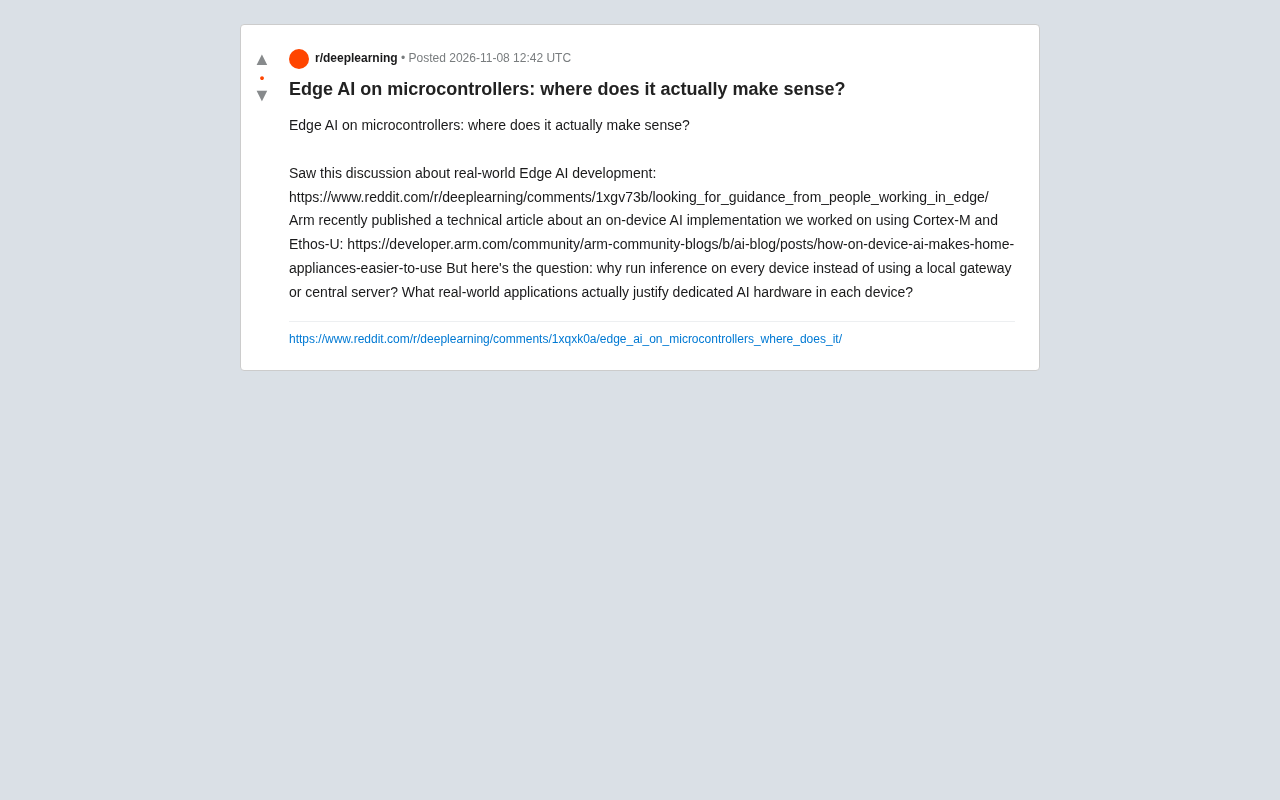
Drawing on Reddit discussions and Arm case studies, this article analyzes the real-world use cases for edge AI on microcontrollers: when each device needs independent inference, when a gateway or cloud is more reasonable, and the costs and boundaries of specialized hardware.
 Tech Frontiers
Pushing the Limits of Extreme Sudoku on a 16GB GPU: Insights from Depth and Flow Matching
A researcher trained a 16.54M-parameter model on a 16GB GPU to solve extreme Sudoku, finding effective depth breaks the 60% plateau and flow matching with improved sampling pushes accuracy past 99% with ~50× lower layer-evaluation budget.
 Tech Frontiers
AI Agent Approval Workflows: Why Human Confirmations Always Get Mindlessly Clicked
Why do AI agent approval workflows always get mindlessly clicked? A Reddit discussion shows that separating rules from keys, low-frequency high-risk approvals, and GitHub Environments-style gates are the keys to effective approvals.