Daily AI News · October 23 Evening Edition: Model Takedowns and the Open Source Revolution
Daily AI News · October 23 Evening Edi…
October 23, 2026 (Friday) Evening Edition: AI news roundup + in-depth discussion of hot topics
October 23, 2026 (Friday) Evening Edition: AI news roundup + in-depth discussion of hot topics
There's been a lot of new action in the AI world today, especially over at Hugging Face — something went down there.
Here's what we're covering today: first, Hugging Face models vanishing en masse; second, an MCP service for Wazuh rule detection; third, a free Cursor Pro tutorial; fourth, ServiceNow's AI Passport; fifth, a new approach called Next-Concept Modeling. For deep dives, we've got two: one is "My Dad Open-Sourced Again" from Bilibili, and the other is a discussion on open source and tech for the greater good. Let's count — five news items plus two deep dives, that's seven things exactly.
Yep, seven. That's the full lineup.
Alright, let's kick off with the news roundup, one by one.
First item: I just saw a post on the LocalLLaMA subreddit saying multiple models on Hugging Face suddenly disappeared, and downloads can't even resume.
Yeah, I saw that. The key point isn't the disappearance itself — it's that the batch that vanished basically all had tags like uncensored, abliterated, for-offensive-cyber.
So this looks more like the platform actively taking them down, not a technical glitch?
Right. Downloads getting stuck and being unrecoverable — that's basically the signature of platform-side removal. If the author deleted it themselves, it usually wouldn't get stuck in that state.
But the post also said there's no official statement, so we can't completely rule out the author self-deleting.
True, but either way, this shows the platform's content governance isn't transparent enough. Developers' dependence on a single platform is itself a risk.
So the takeaway is one sentence: back up key models locally, and factor in content policy risk when planning projects.
Second item: there's a video on YouTube about using an MCP server to let an AI agent catch Wazuh rules that never actually loaded successfully — targeting Wazuh 4.14.9.
That's a pretty practical scenario. Security rules not loading is often the deadliest blind spot, and it's a pain for humans to check.
Having an agent do that kind of troubleshooting is definitely faster than a human digging through logs.
Third item: another YouTube video, title's very direct — teaches you how to get Cursor AI Pro for free, and stresses it's a legal and effective method.
How much do you believe that title? I'm putting a big question mark on it.
Fair enough. But these tutorials always get a lot of heat, which shows people are really sensitive about the price of AI coding tools.
Fourth item: ServiceNow released something called AI Passport, specifically for runtime governance of AI agents.
"Runtime governance" is an interesting term. It means once an agent is running, who's managing it, what it did — there needs to be a record.
Right, in enterprise scenarios this demand is only going to get harder.
Fifth item: someone on the MachineLearning subreddit is talking about Next-Concept Modeling, NCM for short — pretty fresh idea.
This one deserves a bit more. It doesn't go the next-token prediction route — it first learns a multi-level discrete concept encoding.
Concept encoding? Sounds a bit abstract.
Think of it as coarse to fine. During generation, it first sets the coarse-grained layer, then predicts fine-grained encodings layer by layer in parallel, and finally a decoder turns it back into text. The core component is VQ-VAE, which quantizes continuous representations into a discrete codebook.
So where's the speedup?
The researchers report that on specific benchmarks, generation speed can reach 31 times the diffusion language model baseline.
31 times — that sounds pretty wild.
But note, that's only compared to the diffusion baseline, not a full comparison with autoregressive models. Quality, training stability — like codebook collapse — and large-scale generality are all still open questions.
So the takeaway: NCM is worth watching, but that 31x number needs to be seen within the specific benchmark context — don't overinterpret it.
Alright, that's it for the news. Next, let's talk about two hot topics on Bilibili.
First one, titled "My Dad Open-Sourced Again" — Bilibili interaction score 663, pretty hot.
The title itself is a meme. "My Dad Open-Sourced Again" — it's got that proud yet self-mocking vibe.
Think about it — open source has always had a special emotional projection in the Chinese community.
Yeah, it's not just code made public — it's more like a legacy. The older generation of developers puts their stuff out there, and the younger ones pick it up and keep modifying it.
But I have to ask: with so many open source projects now, how many actually get used?
You hit the nail on the head. The barrier to open sourcing is lower, but the barrier to adoption isn't. Docs, maintenance, community responsiveness — those are what determine survival.
So the popularity of stuff like "My Dad Open-Sourced Again" is, in a way, giving emotional endorsement to open source itself.
Exactly. It makes open source feel human, not just a cold repo address.
Second topic, a quote from a Bilibili video: "Of course I hope I won't be revolutionized, but if I must be, I hope the one who revolutionizes me is myself."
That line totally makes sense in the open source context. The essence of tech for the greater good is revolutionizing the old stuff yourself first, then handing it to everyone.
But there's a precondition to that logic — you need the ability to self-revolutionize first.
Right, not everyone can revolutionize themselves. When big companies open source core models, it's backed by compute and talent.
So from another angle, is open source for commercial companies really about the greater good, or just another competitive strategy?
They're not mutually exclusive. An open ecosystem expands influence and forces you to run faster. But to say it's purely altruistic — that's not realistic either.
So some people on Reddit argue open source is idealism, while HN programmers think it's commercial calculation — actually both are half right.
Exactly. Tech for the greater good is real, and commercial motives are real — they're often two sides of the same coin.
To sum up: open source is both ideal and strategy. The key is whether it actually puts capabilities into more people's hands.
Yeah, if it can be handed out, then the greater good holds.
Great chat today — from model takedowns to the new NCM idea, and the emotional side of open source. See you tomorrow.
See you tomorrow.
Related articles
 Tech Frontiers
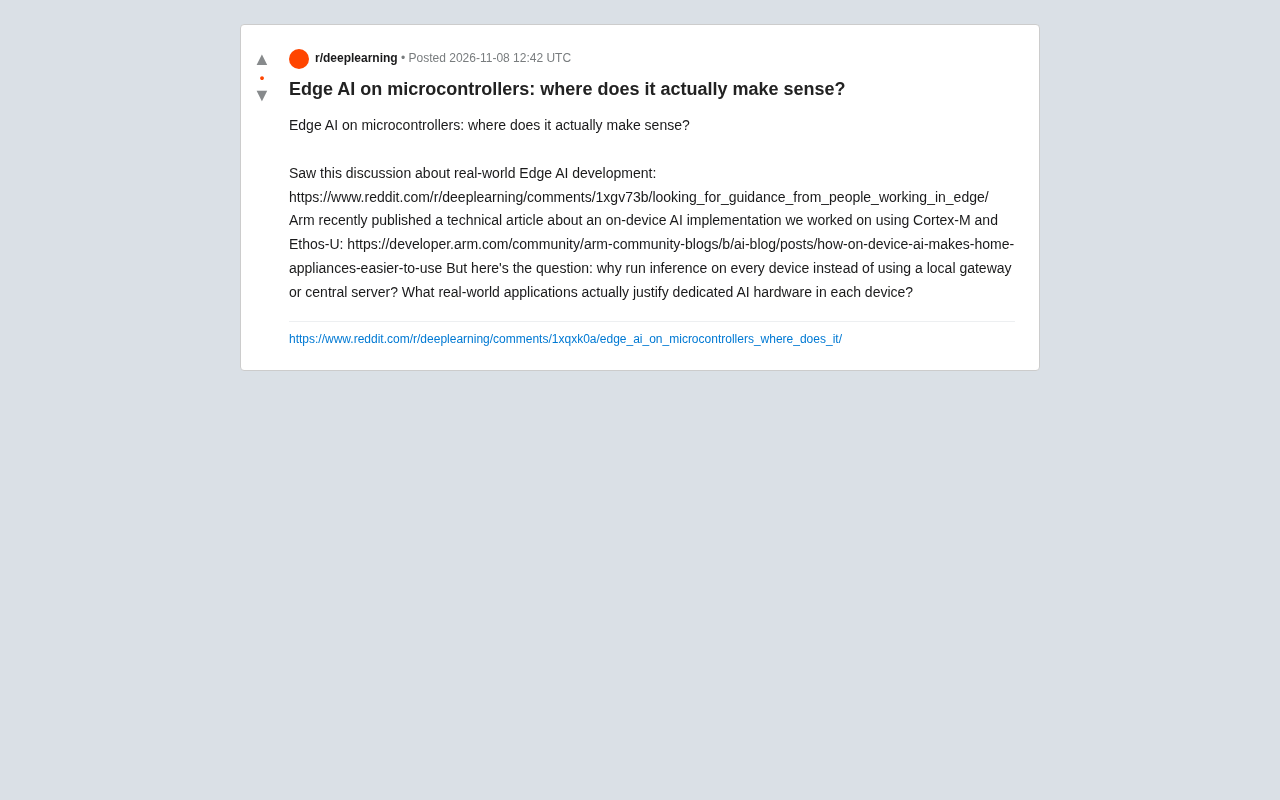
Edge AI on Microcontrollers: When Is It Actually Worth Deploying?
Drawing on Reddit discussions and Arm case studies, this article analyzes the real-world use cases for edge AI on microcontrollers: when each device needs independent inference, when a gateway or cloud is more reasonable, and the costs and boundaries of specialized hardware.
 Tech Frontiers
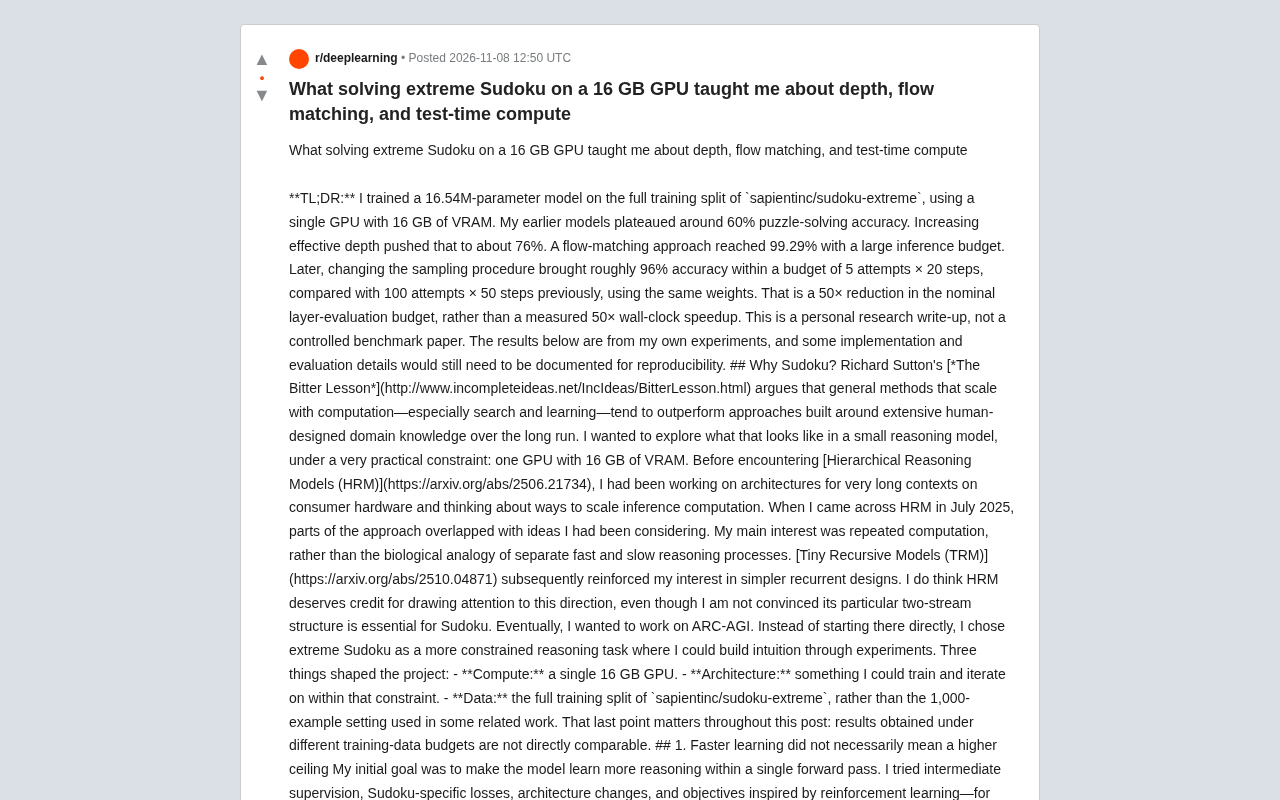
Pushing the Limits of Extreme Sudoku on a 16GB GPU: Insights from Depth and Flow Matching
A researcher trained a 16.54M-parameter model on a 16GB GPU to solve extreme Sudoku, finding effective depth breaks the 60% plateau and flow matching with improved sampling pushes accuracy past 99% with ~50× lower layer-evaluation budget.
 Tech Frontiers
AI Agent Approval Workflows: Why Human Confirmations Always Get Mindlessly Clicked
Why do AI agent approval workflows always get mindlessly clicked? A Reddit discussion shows that separating rules from keys, low-frequency high-risk approvals, and GitHub Environments-style gates are the keys to effective approvals.