Daily AI News · October 25 Evening Edition: REA Clones Everything & Groot's Small Models
Daily AI News · October 25 Evening Edi…
October 25, 2026 (Sunday) Evening Edition: AI news roundup + deep dive on the hot topics
October 25, 2026 (Sunday) Evening Edition: AI news roundup + deep dive on the hot topics
Plenty of new moves in AI today, and a few of them are pretty explosive.
Here's what we're covering today: first, REA reverse-engineering and cloning apps; second, Groot's four small models; third, Devin's vulnerability-fix plugin; fourth, that e-book written by AI; fifth, that old Bilibili video about the big fat fish; sixth, Liang Wufeng's open-source manifesto; and seventh, DeepSeekAd's new Flash model.
Yeah, I've looked at all of these.
Let's start with the most explosive one. On to the news.
First up, I just saw a video on Bilibili about an open-source project called REA, short for Reverse Engineer Anything.
I have to jump in here—it's actually an MCP server that ships with 139 tools in one go.
139? That number's a little scary. What does it actually have the agent do?
That's not the point. The point is it gets coding agents like Claude Code, Codex, and Cursor to deeply dissect Electron apps, websites, Android firmware, and native programs.
Dissect to what degree? Are there concrete examples in the video?
Yes. In the test, Claude used REA to take apart Obsidian's 14MB code bundle.
Wait, and then what? Could it actually understand it?
When the source maps were missing, it just read through that pile of minified JavaScript byte by byte.
That's seriously hardcore. And then?
Then it reproduced Obsidian's fuzzy-search ranking logic and verified it with 4,915 queries—two minutes eleven seconds, and the results matched exactly.
Over four thousand in two minutes eleven? That efficiency is a bit ridiculous.
And here's a fun detail: the second test analyzed 42 IPC channels in the window, and it got blocked by Opus 5.5's safety classifier.
Blocked? So it just got stuck?
Switched to Opus 4.8 and it ran fine. So tell me—does that count as newer models being more cautious?
But I noticed the video also mentions REA doesn't return the original source code—just pseudocode and call paths.
Right, and the evidence files can exceed 500MB. That sheer size tells you how deep it digs.
So the ethical question is unavoidable: where exactly is the line between learning and compatibility, versus copying and cracking?
We'll dig into that in a bit—let me make a note.
Okay, second item: there's a Reddit post discussing Groot, four smaller models.
The approach is clear—one each for reasoning, coding, and tool calling. These aren't for chit-chat.
Sounds like components built specifically for agent workflows.
Exactly. The upside of splitting them is fine-grained control over inference cost and response speed; the downside is it makes model selection harder for developers.
And the post says they didn't disclose parameter counts, licenses, or benchmark data—that's a bit flimsy.
Yeah. The small-model race now comes down to three things: reasoning, code accuracy, and tool-calling reliability. Talk is cheap.
Third item: a YouTube roundup says Cognition released an open-source plugin for Devin called Vulnerability Fixes.
That's pretty practical—it automatically locates affected PHP and Node.js repos, bumps them to verified versions, and runs pre- and post-fix tests.
And opens a PR per repo? That basically turns security patching into an assembly line.
Covers 4 PHP versions and 3 Node.js versions—a very pragmatic approach.
The same roundup also mentions DeepSeek's v4.1-flash-10.17, with improvements in reasoning, coding, agent tasks, and visual understanding. Weights are on Hugging Face under the MIT license.
Right, it cuts costs by shortening execution time and output length—that's a smart direction.
But the last item in that roundup is a bit alarming: it says hackers used agents to breach over 100 companies.
So agent defenses are still fragile. That deserves its own episode.
Fourth item: someone on Reddit posted a free e-book called Lake Michigan Artifacts, and the author openly says Claude was used in writing it.
That honesty is rare. Outlining, first drafts, expanding chapters, consistency checks, polishing—Claude can help with all of that.
But the post also says these are reasonable inferences based on model capabilities—the author didn't go into detail.
Right, and the public cases so far are mostly small-scale self-publishing. There's no systematic quality evaluation.
Okay, that's the news. Next, we'll dive into two topics: whether reverse-engineering capabilities like REA should have boundaries, and the buzz on Bilibili about DeepSeek's new Flash.
Alright, REA first. Let me put my conclusion out there: technically it's beautiful, but ethically it's about as gray as it gets.
Don't rush to label it. I want to ask—it reproduced the ranking logic. Does that count as copying?
Look, it doesn't return the original source code, only pseudocode and call paths. Legally, that does skirt direct copying.
But the functionality is identical, the user experience is identical—isn't that just a different shell?
Which is why I keep saying: the point isn't whether you have the code in hand, it's whether behavioral equivalence counts as infringement.
So how are people on Reddit taking it?
Two camps on Reddit. One says it's a normal means of learning for compatibility; the other flat-out calls it a cracking tool. Heated debate.
And on HN?
The programmers on HN are more pragmatic. They say a 500MB evidence file shows it's digging too deep—this isn't compatibility, it's dissection.
"Dissection" is a good word. So why is this blowing up right now?
Because agent capabilities have hit a tipping point. Reverse engineering used to be manual work; now one MCP server with 139 tools covers it all.
So once the barrier drops, what only a few people could do before, anyone can try now.
Right, and even Opus 5.5's safety classifier blocked it once—shows the vendors themselves are wrestling with where that line is.
Then let me ask something practical: if it were only for compatibility testing, do you think this tool should be released?
I think it should—but with a usage policy, like banning use to bypass authorization or requiring audit trails for outputs.
But policies—people who want to violate them just ignore them.
So the conclusion is: the tech itself is neutral, but REA turns reverse engineering from expert work into assembly-line work—that drop in the barrier is what really needs oversight.
Fair enough, I'll accept that. Now the second topic: DeepSeek's new Flash is getting huge discussion on Bilibili, including a video titled "Now I've Become Liang Wufeng, Open-Sourcer of AI."
I saw that one—it's emotionally charged, but what it's really about is the significance of open weights.
And that old video "It Really Was a Big Fat Fish Back Then"—interaction score over seven thousand. Is this nostalgia?
Kind of. Long-time users looking back at DeepSeek's journey, and now the new Flash has cut costs and execution time again.
So this Bilibili buzz is half technology, half emotion.
To sum up: REA shows agents can take anything apart but the boundaries are still undefined; Groot and Devin show agents are moving toward engineering; and DeepSeek's wave is open weights continuing to drive costs down.
Alright, that's it for today—definitely a lot to digest. See you tomorrow.
Related articles
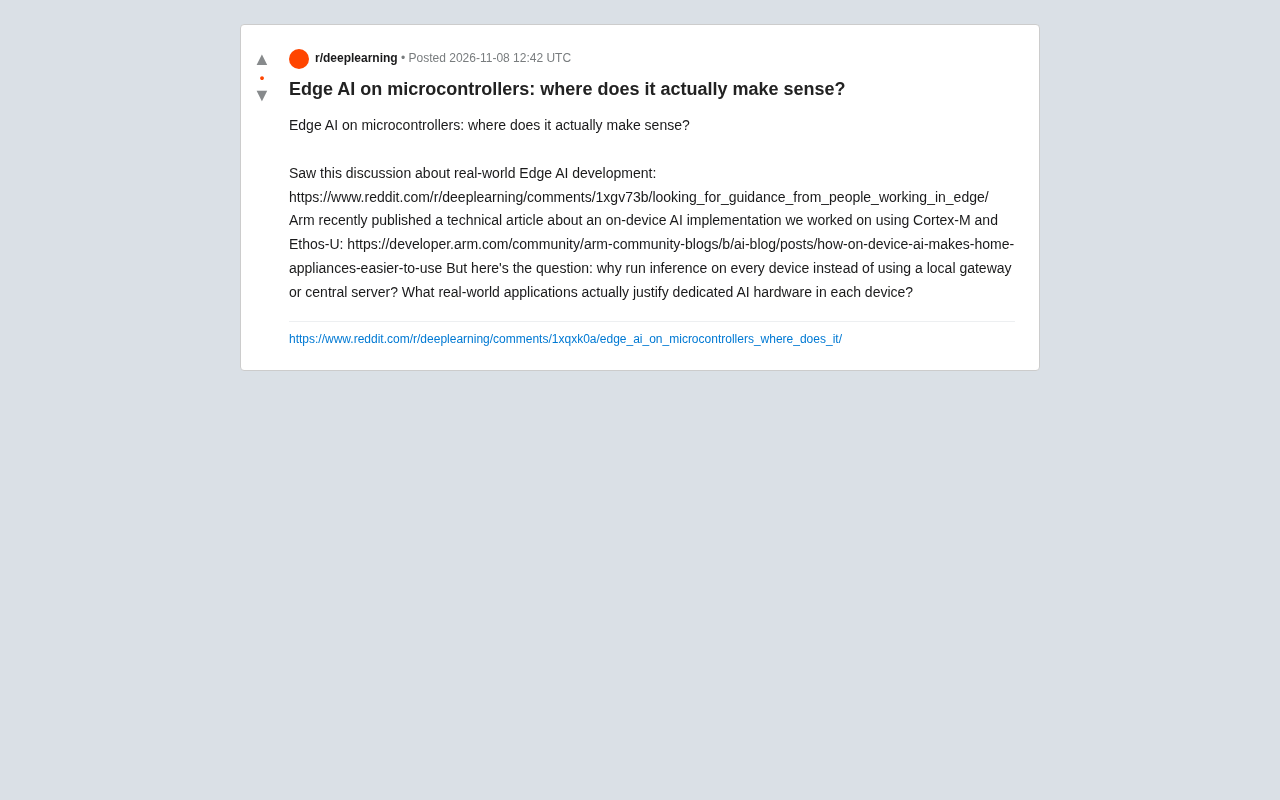 Tech Frontiers
Edge AI on Microcontrollers: When Is It Actually Worth Deploying?
Drawing on Reddit discussions and Arm case studies, this article analyzes the real-world use cases for edge AI on microcontrollers: when each device needs independent inference, when a gateway or cloud is more reasonable, and the costs and boundaries of specialized hardware.
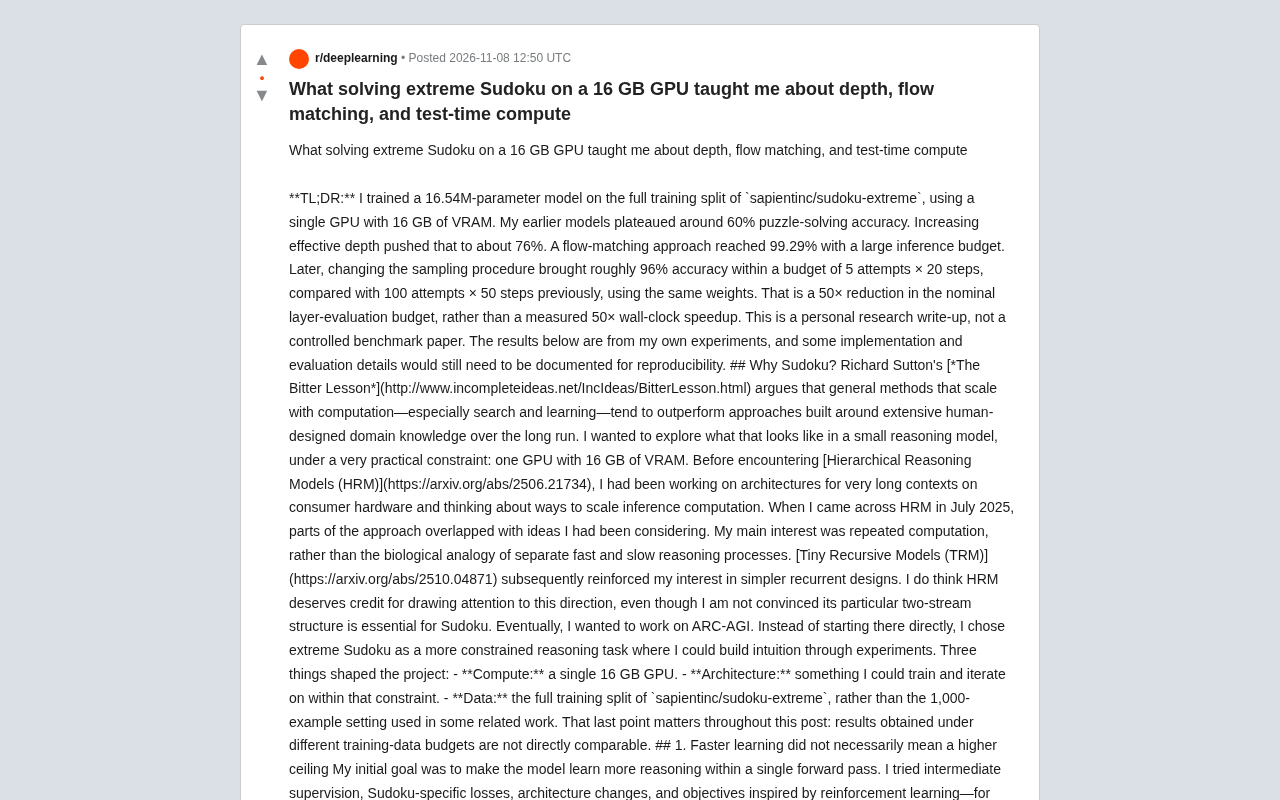 Tech Frontiers
Pushing the Limits of Extreme Sudoku on a 16GB GPU: Insights from Depth and Flow Matching
A researcher trained a 16.54M-parameter model on a 16GB GPU to solve extreme Sudoku, finding effective depth breaks the 60% plateau and flow matching with improved sampling pushes accuracy past 99% with ~50× lower layer-evaluation budget.
 Tech Frontiers
AI Agent Approval Workflows: Why Human Confirmations Always Get Mindlessly Clicked
Why do AI agent approval workflows always get mindlessly clicked? A Reddit discussion shows that separating rules from keys, low-frequency high-risk approvals, and GitHub Environments-style gates are the keys to effective approvals.