Daily AI Buzz · October 26 Midday Edition: A Veteran Engineer Pushes Back & Child-Proof Agent Architecture
Daily AI Buzz · October 26 Midday Edit…
October 26, 2026 (Monday) midday edition — AI news roundup plus deep dives on the hot topics
October 26, 2026 (Monday) midday edition — AI news roundup plus deep dives on the hot topics
Lots of new stuff happening in AI today — Monday's off to a busy start.
Today we're mainly covering a few things: first, a veteran engineer pushing back on the anti-AI arguments; second, a child-proof agent architecture;
then a roundup of reading-tracker apps, plus raising an agent as a god in a sandbox, and finally an ADHD startup buddy and a test to find your soulmate agent.
Yeah, sounds like a grab bag, but it's all interesting.
Right, so let's start with that pretty heated post on Reddit.
An engineer with fifteen years of experience, who even worked at Google, posted that he's just had enough of the anti-AI rhetoric.
I remember that one. His example was really specific — debugging tail latency in a C++ search service.
Before, you'd manually chase RPC call chains, dig through traces and profiles, build reproducers — days of work. Now with an assistant like Opus, you can pinpoint deadline propagation issues across files in an afternoon.
But he didn't oversell it, either — he said humans still have to own the fix and still have to do load testing.
Right, that's what makes him reasonable. But that's not the main point — the main point is what he said: accept that AI is better than you at some tasks, so you can free up time for higher-value judgment.
That stings a little for us product managers, but it's true.
Number two — let's talk about that child-proof agent architecture. The title's a real grabber.
The core idea is one line: verification over orchestration. Don't lock the model's path down with flowcharts.
Precise operations like counting, rendering, data cleaning — hand those to code scripts. Check evidence at every step, and let the model plan inside the loop itself.
Wait — so that's basically the harness itself being the app? And behavior definition switching to plain-English profiles?
Exactly, so domain experts can tune it directly. They used the same codebase to run two completely different scenarios — bank customer service and airline surveys.
Did he mention the costs? I always feel like giving up that much control must have downsides.
He was upfront about it. Rigid workflows have three traps: workarounds lose value as models iterate, flowcharts assume the wrong invariants, and domain experts get locked out.
The costs are token consumption, latency, and sandbox security issues. He didn't dodge any of that.
Alright — honestly, articles that dare to talk about the costs make me trust them more.
Third one's lighter — TechCrunch rounded up a few apps for tracking reading and discovering new books.
I skimmed that. Goodreads is strong on community and reviews, StoryGraph does fine-grained personalized recommendations, and Libby connects straight to public libraries to borrow ebooks and audiobooks.
Is that very AI-related? I'm kind of curious why it made the cut for this episode.
Strictly speaking, not really — it's just a practical list. The advice is to pick based on your core needs and combine them.
Okay, we won't dwell on that. Next one's pretty interesting.
Someone on Reddit asked: I want to treat an AI agent as a god in a sandbox — is that crazy?
The idea itself is basically multi-agent simulation layered on top of an intervenable sandbox environment.
You don't need to train models from scratch to build agents anymore — frameworks like AutoGen, CrewAI, and LangGraph have lowered the bar a lot. And for the sandbox, just borrow Minecraft or Godot.
So where are the underrated hard parts? I'd like to hear that.
Scheduling logic, world-state sync, and the engineering problems of multiplayer. Completely free isn't realistic, but small models splitting the work plus limiting inference frequency can run a prototype on the cheap.
The practical path is to start with a pure text turn-based version, validate whether it's fun, then hook up an engine.
Alright, that's it for the news. Next, let's dig into those two really popular AI-application videos on Bilibili.
One's called "I Made an ADHD Startup Buddy with an AI Phone" — 18,000 interactions, really hot.
What's clever about this topic is it's not showing off tech — it's solving a real pain point. For people with ADHD, the hardest part is just getting started on something.
Right — from a product view, helping someone get over that starting threshold is worth way more than one more fancy feature.
And using the AI phone as the载体 — sorry, as the vehicle — that's a signal. Phones are personal devices, naturally suited to this kind of real-time interruption and companionship.
But I have to push back: does this actually help people, or just make them feel helped?
Good counterexample. If it just sends daily reminders, it's no different from an alarm clock. The key is whether it can break tasks down small enough that people actually start moving.
Agreed. So the real moat for this kind of product is turning a vague "I want to do it" into a concrete first step.
Then there's another one: "Don't Know How to Choose? 10 Questions to Find Your Soulmate AI Agent" — 4,700 interactions.
That's classic quiz-style content, but I think it'll spread well. Faced with a pile of agents, people really don't know which to pick.
But isn't that contradictory? Can ten questions really find your soulmate? Feels more like an entertainment quiz to me.
Your instinct is right. Technically, ten questions don't carry enough information for precise matching.
But its value is lowering the cost of choosing. Route users into a rough direction first, then let them try things themselves — way better than staring blankly at a list.
That makes sense. It's more like an entry point — turning selection anxiety into a lightweight decision.
Right, so I won't fault it for not being precise. As long as you don't treat the result as gospel and just use it as a starting point, it's fine.
To sum up, these two videos are popular for the same reason — both lower the barrier for users. One lowers the barrier to action, the other lowers the barrier to choosing.
Well put. It also shows that with AI apps today, it's not about parameters — it's about whether they can fit into specific everyday scenarios.
Alright, good chat today. See you tonight!
Related articles
 Tech Frontiers
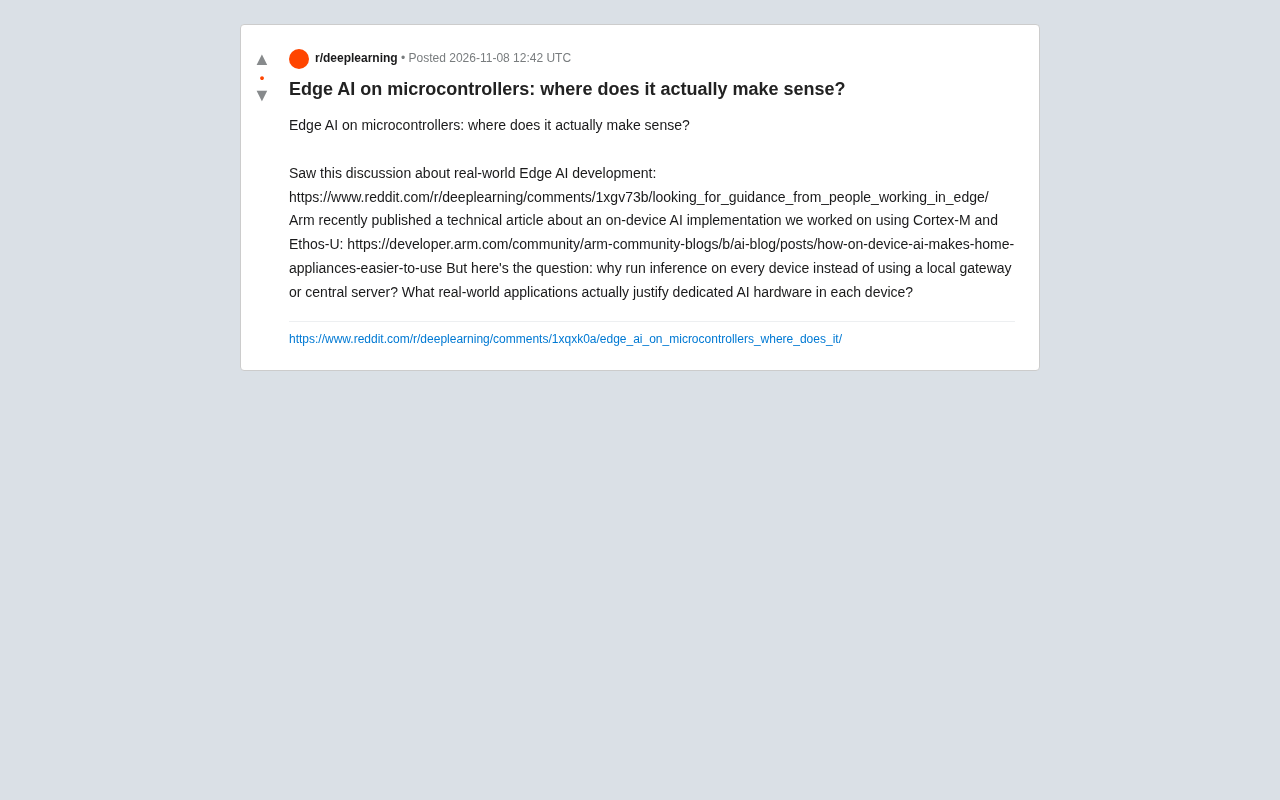
Edge AI on Microcontrollers: When Is It Actually Worth Deploying?
Drawing on Reddit discussions and Arm case studies, this article analyzes the real-world use cases for edge AI on microcontrollers: when each device needs independent inference, when a gateway or cloud is more reasonable, and the costs and boundaries of specialized hardware.
 Tech Frontiers
Pushing the Limits of Extreme Sudoku on a 16GB GPU: Insights from Depth and Flow Matching
A researcher trained a 16.54M-parameter model on a 16GB GPU to solve extreme Sudoku, finding effective depth breaks the 60% plateau and flow matching with improved sampling pushes accuracy past 99% with ~50× lower layer-evaluation budget.
 Tech Frontiers
AI Agent Approval Workflows: Why Human Confirmations Always Get Mindlessly Clicked
Why do AI agent approval workflows always get mindlessly clicked? A Reddit discussion shows that separating rules from keys, low-frequency high-risk approvals, and GitHub Environments-style gates are the keys to effective approvals.