Daily AI Scoop · October 29 Morning Edition: DHS Data Breach & the Agent Data Backbone
Daily AI Scoop · October 29 Morning Ed…
October 29, 2026 (Thursday) Morning Edition — AI news roundup + deep dive on the hot topics
October 29, 2026 (Thursday) Morning Edition — AI news roundup + deep dive on the hot topics
Lots of new stuff in the AI world today, and a few of these are a little worrying.
Here's what we're covering today: one, a forty-thousand-person data breach. Two, Agents love Supabase. Three, the FCC bans foreign devices. Four, an insanely expensive touchscreen MacBook.
Five, Anthropic's spending tool. Six, the ADHD launch buddy.
Yep, six of them. Let's take them one by one.
Okay, let's start with the one that hits hardest. News item one: the forty-thousand-person data breach.
Just saw the TechCrunch piece. A hacker published the personal info of over forty thousand DHS employees, including CBP and ICE law enforcement officers.
Forty thousand people. And it wasn't random — this was clearly targeted.
Right, and the key thing is the data looks deliberately filtered, not some random credential-stuffing dump. When you tie law enforcement identities to personal data, the risk goes way beyond privacy.
So what does that mean? Doxxing, harassment, even physical threats?
Exactly, you can build a targeted profile. So this is a reminder for anyone in AI and tech too — tiered permissions, encrypted storage, anomaly detection on access. You can't skip any of them.
The attack method and who did it haven't been disclosed yet, but the systemic permission gaps are already out in the open.
Next, item two: Agents love Supabase. I'm pretty interested in this one — just saw it on Latent Space.
Supabase's two founders made a point that what agents really need is persistent state, programmable APIs, fine-grained permissions, and vector search.
Wait, isn't that just a bunch of infrastructure capabilities? What's the connection to a database?
That's the whole point. It uses Postgres plus pgvector to put structured data and semantic search in the same transaction boundary, so you don't need cross-database syncing.
Oh, so that old consistency problem just gets sidestepped.
And it's open source, built on standard Postgres. On portability, that's something enterprises really care about when they're buying.
So the takeaway is, the competition in agent infrastructure is shifting from model capability to data and state management.
Item three: the FCC bans foreign devices. Just saw it on The Verge — the first batch is drones, routers, and Roomba robot vacuums.
Yeah, and the original piece straight-up used the term 'xenophobic stance' to describe the US position. That's some strong wording.
This ban isn't a one-shot deal — it rolls out category by category, enforced through certification and licensing.
It moves fast, transparency is low, and on the consumer side you get fewer choices and likely higher prices. On the industry side, competition shifts from performance and price to country-of-origin compliance.
Which categories come next, how it'll actually be implemented — none of that's clear yet, and that uncertainty is kind of the defining feature right now.
Item four: the insanely expensive touchscreen MacBook. A YouTube video — a touchscreen MacBook Pro costing over fourteen thousand five hundred dollars.
Fourteen thousand-plus dollars. That's enough to buy a decent used car.
Right? The video didn't go into much detail, but that number alone is enough to scare anyone off.
Item five: Anthropic's spending tool. Just saw the TechCrunch report — Anthropic launched a new tool that lets enterprises see what their AI spending actually buys them.
Basically, it takes the token billing black box and makes it traceable and attributable. And the timing is interesting — they're preparing for an IPO.
So it's both a response to enterprises questioning ROI and a signal to the capital markets that the product is measurable and manageable.
But the tool's value still depends on whether enterprises can use that data to make better decisions, and whether Anthropic can turn cost visibility into perceived customer value.
Alright, that's the news. Next, let's talk about a really hot topic lately — the ADHD launch buddy.
There's a video on Bilibili — 'I made an ADHD launch buddy with an AI phone' — and it's got over eighteen thousand interactions, super hot.
'Launch buddy' is a great term. With ADHD, the hardest part isn't doing the thing — it's getting started.
Right, like having someone there to give you a push. But can you really do that with an AI phone?
Think about it — the phone's already right there in your hand. It can sense your state and proactively trigger reminders. That's a way lower barrier than a separate app.
But isn't that a contradiction? The phone itself is the biggest distraction. Using it as a buddy is like inviting the wolf in.
And that's exactly the key point. It's not about that — it's about whether the interaction can be short enough and interruptive enough, instead of just opening another feed.
So really it's not about how smart the model is — it's about whether the product form can nail that one second of getting started.
Exactly, and it's the same logic as Anthropic's spending tool. AI's value has to land on measurable actions in a concrete scenario, or it's just spinning its wheels.
There's also a Dify tutorial on Bilibili with over fifteen thousand interactions — from beginner to expert, thirty-plus enterprise-grade hands-on projects. Looking at these two together is interesting.
One's a small personal tool, the other's enterprise app building — which shows both ends of AI adoption are moving toward hands-on execution.
So the summary is — whether you're building an ADHD buddy or an enterprise app, success comes down to whether you can fit AI capability into a concrete, perceptible loop.
Agreed. Model capability isn't the bottleneck anymore — scenario and state management are.
Alright, that's it for today's episode. See you at noon.
Related articles
 Tech Frontiers
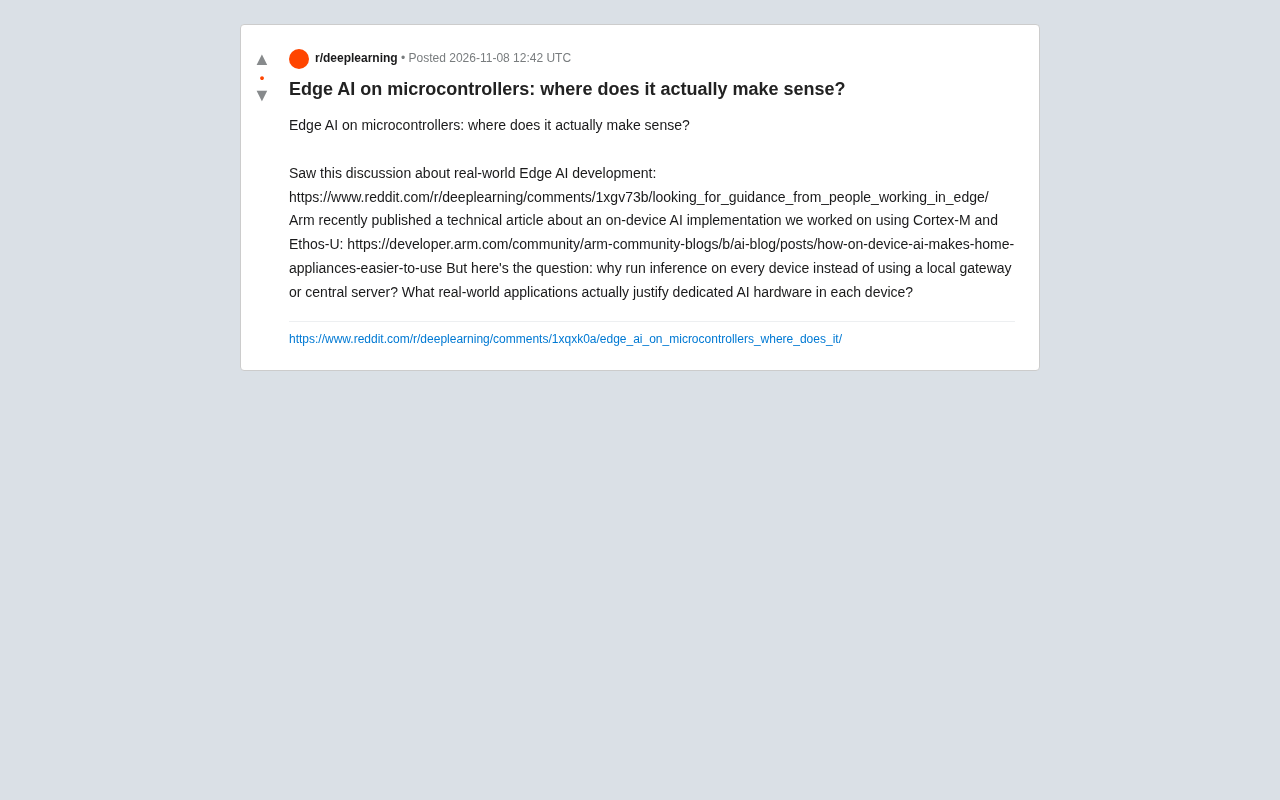
Edge AI on Microcontrollers: When Is It Actually Worth Deploying?
Drawing on Reddit discussions and Arm case studies, this article analyzes the real-world use cases for edge AI on microcontrollers: when each device needs independent inference, when a gateway or cloud is more reasonable, and the costs and boundaries of specialized hardware.
 Tech Frontiers
Pushing the Limits of Extreme Sudoku on a 16GB GPU: Insights from Depth and Flow Matching
A researcher trained a 16.54M-parameter model on a 16GB GPU to solve extreme Sudoku, finding effective depth breaks the 60% plateau and flow matching with improved sampling pushes accuracy past 99% with ~50× lower layer-evaluation budget.
 Tech Frontiers
AI Agent Approval Workflows: Why Human Confirmations Always Get Mindlessly Clicked
Why do AI agent approval workflows always get mindlessly clicked? A Reddit discussion shows that separating rules from keys, low-frequency high-risk approvals, and GitHub Environments-style gates are the keys to effective approvals.