Daily AI Bites · October 31 Morning Edition: AI Law Firm Acquisition & Google Search's Predicament
Daily AI Bites · October 31 Morning Ed…
October 31, 2026 (Saturday) Morning Edition — AI news roundup + in-depth discussion of hot topics
October 31, 2026 (Saturday) Morning Edition — AI news roundup + in-depth discussion of hot topics
Lots of new buzz in the AI world today. I scrolled through everything this morning — from the legal world to Android development, there's a lot to unpack.
Here's what we're covering today. First, AI law firm Crosby bidding for the veteran firm Weil Gotshal. Second, a new approach to cross-device interaction on Android. Third, the AI paradox in wealth management onboarding. Fourth, Google Search facing 'Google Zero.' And fifth, the three-R framework for Bitmap memory optimization.
Then in the deep-dive segment, we'll talk about two hot topics. One is the wave of releases led by DeepSeekAd V4.1 Pro, and the other is the open-source Agent-Live2D bridge workbench.
Yeah, these are all pretty meaty.
Alright, let's get started. Let's begin with the most explosive one.
Just saw a TechCrunch report — AI law firm Crosby has formally made a bid for Weil Gotshal. That's a Wall Street powerhouse, and now it's on the verge of breaking apart.
This case is really symbolic, I think. The point isn't the M&A deal itself — it's the playbook they're using.
See, Crosby wants to get three things fast through this deal: client relationships, case databases, and brand reputation.
Wait — isn't that just the tech world's playbook? Trade capital for time, trade acquisitions for data?
Exactly. Traditional law firms' moats are collapsing under the double squeeze of high costs and talent drain. AI companies aren't looking at a law firm — they're looking at an asset package.
But the legal profession is all about accountability and trust. Can you really acquire that?
That's where it gets uncertain. Accountability mechanisms, ethics, client trust, plus asset depreciation and integration hurdles — all variables.
So whether it goes through or not, this whole thing shows AI legal companies are moving from selling tools to directly delivering services.
Alright, second item — let's get a bit more technical. There's something new in Android cross-device.
There's a YouTube video that lays it out pretty clearly. People now have three or four devices each, and globally there are about 22 billion IoT devices — cross-device has become basic infrastructure for apps.
But if developers build it themselves with low-level network and Bluetooth APIs, they hit three walls: battery and memory overhead, unpredictable latency, and connection friction.
So the Android team offers three dedicated APIs: Companion Device Manager, Jetpack Telecom, and Quick Share SDK. Each has its own boundaries.
That's a good approach — instead of everyone reinventing the wheel, the platform fills in the gaps.
Then third — there's a Databricks blog post about wealth management with a pretty counterintuitive take.
I read it. It says onboarding bottlenecks usually aren't about one step failing — it's the handoffs between steps that break down.
AI is great at handling unstructured information — document classification, field extraction. But process orchestration and exception judgment? It really can't do that. That involves institutional risk appetite and regulatory context.
So the conclusion is: rather than polishing individual models, invest in orchestration capability — and the returns could be higher?
Right, and it gives a good evaluation criterion too. Look at whether AI output has structured state, whether it's traceable, and design processes around the client application.
Fourth one's a bit of dark humor. 'Google Zero' — this time it's aimed at Google itself.
In its earnings report, Google itself admitted that AI search monetizes worse than traditional search — and the stock took a direct hit.
There are two fatal problems here. One: the product is highly commoditized against ChatGPT and Claude, so user switching costs are extremely low.
The other is even worse. Google stops sending traffic outward, web content supply shrinks, which in turn weakens its unique indexing advantage — creating a negative loop.
The traditional full-web index plus click feedback loop was a nearly irreplicable moat. And now they're dismantling it themselves.
So the article says the hard part of fixing this is the business model, not the technology. That's a heavy statement.
Last item — for Android developers. Memory optimization, the Bitmap one.
Engineers from the Android team tested about 500 popular apps and proposed a three-R framework: Reduce, Reuse, Recycle.
The key insight is that Bitmap memory is determined by decode dimensions and color depth — not file size. A few full-resolution images can eat up hundreds of MB.
They identified over 15 categories of high-frequency anti-patterns, and the core commonality is one thing: decode dimensions far exceeding display needs.
And I see Google Play has already set a memory quality threshold, enforced starting February 2027. Developers need to get moving.
Alright, that's the news for now. Let's dive into today's hottest topics.
First one — Uncle Will's daily AI update on Bilibili shot past ten thousand engagement points. It listed a whole bunch of things in one go.
DeepSeek V4.1 Pro about to launch, Gemini's office suite going live, Qwen 4.0 with a date set, and a 1T flagship open-source model from Europe.
This release density is honestly a bit scary. Think about it — within one week, everyone from domestic to international is dropping cards.
And notice those keywords: Pro, full suite, date set, 1T open-source. They're all going big and comprehensive.
The 1T open-source one interests me most. Europe open-sourcing a flagship with trillions of total parameters — that's a big move.
Right, but think about it — wasn't there someone in Europe saying 'build or surrender'? Now they're actually putting out a 1T flagship open-source model — that's fighting for AI sovereignty.
But let me throw some cold water here. Lots of releases doesn't mean everyone's stuff is actually competitive. Commoditization is also a risk.
I half agree. The release wave itself is a signal — it means compute and inference costs are coming down, which is why everyone dares to play their cards densely.
So if a user had to choose right now — facing DeepSeek V4.1 Pro, Qwen 4.0, and that 1T open-source model — how would they pick?
I'd say look at the use case first. If you want an office suite, tie into the ecosystem. If you want autonomy and control, look at the open-source one. The model capability gap is actually narrowing.
So the conclusion is: the real significance of this release wave is that models are going from scarce goods to replaceable commodities. The competitive focus will shift to product and ecosystem.
Alright, the second hot topic also comes from Bilibili, but the vibe suddenly shifts. An open-source Agent-Live2D bridge workbench has been released.
The name's pretty funny — 'let the big fat fish drive Live2D.' Basically, it lets an agent drive a virtual avatar.
I think this is pretty interesting. It's essentially connecting agent output to a presentation layer — a bridge workbench.
So besides being fun, does this have any practical value? My first reaction is it's a demo.
Don't jump to conclusions. Virtual streamers, companion apps — they all need agents to have an avatar outlet. Once this is connected, the imaginative space is significant.
I still think projects like this are more about technical validation right now — there's still a way to go before productization.
Let's agree to disagree. But at least it proves one thing: the boundaries of agents are expanding from text to multimodal presentation layers.
Alright, that's about it for today. Definitely a lot to take in — take your time digesting it.
I'm Xiaoyu. See you at noon.
Related articles
 Tech Frontiers
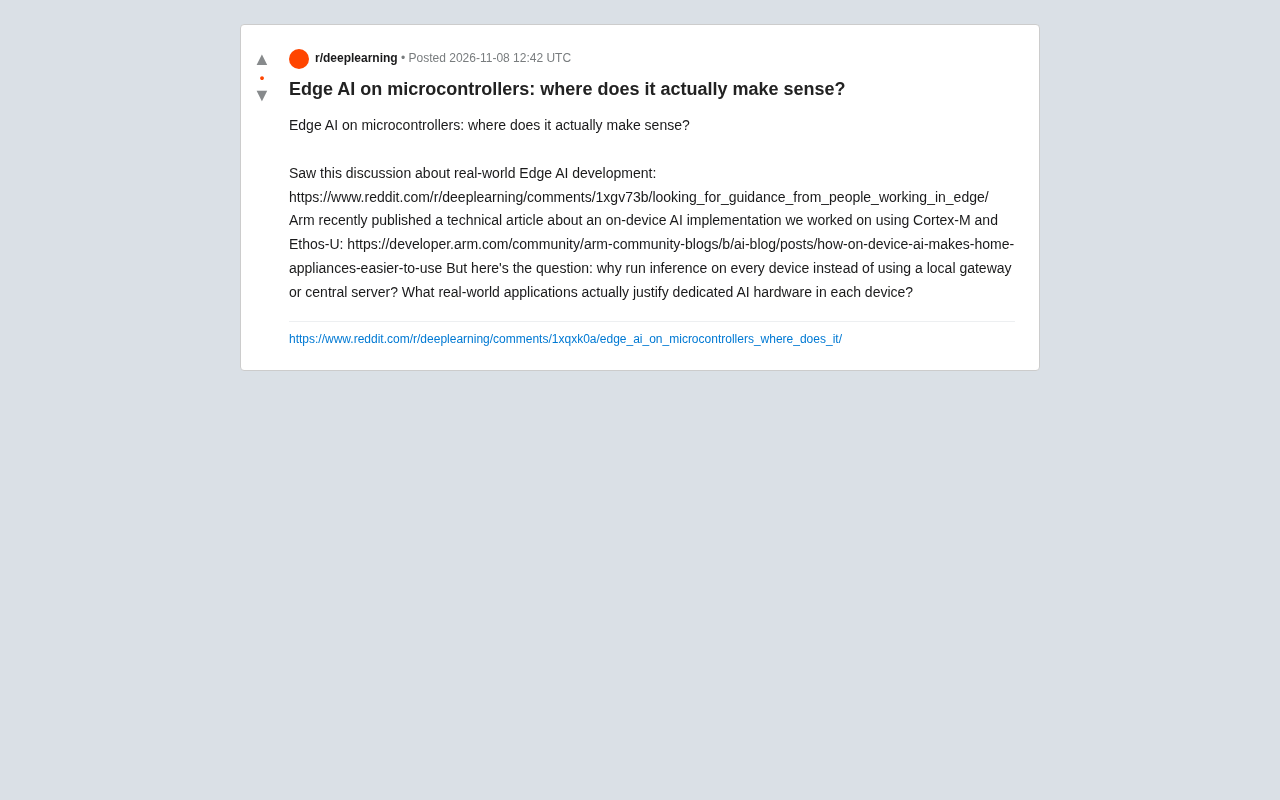
Edge AI on Microcontrollers: When Is It Actually Worth Deploying?
Drawing on Reddit discussions and Arm case studies, this article analyzes the real-world use cases for edge AI on microcontrollers: when each device needs independent inference, when a gateway or cloud is more reasonable, and the costs and boundaries of specialized hardware.
 Tech Frontiers
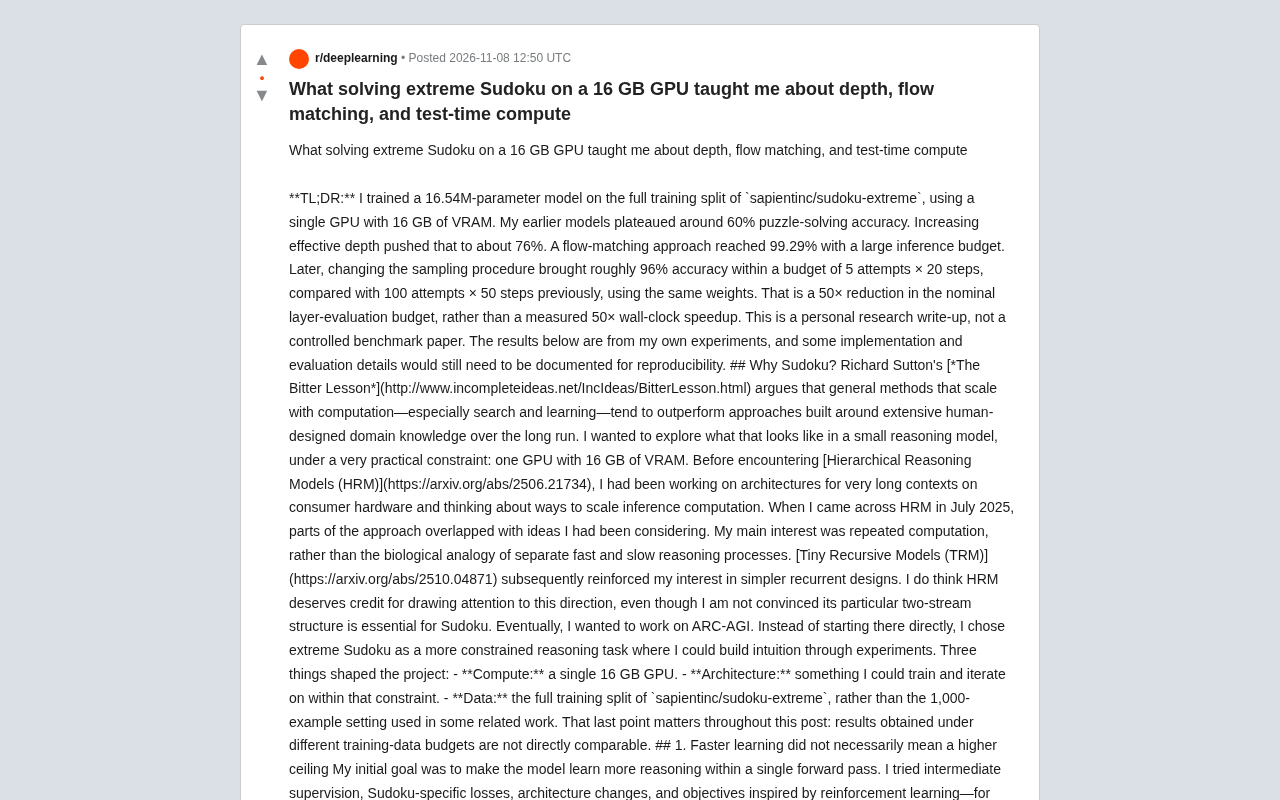
Pushing the Limits of Extreme Sudoku on a 16GB GPU: Insights from Depth and Flow Matching
A researcher trained a 16.54M-parameter model on a 16GB GPU to solve extreme Sudoku, finding effective depth breaks the 60% plateau and flow matching with improved sampling pushes accuracy past 99% with ~50× lower layer-evaluation budget.
 Tech Frontiers
AI Agent Approval Workflows: Why Human Confirmations Always Get Mindlessly Clicked
Why do AI agent approval workflows always get mindlessly clicked? A Reddit discussion shows that separating rules from keys, low-frequency high-risk approvals, and GitHub Environments-style gates are the keys to effective approvals.