Daily AI News · Nov 1 Morning Edition: DeepSeek V4.1 Pro and Agent Security
Daily AI News · Nov 1 Morning Edition:…
Nov 1, 2026 (Sunday) morning edition — AI news roundup plus deep dive on the hot topics
Nov 1, 2026 (Sunday) morning edition — AI news roundup plus deep dive on the hot topics
Lots of new stuff in AI today — from keyboards all the way to agent security. Quite a spread.
Here's what we're covering today: first, keyboards as brain-computer interfaces; second, a multi-model CLI assistant;
third, Binance's theft compensation; fourth, agent security tags; fifth, Demoscene small models;
and finally, a deep dive on DeepSeekAd V4.1 Pro and hooking Claude Code up to DeepSeek.
Mm.
Alright, let's run through the news. First up, I just saw a pretty interesting retrospective on The Verge.
The Verge? Don't they do keyboard reviews all the time?
Yeah, but this time they took a new angle — saying the keyboard might be humanity's earliest and most widespread brain-computer interface.
That's an interesting way to put it. I mean, voice and touchscreens are so mature now, but who uses voice when they're writing code?
Nobody, really. They say the keyboard relies on physical feedback and muscle memory — skilled typists can output close to the speed of thought.
That's not even the main point. The point is it's a high-bandwidth, low-latency output channel. The problem with voice is the cost of correcting errors is way too high.
So all those custom keyboard people obsessing over switches and keycaps are really just optimizing their workflow?
Exactly — same logic as tuning your dev environment: reduce friction. For complex information tasks, the keyboard's still the go-to for now.
Okay, number two. There's a really practical post on Reddit about building a fault-tolerant CLI AI assistant in Python from scratch.
Using LangChain and Pydantic, right? The multi-model orchestration one.
You actually read it. It treats multiple models as interchangeable backends — if one goes down it auto-switches to a backup, and a validation failure counts as a soft failure that triggers fallback.
That's a pretty engineering-minded approach. Timeout retries, fallback chains, state isolation — the full trio.
Number three's a bit of a bombshell — Binance's CEO says they've already covered 90% of the stolen assets.
The six-point-three-billion-dollar case? Covering 90% straight from their own funds — that's a big move.
Yeah, totally different from exchanges that go through insurance or issue debt to pay people back.
But think about it — this actually exposes the risk of centralized custody. Proof of reserves and transparency are what matter long term.
Number four, also from Reddit — a discussion about agent security. The keywords are provenance tags and the Lethal Trifecta.
I think this is the most technically meaty one today. Provenance tags get lost really easily in multi-tool calls.
What's the Lethal Trifecta? Sounds like some kind of attack chain.
It's when you have sensitive data access, untrusted input processing, and external action execution all at once. That's the fundamental difference between agent security and traditional security.
So they recommend input isolation, least privilege, structured provenance propagation, and human-in-the-loop?
Right, but how tags propagate in multi-agent collaboration, and how to automate detection — those are still unsolved.
Last news item — someone on Hacker News trained a model on a Demoscene dataset.
Ah, Demoscene — that digital culture where people make stunning visuals in tiny file sizes. High information density.
Yeah. The author says data quality beats quantity, and picking a niche, high-quality vertical dataset is a way to differentiate.
I agree with that. Mainstream models are all racing on scale, so going the opposite way is definitely a strategy. Though the community's also arguing about copyright and ethics.
Alright, that's the news. Now let's dig into a topic that's been really hot lately.
On Bilibili, Uncle Will's daily AI updates — one video broke ten thousand engagement points, and the titles are all big scoops: DeepSeek V4.1 Pro is about to drop.
Plus the Gemini office suite going live, Qwen 4.0 with a release date, and a 1T flagship open-sourced in Europe, right?
Yep. Let's start with DeepSeek V4.1 Pro — the version number's kind of subtle, just one extra point-one.
Small version numbers like that usually aren't regular iterations. My guess is targeted tuning — probably aimed at agent scenarios.
Why do you figure that? Pro plus point-one sounds like patching things up.
Look at what's all landing at the same time — the Gemini office suite, Qwen 4.0, the European 1T open-source model. They're all pushing down to the application layer.
So it's not just about climbing leaderboards — it's about grabbing real-world use cases?
Exactly. The capability gap between models is narrowing — whoever can make agents run reliably in real workflows wins. That's what a version number like V4.1 really means.
Speaking of running reliably — the second one is super down-to-earth. A tutorial on hooking Claude Code up to DeepSeek, with a China mirror plus official config.
I saw that one. Basically you use Claude Code as the shell and swap the backend to DeepSeek. Costs drop instantly.
So here's the question — is what you get still reliable? Claude Code was tuned for Claude, after all.
That's exactly where that fault-tolerant CLI idea from the news comes back in. Multiple models, interchangeable — the key is a solid orchestration layer.
But I feel like the toolchain and the model are deeply coupled. Swap the backend and the experience definitely takes a hit, right?
Sure it does, but think about it — for budget-sensitive teams, getting sixty-percent-quality work done with eighty-percent capability? That's a real need.
Alright, alright, I partly agree. But who fills in the gaps on tool-call formats and prompt adaptation?
The community, of course. The fact that a Bilibili tutorial like this exists proves people are already filling them in. That's a signal of the ecosystem forming on its own.
So to sum it up — the core of this wave isn't whose model is stronger, it's who can get agents into real workflows and keep them cheap.
Right. DeepSeek V4.1 Pro and hooking Claude Code to DeepSeek are really two sides of the same thing: capability moving down, costs coming down.
Okay, that's it for today. See you at noon.
Related articles
 Tech Frontiers
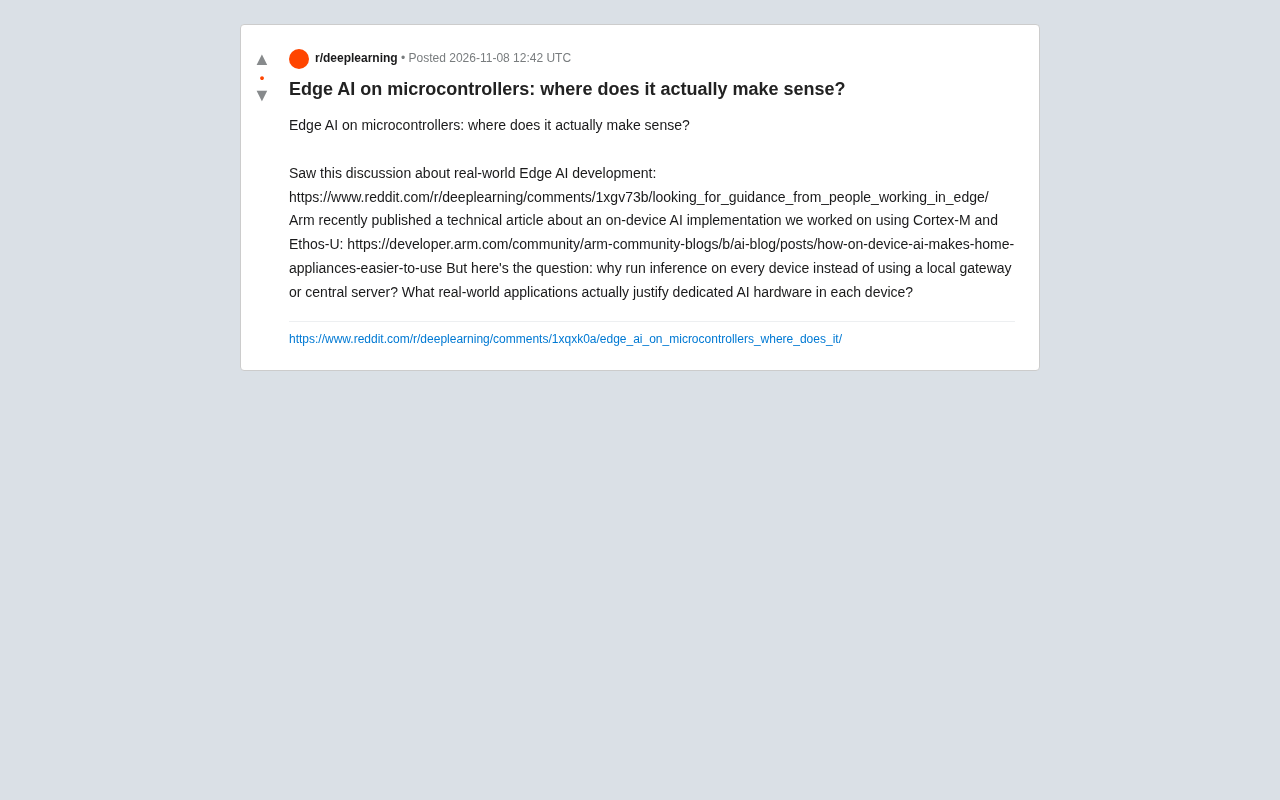
Edge AI on Microcontrollers: When Is It Actually Worth Deploying?
Drawing on Reddit discussions and Arm case studies, this article analyzes the real-world use cases for edge AI on microcontrollers: when each device needs independent inference, when a gateway or cloud is more reasonable, and the costs and boundaries of specialized hardware.
 Tech Frontiers
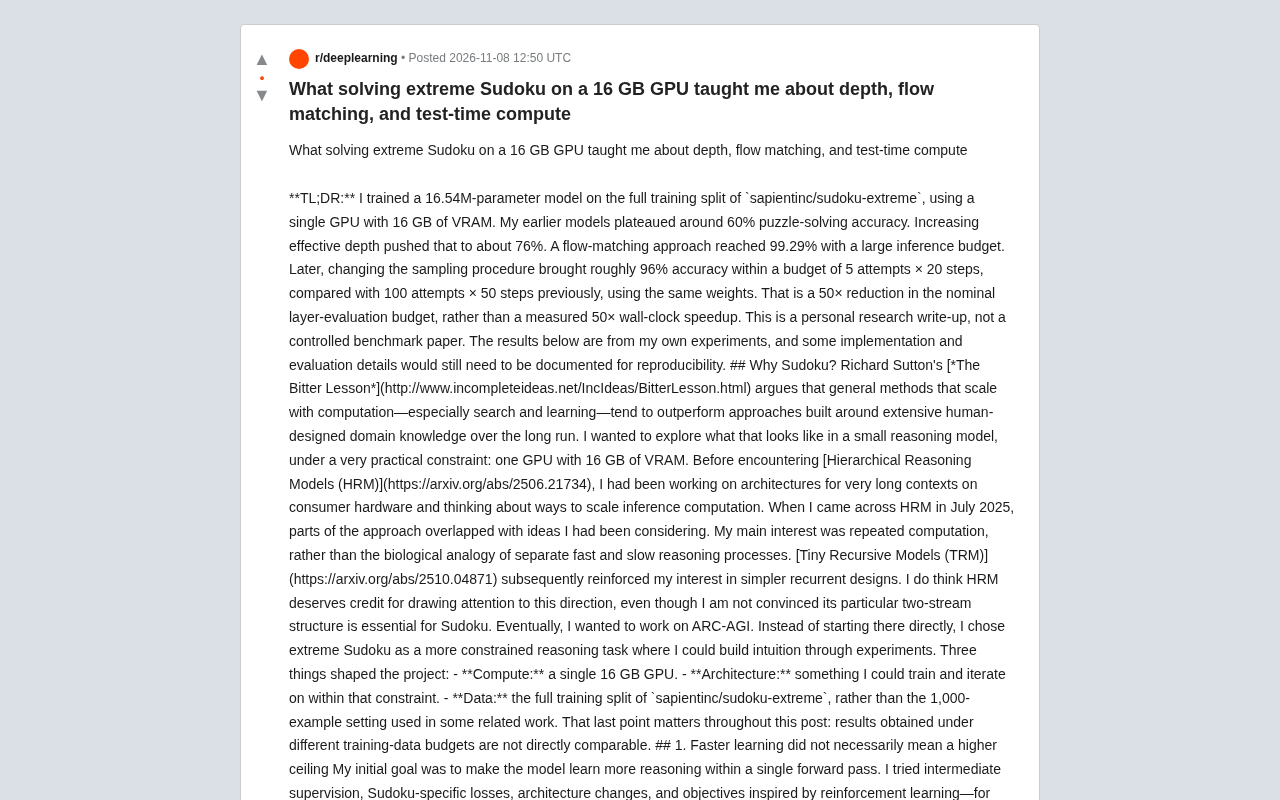
Pushing the Limits of Extreme Sudoku on a 16GB GPU: Insights from Depth and Flow Matching
A researcher trained a 16.54M-parameter model on a 16GB GPU to solve extreme Sudoku, finding effective depth breaks the 60% plateau and flow matching with improved sampling pushes accuracy past 99% with ~50× lower layer-evaluation budget.
 Tech Frontiers
AI Agent Approval Workflows: Why Human Confirmations Always Get Mindlessly Clicked
Why do AI agent approval workflows always get mindlessly clicked? A Reddit discussion shows that separating rules from keys, low-frequency high-risk approvals, and GitHub Environments-style gates are the keys to effective approvals.