Daily AI Buzz · Nov 03 Morning Edition: BMW Urban Autopilot vs. GPT6 Model Showdown
Daily AI Buzz · Nov 03 Morning Edition…
Nov 03, 2026 (Tuesday) Morning Edition — AI news roundup + deep dive on the hot topics
Nov 03, 2026 (Tuesday) Morning Edition — AI news roundup + deep dive on the hot topics
Lots of new moves in AI today — things are buzzing from automakers to model makers.
Today we're mainly covering these: first, BMW's urban autopilot; second, the MIT energy conference; third, German lawmakers getting hacked; fourth, Replit's ticketing app; and fifth, Airlock's bring-your-own-key.
For the deep dive, we'll talk GPT6 modeling the AI-girl full lineup, the Claude Code hands-on tutorial, and the GPT6 model frontend showdown.
Yeah, all of these have plenty to chew on.
Let's start from the top. First up, BMW.
Just saw on The Verge — BMW plans to expand its navigation-assisted driving to urban roads by 2027, starting in Germany.
Note this: it's still L2 partial automation — it handles the steering and speed, but you gotta keep your eyes on it.
The key here is the approach — it's a map-heavy, incremental path, a totally different lane from Tesla's pure-vision end-to-end.
Urban scenarios are the real battlefield, and everyone's eyeing that 2027 window.
But they haven't revealed the sensor setup, compute platform, or which cities. So how are they gonna compete with Tesla?
So it's not about specs — it's about execution and regulatory fit. Germany's regulatory cooperation is key.
Alright, let's bookmark this one. We'll see what cards they play later.
Second one's interesting — MIT Energy Initiative held its annual conference, themed 'Building Momentum for the Moment.'
They put nuclear and quantum computing in the same conversation — one deploys today, one discovers tomorrow.
That framing is pretty clear-eyed. Nuclear's now treated as a deployable solution, no longer just a long-term option.
Quantum's still a long-term bet in materials simulation and that sort of thing — still far from scale.
So it's not about who's more advanced — it's layered progress. Today's deployment shapes tomorrow's system design.
Exactly. What we invest in today determines where tomorrow's breakthroughs come from, and those breakthroughs then reshape today's investment priorities.
Then third — this one's serious. TechCrunch reports that several German lawmakers and a filmmaker may have had their iPhones compromised by spyware.
Apple sent them security notifications — those usually only go out for highly targeted attacks with government backing.
This kind of software gets in through zero-click exploits — messages, location, even mic and camera can be turned on.
The German government's already investigating. It could push the EU to review its communications security policy.
For regular people, the best you can do is turn on Lockdown Mode and keep things updated — but the real fix needs international regulatory cooperation.
Let's switch to something lighter — number four comes from a Replit share on Twitter. Travis's team had their ticket volume double, but they didn't add headcount.
They built a triage app on Replit that automatically identifies and prioritizes urgent tickets.
And in six months they cut customer issue resolution time by 60% — that number's pretty impressive.
The point isn't the tool itself — it's how it works with process changes. Finding the bottleneck beats throwing more resources at it.
And internal tools can be built lightweight — AI augments people, doesn't replace them.
Fifth — WorkOS's Airlock added a bring-your-own Fireworks AI key feature in early access.
BYOK model — inference costs go through the user's own account, but policies, rules, and human approvals stay with Airlock.
So the model handles understanding and judgment, the platform handles rules and accountability — that division's pretty friendly for compliance teams.
Billing and usage can be monitored in one place too, but before you plug in, make sure key permissions and quotas are set.
Alright, that's the news. Next, let's dig into a few hot topics on Bilibili.
First — GPT6 modeling the AI-girl full lineup, by Da Fei Yu. They turned Claude, GPT, Doubao, GLM, Grok, Gemini, Kimi, MiniMax, and Qwen into AI girls, in a 3D-rendered-into-2D style.
It blew up for a reason — it translates model competition into personified aesthetics. When viewers vote, they're really expressing their preference for each model.
It's basically turning abstract model comparisons into something you can watch and chat about — interaction score's almost 87k.
Right, but note — it's popular for emotional value, not technical evaluation. Model capability still comes down to real tasks.
Then second — a Claude Code hands-on tutorial for real engineers. Interaction score's just over a thousand — not viral, but very targeted.
The value of that kind of content is in execution — engineers want workflows they can actually follow, not concept explainers.
But a thousand-something interactions means the audience is still narrow — tool tutorials naturally don't spread as fast as entertainment content.
But stickiness is high — the people watching will actually use it. That's a different lane from the AI-girl lineup.
Fair point. Third one's interesting — GPT6.1 Terra vs. GPT6 Sol frontend comparison, essentially Terra vs. Sol.
I checked it out — they put both versions on the same frontend task, and the conclusion was Terra's more stable in code generation and layout reproduction.
Wait, you said more stable — so where does Sol fall short? Speed or quality?
According to that comparison, Sol tends to miss details when splitting complex components — Terra's trade-offs are closer to real engineering habits.
But can one frontend comparison really show overall capability? I feel the sample's too small.
You're right — that kind of comparison is more of a directional signal, not a verdict. For real model selection, you still gotta look at your own long-tail tasks.
So looking at all three together, model competition is moving from benchmarks to scenarios, from specs to personality and execution.
To sum up: entertainment-style content drives hype, engineering tutorials drive stickiness, and frontend showdowns give selection reference — each line has its own value.
Alright, that's all for today. See you at noon.
Related articles
 Tech Frontiers
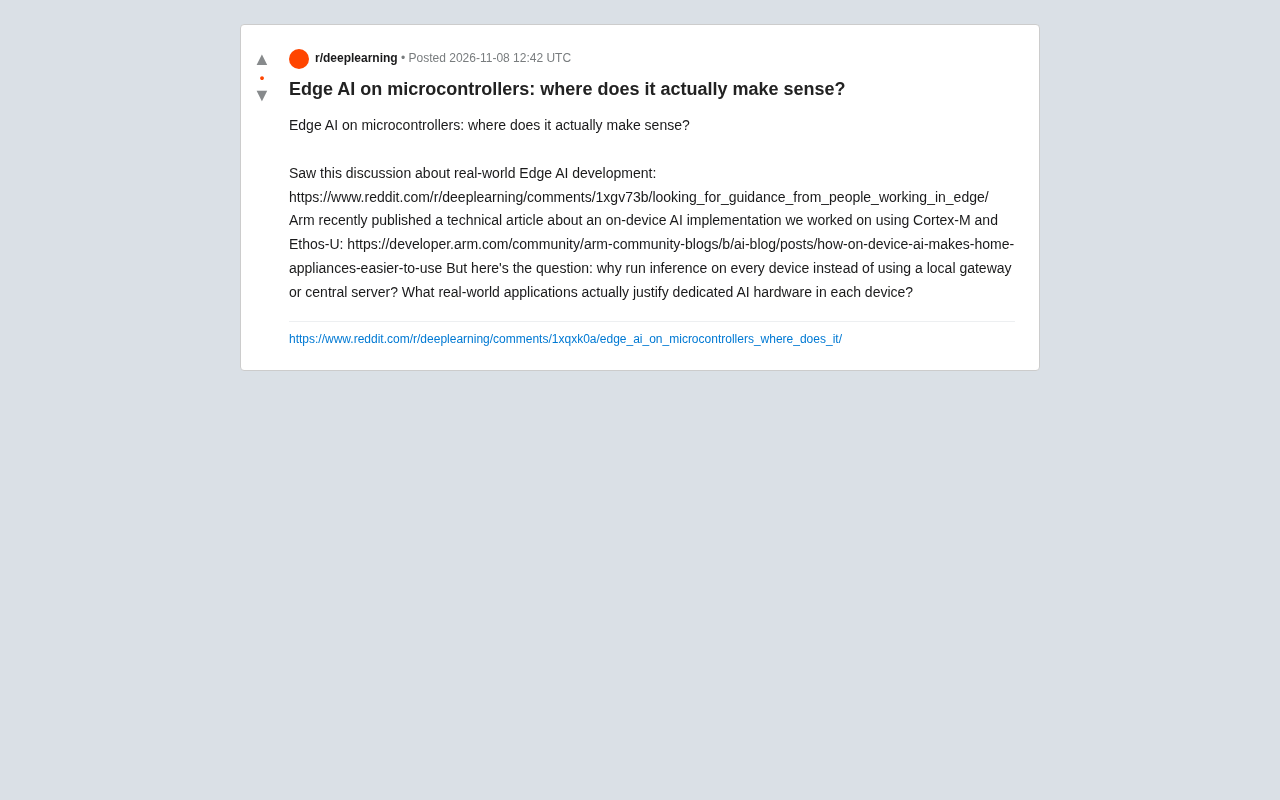
Edge AI on Microcontrollers: When Is It Actually Worth Deploying?
Drawing on Reddit discussions and Arm case studies, this article analyzes the real-world use cases for edge AI on microcontrollers: when each device needs independent inference, when a gateway or cloud is more reasonable, and the costs and boundaries of specialized hardware.
 Tech Frontiers
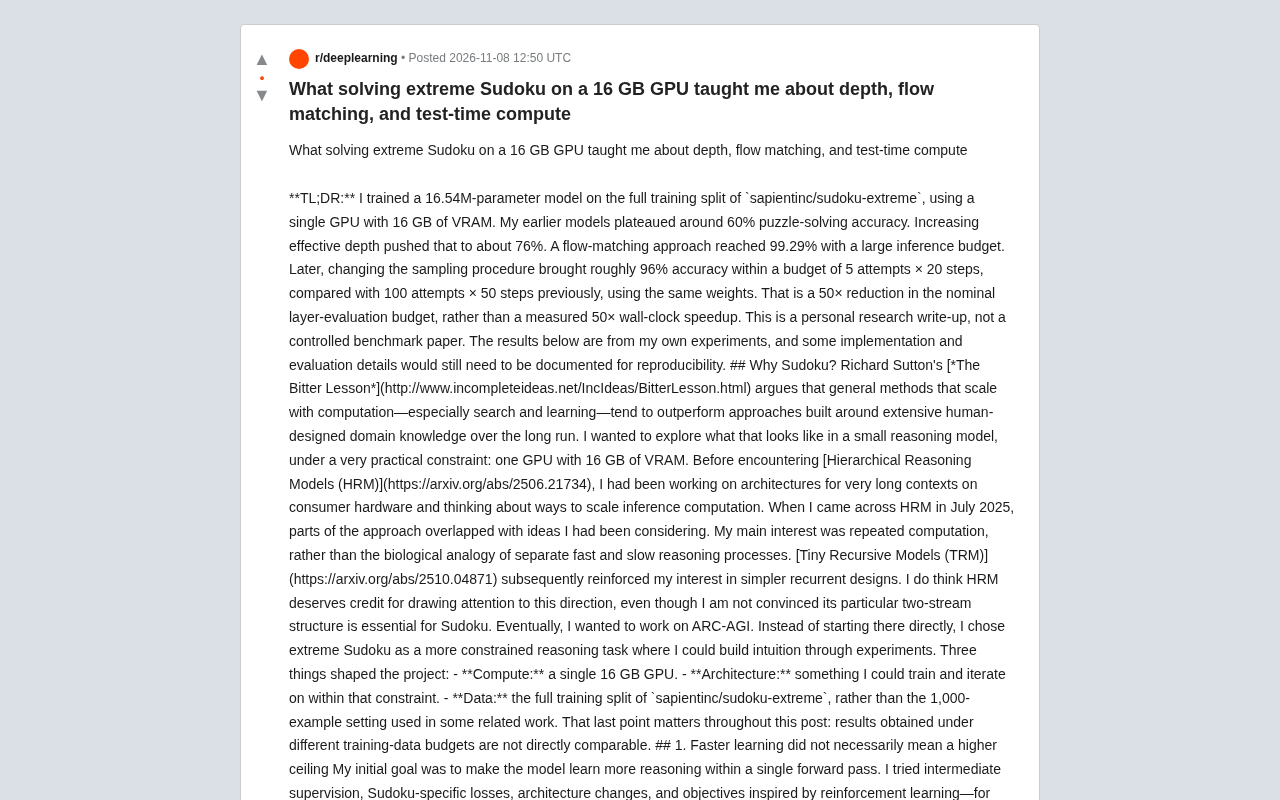
Pushing the Limits of Extreme Sudoku on a 16GB GPU: Insights from Depth and Flow Matching
A researcher trained a 16.54M-parameter model on a 16GB GPU to solve extreme Sudoku, finding effective depth breaks the 60% plateau and flow matching with improved sampling pushes accuracy past 99% with ~50× lower layer-evaluation budget.
 Tech Frontiers
AI Agent Approval Workflows: Why Human Confirmations Always Get Mindlessly Clicked
Why do AI agent approval workflows always get mindlessly clicked? A Reddit discussion shows that separating rules from keys, low-frequency high-risk approvals, and GitHub Environments-style gates are the keys to effective approvals.