Daily AI Buzz · Nov 4 Evening Edition: Altman's Open Source Take & Local Models
Daily AI Buzz · Nov 4 Evening Edition:…
November 4, 2026 (Wednesday) evening edition — AI news roundup + deep dive on the hot topics
November 4, 2026 (Wednesday) evening edition — AI news roundup + deep dive on the hot topics
Lots of new stuff happening in AI today, and a few of these are pretty controversial.
Here's what we're covering today: one, the Democratic blue wave; two, the new religious left in America; three, the HelixCipher machine learning library; four, the blue wave in Texas; five, NeurIPS Sydney visa issues; six, Altman's open source argument; and seven, running Flux.3 Klein image generation locally.
Yeah, that's quite a list.
Right, so let's run through the news first, and save the deep topics for later.
First up, I just saw something on YouTube about the Democratic blue wave in this election, saying there are three things worth noting.
Yeah, this wave is serious. The point isn't those three things themselves — it's that compared to past years, this is a full flip, not a small local win.
So what does that have to do with AI? Aren't we a tech podcast?
It does. Tech policy direction shifts with it. How tight regulation is, where subsidies go — all depends on how these folks set the tone.
Alright, noted. Second item — there's also a video about a new religious left emerging in America. That one's more of a social topic.
I skimmed that one. Basically, the left is starting to borrow the organizing playbook from religious groups. Pretty interesting phenomenon.
Third one's closer to home. Someone on Reddit is promoting a GitHub repo called the HelixCipher machine learning library.
These curated collections are great for people who just finished the theory and want projects to practice on. But it's individually maintained, so quality varies — don't trust it blindly.
It's split into computer vision, predictive modeling, and data analysis. The article suggests reading the README first, then picking things to go deep on.
Right, and you've gotta actually tweak parameters and swap datasets yourself. Just bookmarking it without touching it is as good as not learning at all.
Fourth item — there's a video about a blue wave in Texas too. Everything's big there, and so is the wave.
Texas is more of a signal. If a traditionally red state starts to wobble, the impact gets much bigger.
Last news item — there's a pretty painful post on Reddit about NeurIPS attendees to Sydney getting stuck on visas.
I saw that. People with complete documentation still got rejected, some waited a month. The conference didn't give a clear answer either, so the community's just helping each other out.
So an invitation letter isn't a magic key after all.
Visa officers look at the whole picture — travel history, financial situation, ties to your home country. The invitation letter is just one factor.
And that brings up the hidden cost of cross-border academic exchange. Choosing a conference location really should factor in visa friendliness.
Yeah, and organizers have a real blind spot here. They can't just collect registration fees and call it a day.
Alright, that's the news. Now let's get into two really hot topics.
First one — there's a video on Bilibili discussing Sam Altman's new interview, where he said open source large models with local deployment aren't as good as centralized computing in data centers.
That comment was bound to blow up. Let me lead with my conclusion: he's not wrong on cost efficiency, but his position is way too obvious.
Why do you say his position is obvious?
Think about it — what he sells is centralized compute plus APIs. The better local deployment gets, the more his business gets hit. The conflict of interest is right there.
But he does have a point. Data center economies of scale are real, and unit costs are genuinely lower.
Low cost is a fact, but where do privacy, latency, and controllability fit in? In some scenarios, running locally is just a hard requirement.
So what's the Bilibili comment section saying?
It's heated. One camp says this reflects the US-China industry divide — the US goes centralized cloud, China's open source ecosystem is more active.
And the other camp?
The other camp says don't overread it — it's just a business position, not really about countries.
Which side are you on?
I'm in the middle, leaning practical. It's not either-or between centralized and local — it's layered. Training big models goes centralized; inference and privacy-sensitive scenarios go local.
But isn't that contradictory? He said local is worse than centralized.
He's talking about the economics right now, but tech keeps changing. Small models keep getting stronger, and the barrier to local deployment keeps dropping.
Perfect — our second topic connects right to this. There's another Bilibili video about running Flux.3 Klein and MOSS image generation locally.
Yeah, that's a living counterexample. Small-parameter models can run on a Mac, and the results aren't bad.
The video is a Draw Things tutorial, focused on the Apple ecosystem — local image models on Mac.
See, that shows local deployment isn't unworkable — it's about whether you've found the right model and toolchain.
So does Altman's argument fall apart?
Not entirely. For large-scale general tasks, centralized still makes more sense. But for niche scenarios, local can already compete.
So the conclusion is: centralized and local coexist in layers, neither replaces the other. And Altman's words should be taken with a grain of salt.
Right, and notice — both videos blew up on Bilibili the same day, which itself shows people care about this route debate.
Why is this topic blowing up right now?
Because small models have gotten good enough that running images and text locally is becoming practical, so naturally people are recalculating.
Got it. That's all for today — lots to digest. See you tomorrow.
Related articles
 Tech Frontiers
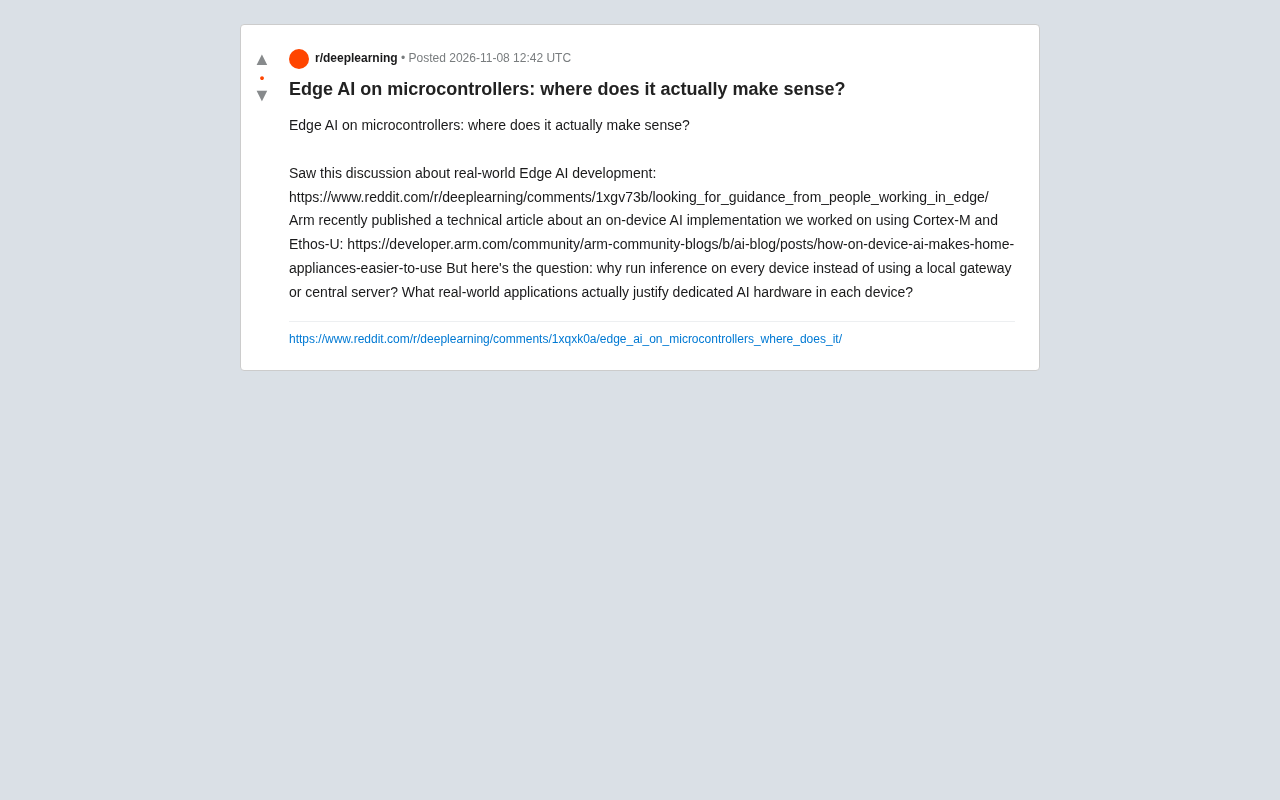
Edge AI on Microcontrollers: When Is It Actually Worth Deploying?
Drawing on Reddit discussions and Arm case studies, this article analyzes the real-world use cases for edge AI on microcontrollers: when each device needs independent inference, when a gateway or cloud is more reasonable, and the costs and boundaries of specialized hardware.
 Tech Frontiers
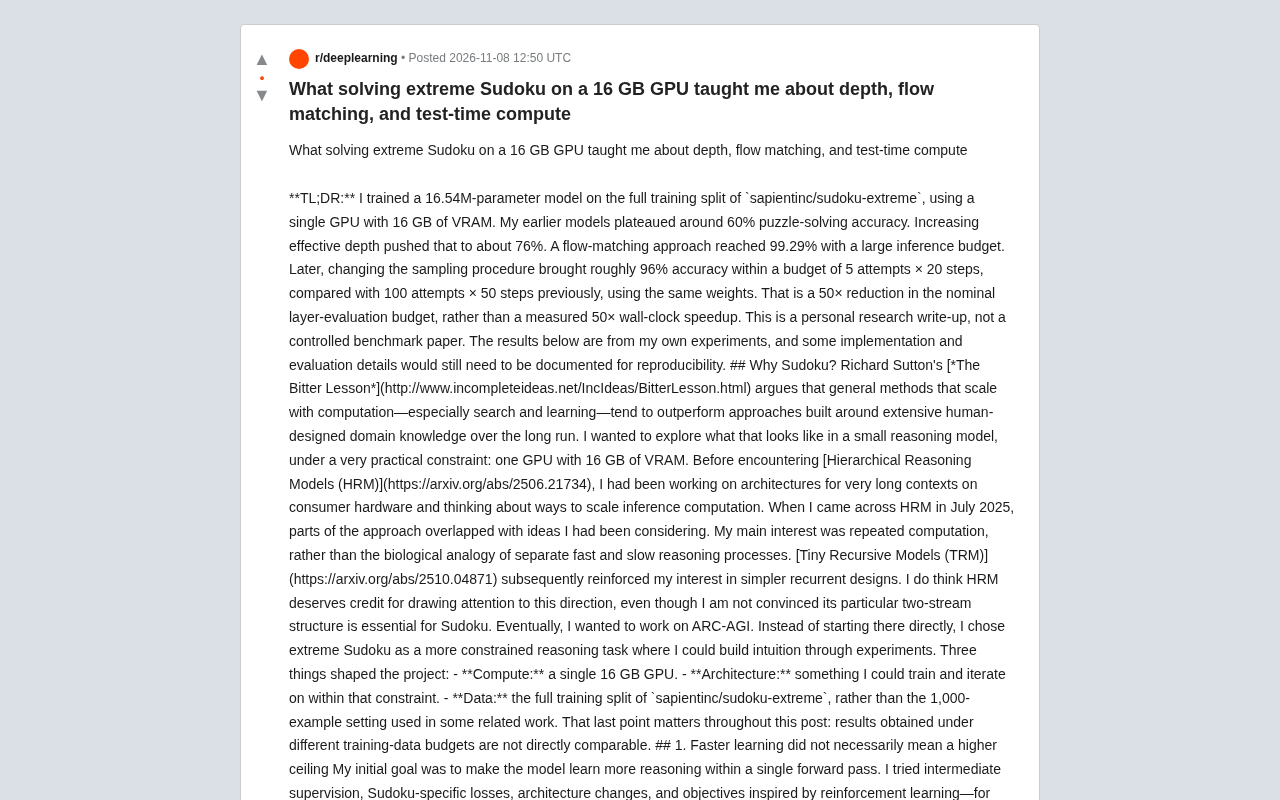
Pushing the Limits of Extreme Sudoku on a 16GB GPU: Insights from Depth and Flow Matching
A researcher trained a 16.54M-parameter model on a 16GB GPU to solve extreme Sudoku, finding effective depth breaks the 60% plateau and flow matching with improved sampling pushes accuracy past 99% with ~50× lower layer-evaluation budget.
 Tech Frontiers
AI Agent Approval Workflows: Why Human Confirmations Always Get Mindlessly Clicked
Why do AI agent approval workflows always get mindlessly clicked? A Reddit discussion shows that separating rules from keys, low-frequency high-risk approvals, and GitHub Environments-style gates are the keys to effective approvals.