Daily AI News · Nov 6 Evening Edition: Tencent Hunyuan HY4 Goes Open Source
Daily AI News · Nov 6 Evening Edition:…
Nov 6, 2026 (Friday) Evening Edition — AI news roundup + deep dive on the hot topics
Nov 6, 2026 (Friday) Evening Edition — AI news roundup + deep dive on the hot topics
The AI world's buzzing again today — Tencent Hunyuan just dropped something big.
Here's what we're covering today: first, Copilot vs. Cursor; second, App Store year-end data; third, an LLM tutorial; fourth, agent database security; and fifth, a WorkBuddyAd tutorial.
Then we've got three hot topics: the official HY4 release, GPT6Astra falling flat, and an Agent development tutorial.
Yeah, those are definitely worth talking about.
So, as usual, let's run through the quick news first and save the big stuff for the end.
First up, I just saw a video on YouTube specifically comparing GitHub Copilot and Cursor.
That comparison's actually a classic — the two are on completely different tracks.
Copilot is more like a plugin that lives inside your existing IDE. Cursor went and built its own editor from scratch.
So from a product experience standpoint, which one do you think feels smoother?
If you're writing code heavily, Cursor's whole-block context rewriting feels better. But for team collaboration and cost, Copilot's more solid.
Okay, let's note that down — we can do a whole episode on it later. Next, the App Store year-end data.
There's a piece on Hacker News looking at 2026's data from three angles: the AI app explosion, pricing strategies, and abandoned apps.
That's an interesting angle. AI lowered the barrier to development, and the result is super fast homogenization.
The window for feature differentiation is absurdly short — competition went from 'do you have AI' to 'how deeply is it embedded in the use case.'
The article also mentions subscription fatigue — one-time purchases are making a comeback.
Right, users are sick of being nickel-and-dimed by monthly fees. And all those zombie apps sitting there unmaintained are a hidden cost too.
So the conclusion is, the ecosystem's competitive focus has shifted from grabbing new users to retaining active ones and maintaining trust.
Third item — there's a 2026 LLM Wiki tutorial on Bilibili, claiming to take you from beginner to expert, plus enterprise deployment.
I've seen way too many titles like that — reeks of clickbait.
Still, there's definitely demand for a systematic rundown of LLM fundamentals.
Sure, but for the hands-on deployment part, I'd trust engineering blogs more than a compilation.
Fourth item — there's a YouTube video with a really grabby title: 'Stop giving AI agents your database password.'
That deserves a like. Handing your database password straight to an agent is just a disaster.
With the MCP connection approach, you've gotta lock down permission boundaries hard and stick to the principle of least privilege.
So the industry's starting to favor temporary credentials or going through a middle layer — never handing over the real password.
Fifth item — there's also a super hand-holding WorkBuddy tutorial on Bilibili, claiming zero-to-one-hour beginner entry.
For workflow tools like WorkBuddy, there's genuinely huge demand for tutorials.
Alright, that's the news for now. Next, let's dive into the most explosive one — Tencent Hunyuan HY4.
This Bilibili video's title literally says 'earth-shattering,' claiming the official HY4 release ties with K3.1pro for the top open-source spot.
Let me lead with my conclusion: 'top open-source tier' — there's both hype and real substance there.
The point isn't the ranking itself — it's that a major company is willing to open-source the official release. That's a big signal.
Hold on, there's a line in the video that really stuck with me: 'If you don't have money, what are you even training a large model for?'
Is that hinting that training costs have already become the barrier to entry?
Exactly — think about it, very few can even sit at the table. The fact that Hunyuan can stand alongside K3.1pro means they've thrown enough resources at it.
But 'tied for first' — that depends on the eval set. Different leaderboards can give conclusions that are worlds apart.
The video ends by saying it's free to use in WorkBuddy — what do you make of that?
That's a classic traffic play. Open-source the model to pull people in, embed it in the product, get users first and talk monetization later.
But after going open source, the question of how to actually make money gets even sharper.
That's why I say it's the best at doing AI among the big companies — not necessarily the strongest technically, but the steadiest in pacing.
Alright, the second topic has a bit of ironic charm: GPT6Astra making a Tianhuilong in blockbench and not doing well.
This one's really representative. Strong text ability doesn't mean it can handle complex 3D modeling tasks.
It's got over two thousand interactions on Bilibili — seems people really love watching models fail.
Because failure is more informative than bragging. It exposes shortcomings in spatial reasoning and long-horizon planning.
So doesn't that show that evaluation can't just rely on benchmark scores — it has to look at real tasks?
Exactly — benchmarks look great, but the moment you hit a specific toolchain, it falls apart. That's why everyone's discussing it so heatedly.
And the last one, the Agent development tutorial — over seven hundred episodes, claiming to take you from novice to master in seven days.
Seven hundred episodes in seven days — the math doesn't add up. But the demand is real.
So to sum up, the Hunyuan HY4 open-source story and the real-task evaluation story actually point to the same thing.
Right — model competition has shifted from parameter contests to real-world deployment and actual usability.
Alright, that's it for today — plenty to chew on. See you tomorrow.
Related articles
 Tech Frontiers
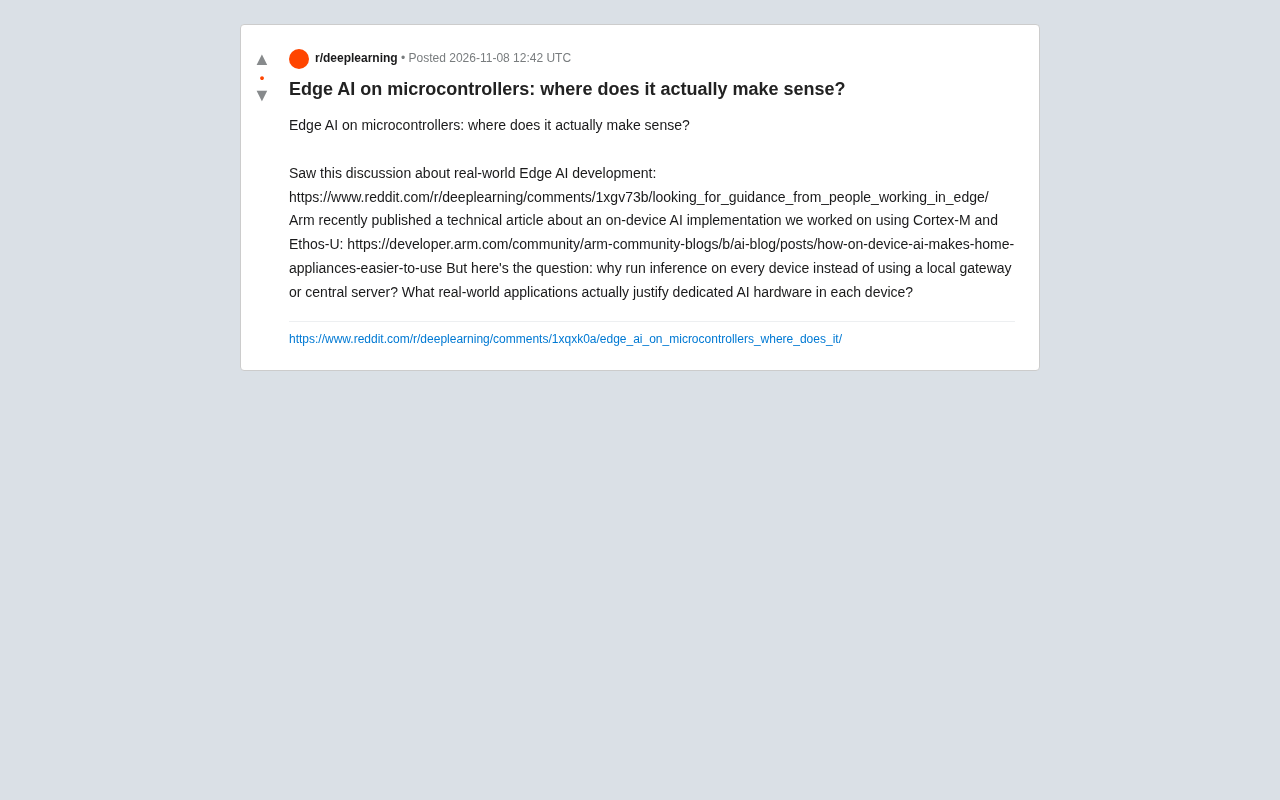
Edge AI on Microcontrollers: When Is It Actually Worth Deploying?
Drawing on Reddit discussions and Arm case studies, this article analyzes the real-world use cases for edge AI on microcontrollers: when each device needs independent inference, when a gateway or cloud is more reasonable, and the costs and boundaries of specialized hardware.
 Tech Frontiers
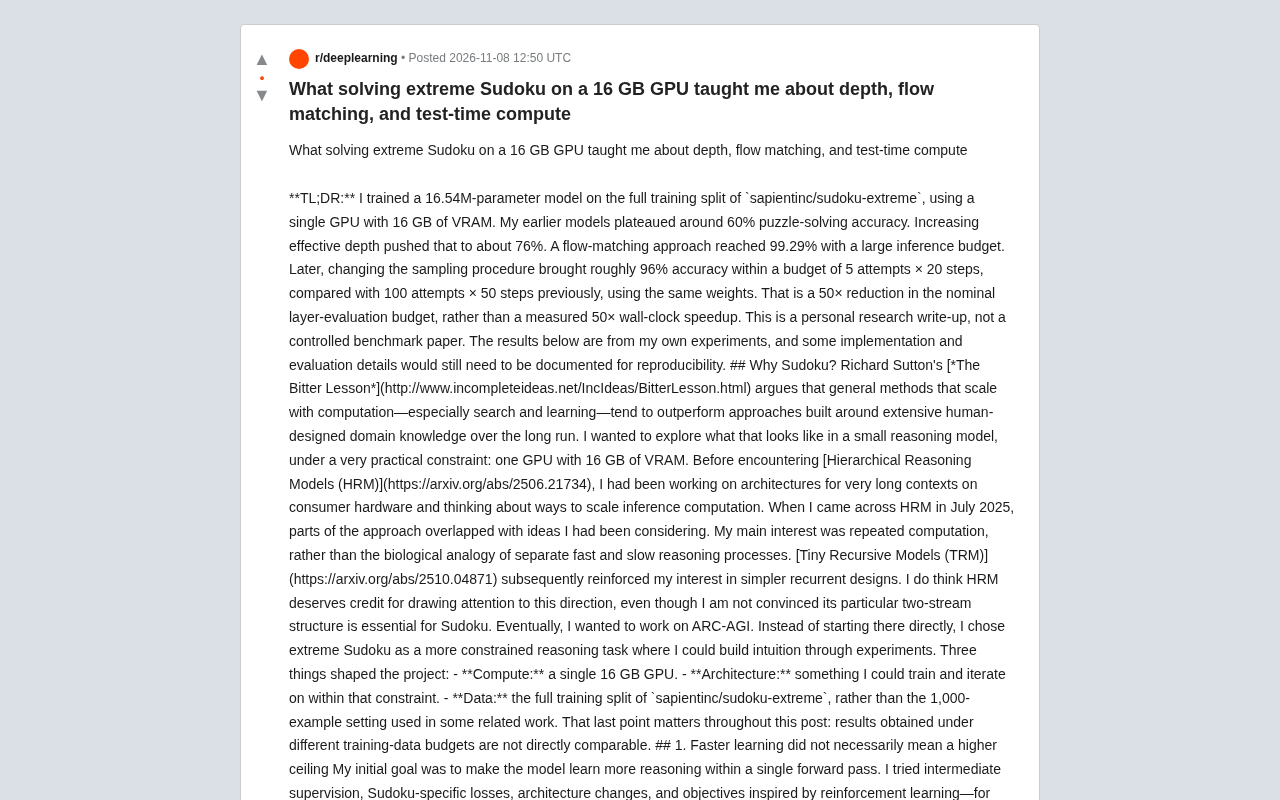
Pushing the Limits of Extreme Sudoku on a 16GB GPU: Insights from Depth and Flow Matching
A researcher trained a 16.54M-parameter model on a 16GB GPU to solve extreme Sudoku, finding effective depth breaks the 60% plateau and flow matching with improved sampling pushes accuracy past 99% with ~50× lower layer-evaluation budget.
 Tech Frontiers
AI Agent Approval Workflows: Why Human Confirmations Always Get Mindlessly Clicked
Why do AI agent approval workflows always get mindlessly clicked? A Reddit discussion shows that separating rules from keys, low-frequency high-risk approvals, and GitHub Environments-style gates are the keys to effective approvals.