Daily AI Fresh News · Nov 7 Midday Edition: Tool Gateways and Agent Fault Tolerance
Daily AI Fresh News · Nov 7 Midday Edi…
Nov 7, 2026 (Saturday) midday edition AI news roundup + deep dive on hot topics
Nov 7, 2026 (Saturday) midday edition AI news roundup + deep dive on hot topics
Lots of new stuff in the AI world today, from open-source tools to batteries — quite a spread.
Today we're covering these main things: first, the ToolLens gateway; second, Agent step failures; third, SIP outbound calling opening up; fourth, sodium batteries reaching cost parity; fifth, SMFL choosing Replit; sixth, DeepSeekAd's open-source motivation; seventh, the Agent babysitter tutorial.
Yeah, pretty broad coverage.
Let's kick off with the news roundup, starting with the most eye-catching stuff.
Just saw a post on Reddit called ToolLens — an open-source MCP gateway written in Rust.
That's a really interesting idea. The core is one sentence: too many tools, the model can't pick.
MCP standardized how to connect, but every tool's description eats context window. Hang a hundred tools on there and the descriptions alone fill the window.
So how does it solve that?
It only exposes three entry-point tools to the agent — one for discovery, one for invocation, one for state management. Whatever's behind them doesn't matter.
So it moves the choice from the model to the gateway layer. The model only faces three doors.
Right, complexity sinks down. Rust makes sense too — the gateway has to handle high concurrency and low latency, so it needs to run long.
But I've got a nagging doubt: how does the gateway decide which tools are visible? Doesn't that become a single point of failure?
Yeah, the community response has been positive, but the post itself says those two questions are still open.
Second item, also Reddit — someone asked a really practical question.
You mean the post about the agent failing on step three? I read that one a few times.
The scenario is creating an issue, sending a Slack message, writing to Notion. Step three fails because the database ID was mistyped, but the first two steps already had external effects.
The root cause is that multi-step operations span multiple stateful systems without distributed transaction coordination. Once side effects are visible, you can't take them back.
So manual cleanup, idempotent retries, accepting inconsistency — none of those three strategies are enough?
They all have limits. The post introduces AgentRein, which uses reverse undo — essentially the Saga pattern applied to the agent toolchain, executing compensations in reverse order.
But compensation has boundaries too. How do you undo a payment or a PR merge?
Exactly, and the author says it clearly: Slack undo replaces content, it doesn't delete it. Compensation isn't traceless. Tools can't replace architectural responsibility division.
So at design time you have to separate reversible from irreversible, and push irreversible steps to the end or add confirmation. I'm noting that one down.
Third item, on Hacker News: OpenAI's SIP outbound calling is now open to all organizations.
This isn't just a permissions change — it's voice communication infrastructure leveling out. Capability that was enterprise-only is now a programmable API.
Messaging, email, video are all standardized. Voice was the last piece of the puzzle.
Customer service notifications and sales outbound benefit most directly, but number compliance and user consent — those governance responsibilities get dumped on the user.
Fourth item, on Hacker News: CATL's sodium battery reaching cost parity with LFP in 2026, 15,000 cycles, 30-year lifespan.
Those three numbers show it's shifting from a lithium price hedge to a full-lifecycle challenger to LFP.
But the article pours cold water too: energy density is still a weakness, and it's unclear whether the parity figure is cell or system, measured or projected.
Right, the conclusion is sodium won't replace lithium — it'll drive scenario segmentation.
Fifth item, from Replit on Twitter: Sumitomo Mitsui Finance and Leasing, SMFL, chose it as their development platform, citing security, certification, and quality.
This is a single-source vendor disclosure, no details public, so take it with a grain of salt. But those three criteria can serve as a skeleton for an evaluation checklist.
Enterprise platform competition is shifting from feature count to making regulated industries willing to use it.
Alright, that's the news. Next, let's dig into a topic I really want to hear you talk about.
There's a hot video on Bilibili — a DeepSeek research engineer responding to why they open-source, saying the opponent isn't peers, it's time, to make AGI arrive sooner.
Sounds inspiring, but did you notice there are three related discussions on Bilibili about this? That's multi-source corroboration.
So it's not a casual remark — it's a narrative the team keeps repeating.
Right. But flip it around — is open source really just about idealism? I have my reservations.
Go on, I'm listening.
Open source trades for ecosystem, talent, and voice. Those are all part of the calculation. But that line about 'the opponent is time' really does hit the essence of today's competition.
So what do you think 'time' means here? That the window is getting shorter?
It's about who builds AGI first and sets the rules. At that scale, the open vs. closed source debate becomes a tactical question.
Then the other Bilibili hot item makes sense: the 2026 latest AI Agent zero-to-hero full tutorial — MCP plus Agent Skills plus multi-agent plus workflow automation.
This one has an engagement score of 800-plus, lower than the other two, but it shows one thing: demand for learning to build agent workflows is moving downstream.
Building a working agent from scratch — the fact that this title catches fire means a lot of people have real work on their hands.
But it exposes a problem too. Earlier ToolLens talked about too many tools, and now tutorials teach you to pile on tools. These are two sides of the same coin.
You add like crazy while building, then realize you have to pull back once it's running.
So my take is, agent engineering is moving from 'can it connect' to 'how do you manage it once there are too many connections.'
To sum up: ToolLens manages tools, AgentRein manages failures — both are laying engineering groundwork for agents. The open-source narrative and tutorial hype are just two sides of that trend.
Right. At this stage it's not about how flashy the demo is — it's about not breaking when it runs.
Alright, that's it for today. See you tonight.
Related articles
 Tech Frontiers
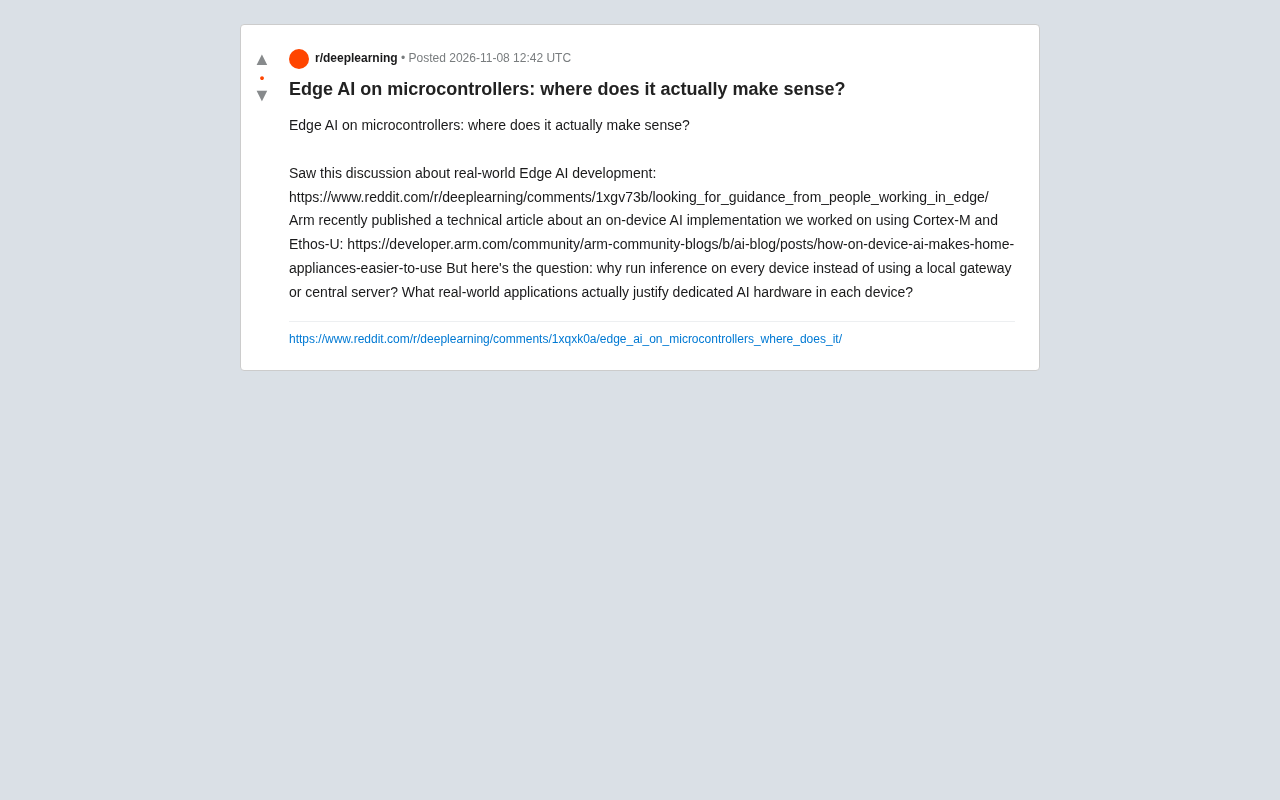
Edge AI on Microcontrollers: When Is It Actually Worth Deploying?
Drawing on Reddit discussions and Arm case studies, this article analyzes the real-world use cases for edge AI on microcontrollers: when each device needs independent inference, when a gateway or cloud is more reasonable, and the costs and boundaries of specialized hardware.
 Tech Frontiers
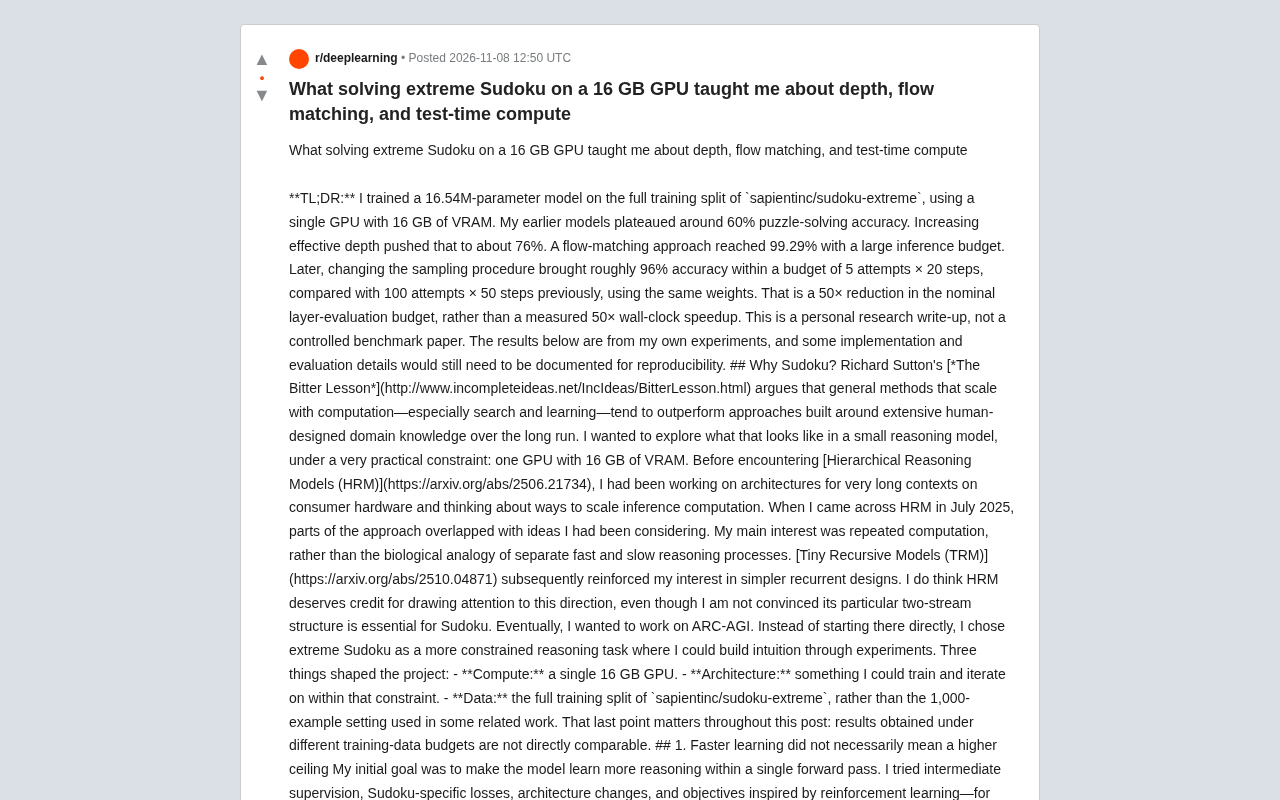
Pushing the Limits of Extreme Sudoku on a 16GB GPU: Insights from Depth and Flow Matching
A researcher trained a 16.54M-parameter model on a 16GB GPU to solve extreme Sudoku, finding effective depth breaks the 60% plateau and flow matching with improved sampling pushes accuracy past 99% with ~50× lower layer-evaluation budget.
 Tech Frontiers
AI Agent Approval Workflows: Why Human Confirmations Always Get Mindlessly Clicked
Why do AI agent approval workflows always get mindlessly clicked? A Reddit discussion shows that separating rules from keys, low-frequency high-risk approvals, and GitHub Environments-style gates are the keys to effective approvals.