Daily AI Buzz · Nov 9 Morning Edition: Sequoia Board Shakeup and Siri the Agent
Daily AI Buzz · Nov 9 Morning Edition:…
Nov 9, 2026 (Monday) Morning Edition — AI news roundup + deep dive on the hot topics
Nov 9, 2026 (Monday) Morning Edition — AI news roundup + deep dive on the hot topics
Lots of new stuff in AI today, and a few of these are pretty interesting.
Today we're covering a few things: first, Sequoia partners got blindsided by a board appointment; second, Outlook is quietly rejecting emails without DMARC; third, Apple is rushing to turn Siri into an agent.
Fourth, a LangGraph payment node crash can cause double charges. Then we'll dig into two hot topics on Bilibili: one's an open-source MV adventure, the other's about deepseekAd optimizing tokens by 27x.
Yeah, these are all pretty meaty.
Let's start with the Sequoia one.
Just saw something on TechCrunch saying some Sequoia partners were caught off guard by Roelof Botha joining SpaceX's board.
Right, and the key issue isn't whether the appointment makes sense—it's the transparency of communication.
Think about it: in a partnership, the worst thing is exactly this—the tension between decision-making efficiency and partner consensus.
So from the outside, it looks like more than just a board seat—it's a signal about internal governance and power transition?
Exactly. But a quick caveat: this comes mainly from anonymous sources, and neither Sequoia nor SpaceX has commented publicly.
Got it. Let's treat it as an observation and not take a single source as the final word.
Second item—let's talk about Outlook.
Several people on Hacker News reported that Outlook.com is starting to reject emails from domains without DMARC, and there was no official announcement.
That's harsh. Before, you could still get delivered without it, but now it's a hard requirement.
The community's pretty divided. Supporters say no DMARC is basically leaving a backdoor for spoofed emails.
The other side has a point too—no transition period means small sites and self-hosted mail servers could get caught in the crossfire.
So the article suggests starting with a p=none monitoring record first, not going straight to enforcement.
Right—monitor first, then tighten. You can't mess up that order.
Then there's another one: Apple is rushing to make Siri more agentic.
According to Bloomberg's Mark Gurman, CEO John Ternus is pressuring AI head Craig Federighi to speed up the Siri roadmap.
And they're benchmarking against agent products like OpenAI Dots and Meta Muse—the goal is clear.
Going from smarter Q&A to an agent that can execute multi-step tasks—that's a huge leap.
The hard part is doing planning, tool calls, and cross-app actions while still honoring privacy commitments and on-device compute limits.
Whether they can shed the 'lagging assistant' label depends on this push.
Fourth item: there's a LangGraph pitfall on Reddit that's worth mentioning.
If a payment node crashes, when the thread resumes, the payment gets sent again.
Because the checkpoint stores the state before the node executed, so resuming means re-running the whole node.
So how do you fix it? Sounds like a headache.
The core idea is that side effects must be idempotent. Before calling, log the attempt to SQLite, then generate an idempotency key that stays the same across retries.
One more detail: idempotency keys expire—Stripe's is 24 hours—and outside that window a NotFound should be treated as unknown state.
Yeah, to sum it up in one line: LLM reasoning can be retried, but side effects must be idempotent.
Alright, that's it for the news. Next we'll talk about two topics that have been really hot on Bilibili lately.
First: 'The Boy and the Whale's Adventure'—an open-source MV with over 160,000 interactions.
That line in the title—'open source just to see you again'—there's something to it.
Why do you think this kind of work blows up? Is it the tech, or the emotion?
I think it's the combo of emotion and open source. Open source here isn't just code—it's more like a form of expression.
Makes sense. Tech is just the medium; what really moves people is that 'see you again' story.
The second topic is even more interesting—did you know your deepseek can actually optimize tokens by 27x?
This one has over 380,000 interactions, which shows it hit a real pain point: tokens are too expensive.
27x sounds a bit exaggerated—what exactly is it optimizing?
From the title, it's probably about the reasoning and call chain, cutting wasted token consumption—eating less free lunch, so to speak.
But here's the question: does optimizing 27x come at the cost of quality?
That's the key point. If you can cut tokens without losing performance, that's huge value.
So to sum up, today's two Bilibili hot topics—one about the emotional value of open source, one about token cost optimization—are really saying the same thing: AI is becoming more down-to-earth.
Right—one goes into people's hearts, the other squeezes costs. Different directions, but both practical.
Alright, that's all for today. See you at noon.
Related articles
 Tech Frontiers
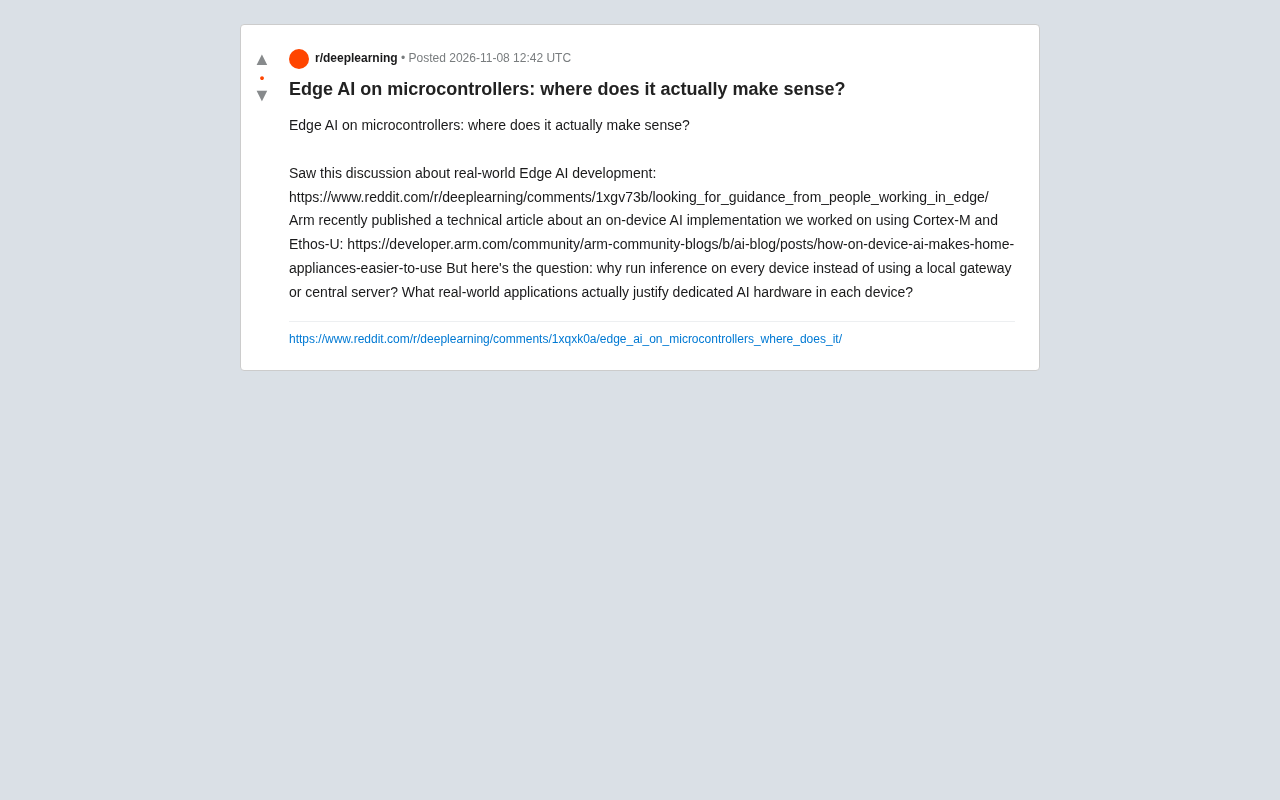
Edge AI on Microcontrollers: When Is It Actually Worth Deploying?
Drawing on Reddit discussions and Arm case studies, this article analyzes the real-world use cases for edge AI on microcontrollers: when each device needs independent inference, when a gateway or cloud is more reasonable, and the costs and boundaries of specialized hardware.
 Tech Frontiers
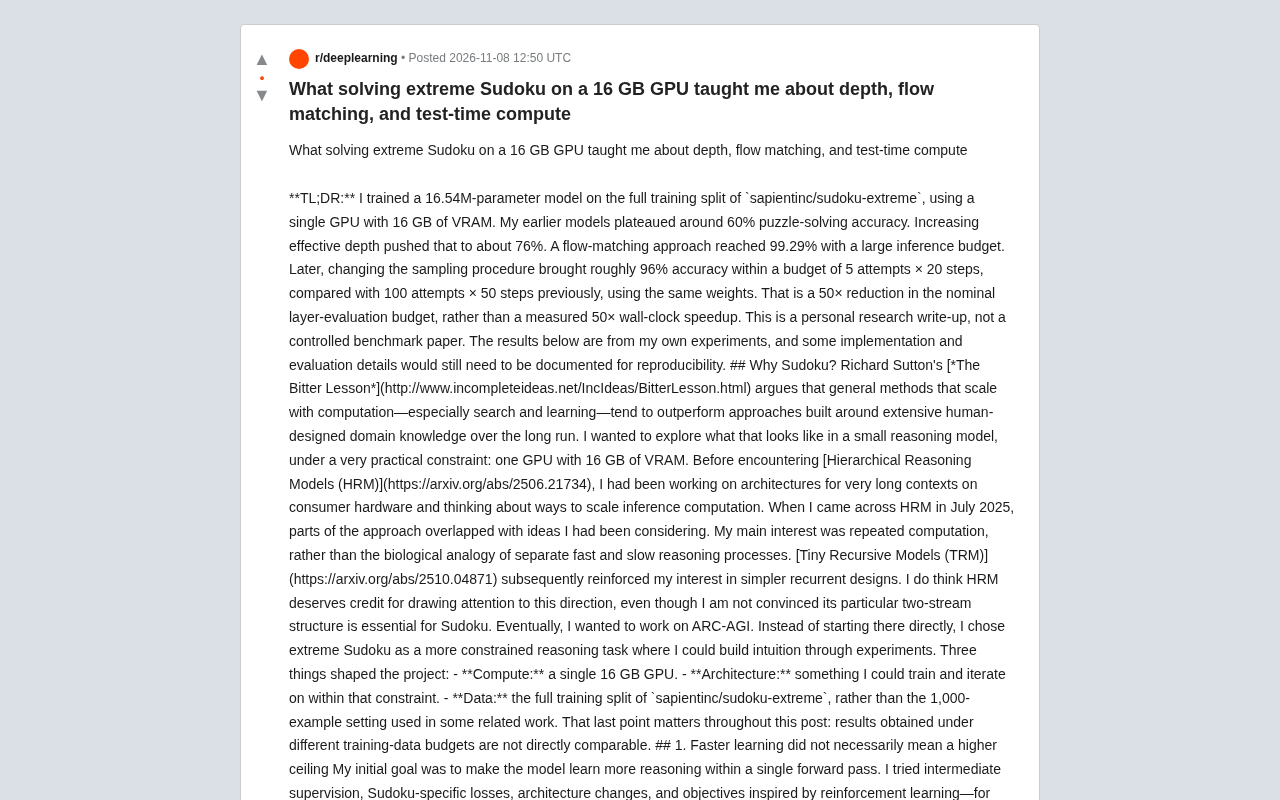
Pushing the Limits of Extreme Sudoku on a 16GB GPU: Insights from Depth and Flow Matching
A researcher trained a 16.54M-parameter model on a 16GB GPU to solve extreme Sudoku, finding effective depth breaks the 60% plateau and flow matching with improved sampling pushes accuracy past 99% with ~50× lower layer-evaluation budget.
 Tech Frontiers
AI Agent Approval Workflows: Why Human Confirmations Always Get Mindlessly Clicked
Why do AI agent approval workflows always get mindlessly clicked? A Reddit discussion shows that separating rules from keys, low-frequency high-risk approvals, and GitHub Environments-style gates are the keys to effective approvals.