GitHub Trends · Oct 21: New Faces in Job Search
GitHub Trends · Oct 21: New Faces in J…
Deep dive into 3 new projects on today's GitHub trending
Deep dive into 3 new projects on today's GitHub trending
So there are some new faces on GitHub Trending today. Yesterday they weren't even there. And one project is climbing really fast.
You're not wrong. I scanned the list. The most eye-catching one is a small project with just 2,000 stars. It gained over 400 in a single day. That ratio is insane.
Two thousand stars, up four hundred. Isn't that a fifth in one day? Let's start with that one. What does it actually do?
It's called freehire. In one sentence: an open-source search engine for job seekers.
Job hunting? Isn't that going head-to-head with LinkedIn and Indeed? How does a new project like this shoot up?
That's not the point. The point is it's written in Go. And it's positioned as search, not a resume-submission platform.
Think about it. Right now on big corporate job sites, you search for a role and get a bunch of expired listings. A bunch of fake jobs posted by recruiters. Job seekers have suffered from this for so long.
I can totally relate. When I was job hunting, I scrolled through listings until I questioned my existence. Half of them weren't even real openings.
So the gap it fills is clear. A clean, pure-search job entry point. Open source means you can plug in your own data sources.
Wait. Where does its data come from? Does it crawl on its own? How do they handle compliance?
That's the key point. The trending description doesn't go into detail. But the beauty of open source is you can connect to whatever job source you want. Configure it yourself.
So it's not a platform. It's a shell. A search frontend you can assemble yourself. That's an interesting approach.
Exactly. And using Go, search performance has a natural advantage. Indexing and concurrency are easier. Smart choice of tech.
But I have a question. Why did it suddenly blow up today? Did it hit some emotional nerve?
I'm guessing it's job-hunting season. Plus people have deep resentment toward existing job platforms. An open-source alternative comes out and emotions ignite instantly.
Makes sense. So who is it for? Can regular job seekers just clone it and run?
Regular users might have to wait for the tech community to set it up. But developers and small teams who want to build a niche job site can take it and modify it right away.
To sum up: freehire is hot because of emotion and lightweight design. Not because the tech is revolutionary. It's that finally someone open-sourced job search.
Okay. Second one. supabase is also newly on the list today. I know this one well. One million one hundred twenty thousand stars. No, over one hundred ten thousand stars.
One hundred twelve thousand plus stars. Up over five hundred today. Ranked eighth. This is a veteran suddenly popping up again.
A veteran back on the list. That's interesting. Why did it suddenly get pushed up again today?
Here's the key point. It's a Postgres development platform. Right now AI applications are exploding. Everyone needs a database. They want both vector and relational.
Supabase sits right in that spot. A dedicated Postgres. Web, mobile, AI apps, all covered. When demand rises, it climbs back on the list.
So it got lifted by the AI application wave. Not because they released something new?
That's my read. Look at everyone building AI products now. Who doesn't want to save on managing another database? Postgres plus pgvector. One set does it all.
I agree. When our product line was choosing tech, we also picked it for convenience. Auth, storage, real-time subscriptions all packaged together.
So its moat isn't a single feature. It's the ecosystem. You outsource a bunch of dirty backend work to it.
To sum up: supabase back on the list shows that AI applications are hot, and underlying database demand follows. It's the most direct beneficiary.
And the third one. twenty. Its positioning is bold. Open-source Salesforce. And specifically designed for AI.
Fifty-eight thousand plus stars. Up over a hundred today. Ranked ninth. Growth isn't explosive. But the positioning really grabs you.
Salesforce is a giant. An open-source project dares to benchmark against it. What pain point does it actually solve?
CRM is something enterprises can't live without, but they find it expensive and hate having their data locked in. twenty is targeting these three frustrations.
And it emphasizes designed for AI. Not AI features added later. AI is a first-class citizen from the architecture up.
That's the right approach. Legacy CRM AI is all patches. The data model was never designed for agents.
Think about it. If every customer record in the sales process can be directly read, written, and reasoned about by an agent, then automation isn't just surface-level.
So who is it for? Would big enterprises dare use open-source CRM?
Big enterprises might watch and wait. But small and mid-sized teams, startups, especially the AI-native ones, will buy in. Data stays in their hands.
Okay. We've covered all three projects. Li Bo, have you noticed? These three new faces today have something in common.
Go ahead. I'm guessing you want to say they're all taking on traditional SaaS territory.
Yes! freehire takes on job platforms. twenty takes on CRM. supabase takes on database hosting. It's all open-source alternative narratives.
That's a sharp observation. And they all brandish AI. Open source plus AI is systematically dismantling the moats of legacy SaaS.
So the conclusion is: today's trend isn't a technical breakthrough. It's open-source alternatives collectively counterattacking with AI backing.
Let me add one thing. Whoever can truly connect data and agents will ride this wave. Just swapping to an open-source shell isn't enough.
My must-see today: freehire. Small project, big emotion. That four-hundred-plus daily gain is worth watching for follow-up.
I recommend twenty. Clearest positioning. If the AI-native CRM path works, it's a big deal.
Alright. That's it for today. If there are new faces on the list tomorrow, we'll dig in again.
Related articles
 Tech Frontiers
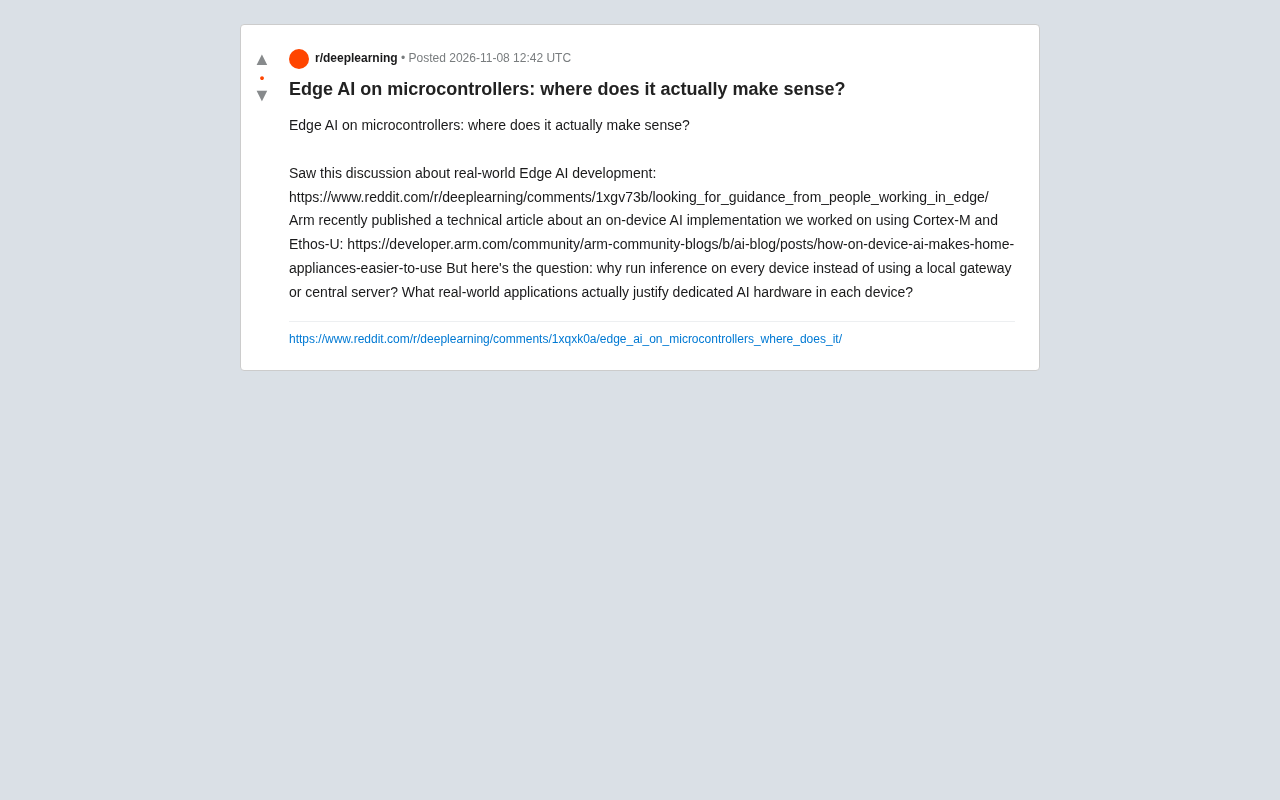
Edge AI on Microcontrollers: When Is It Actually Worth Deploying?
Drawing on Reddit discussions and Arm case studies, this article analyzes the real-world use cases for edge AI on microcontrollers: when each device needs independent inference, when a gateway or cloud is more reasonable, and the costs and boundaries of specialized hardware.
 Tech Frontiers
Pushing the Limits of Extreme Sudoku on a 16GB GPU: Insights from Depth and Flow Matching
A researcher trained a 16.54M-parameter model on a 16GB GPU to solve extreme Sudoku, finding effective depth breaks the 60% plateau and flow matching with improved sampling pushes accuracy past 99% with ~50× lower layer-evaluation budget.
 Tech Frontiers
AI Agent Approval Workflows: Why Human Confirmations Always Get Mindlessly Clicked
Why do AI agent approval workflows always get mindlessly clicked? A Reddit discussion shows that separating rules from keys, low-frequency high-risk approvals, and GitHub Environments-style gates are the keys to effective approvals.