GitHub Trends · Oct 25: A local ElevenLabs storms the charts
GitHub Trends · Oct 25: A local Eleven…
Deep dive into 5 new GitHub projects that hit the trending list today
Deep dive into 5 new GitHub projects that hit the trending list today
There are some new faces on GitHub today, and they're climbing the Trending list fast.
And if you look at the charts these past few days, there's a pretty consistent theme.
How so? Give me the conclusion first, then I'll hear it.
The conclusion is: tools are moving local, onto your own machine.
Alright, let me start with the first one and see if it matches your read.
The top new face is VoiceStudio by debpalash, a fully local ElevenLabs alternative.
The name is pretty straightforward, but its ambition is not small.
It's got over 12,900 stars, and gained more than 500 today alone.
The key isn't the star count, it's the 646 languages.
Wait, 646? I need to double-check that number—it really says that in the description.
Right, that's its moat—not audio quality, but coverage.
So what can it actually do? Break it down for me.
Voice cloning, voice design, video dubbing, transcription, and audiobook production.
That basically covers the whole workflow for content creators.
The key is 'fully-local'—data never leaves the machine, which is a hard requirement for many companies' compliance.
I get it. People used cloud services for convenience, but all the recording material had to be uploaded.
Exactly. Voice is biometric data, and a lot of legal teams won't sign off on uploading it to the cloud.
So how does it relate to projects like VoxCPM2? Competition or complementary?
VoxCPM2 is more like the underlying engine, while VoiceStudio is more of a user-facing workbench.
So one sells the engine, the other sells the whole car—that's the way to see it, right?
Pretty much. And VoiceStudio is written in Python, so it's low-barrier for researchers to modify.
So to sum up this one: localization plus multilingual coverage is why it surged today.
Second one—this I didn't expect. JetBrains has entered the game.
Yep, thinkrail, written in TypeScript, a lightweight true IDE.
The description says 'vibe code with pi,' and the IDE customizes itself around how you work.
The subtext there is that the IDE is no longer a fixed-shaped shell.
Before, we adapted to the IDE; now the IDE adapts to us?
Right, that's a reversal in product logic, and JetBrains has the foundation to pull it off.
But it only gained 52 stars today, total over 1,100—not exactly explosive growth.
So it's not rising on hype; it's being noticed because of the JetBrains name.
It's brand new and hasn't had time for word of mouth to build—I'm guessing that's the state it's in.
And it's actually the same anxiety you mentioned a few days ago with those anti-AI-feel design skills.
You mean people are starting to care about whether AI-generated stuff is actually usable, not just whether it can generate.
Exactly—tools are moving from 'it runs' to 'is it smooth to use.'
Okay, third one: Coolify, a veteran back on the list.
Over 63,000 stars, up 150 today—self-hosted PaaS, competing with Vercel and Heroku.
It says it supports over 360 one-click services—that number is pretty intimidating.
Static sites, databases, full-stack apps—all on your own server.
This is on the same track as today's localization theme, right? Both about data sovereignty.
Exactly the same track—cloud is getting more expensive, so self-hosting is attractive again.
And it's written in PHP—that's a bit counterintuitive.
But that just shows it's not chasing new tech; it's focused on stable operations.
To sum up: an old project back on the list means the demand never left, the wind just blew back this way.
Fourth: TradingAgents, a multi-agent financial trading framework.
Over 96,000 stars, up almost 600 today—that scale is already scary.
I remember agency-agents was also in the 100k range a few days ago—why are these projects all so big?
Because agents are the narrative entry point—people are buying the imagination, not the lines of code.
But from a product perspective I have a question: financial trading—would you really dare let an agent place orders?
So it's more of a research framework—multiple roles, some analyze, some review.
The focus is on the multi-agent collaboration structure, not real-money live trading.
So it's translating the org chart of a trading desk into agent roles.
Exactly, that analogy is spot on—role-based design is the mainstream agent approach this year.
But I have to point out: the compliance cost in finance isn't something open source can solve.
Agreed, so its value is in the methodology, not in directly running money with it.
Last one: claude-seo, an SEO skill pack for Claude Code.
Over 20,100 stars, up 179 today—solid among new projects.
26 sub-skills, 19 sub-agents—that breakdown is a bit extreme.
It covers technical SEO, E-E-A-T, structured data, and even GEO and AEO.
Wait, llms.txt and WebMCP—are those preparing web pages for agents to read?
Yes, that's called agent readiness—meaning web pages aren't just for humans, they're for agents too.
I think that's a big shift: SEO went from pleasing search engines to pleasing agents.
And it's on the same track as those Claude skill libraries—skills are becoming a plugin marketplace.
So the charts these past few days are all telling the same story.
Go on, I want to hear how you sum it up.
It's that people aren't comparing whose model is stronger anymore—they're comparing whose surrounding ecosystem is more complete.
Right, models are commoditizing, and value is migrating to the local runtime and the skill layer.
So for today's must-see, I'd pick VoiceStudio, for a very simple reason.
Give the reason, don't just say the name.
Because it's the only one today that an ordinary person can actually start using right away.
I'll add one: if you're building agents or data pipelines, check out TradingAgents' role design.
Alright, that's it for today—see you on tomorrow's chart.
Related articles
 Tech Frontiers
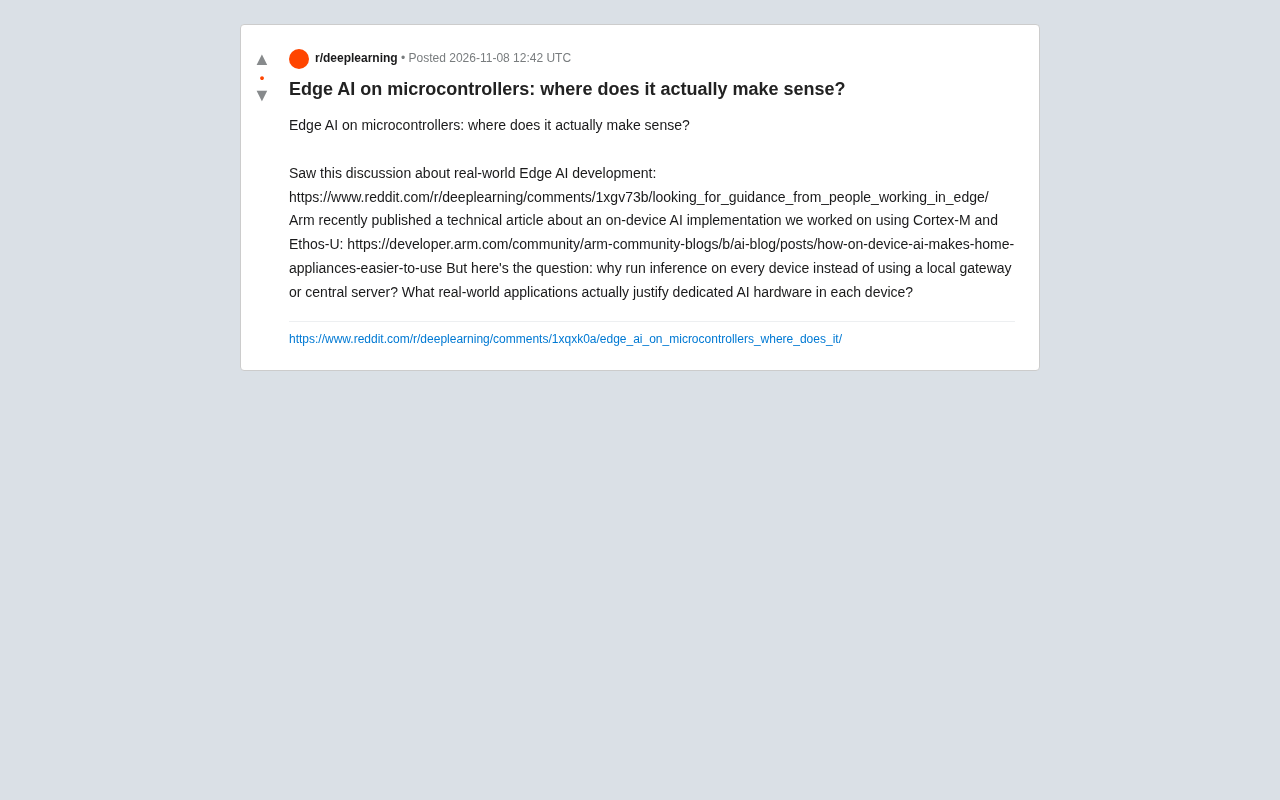
Edge AI on Microcontrollers: When Is It Actually Worth Deploying?
Drawing on Reddit discussions and Arm case studies, this article analyzes the real-world use cases for edge AI on microcontrollers: when each device needs independent inference, when a gateway or cloud is more reasonable, and the costs and boundaries of specialized hardware.
 Tech Frontiers
Pushing the Limits of Extreme Sudoku on a 16GB GPU: Insights from Depth and Flow Matching
A researcher trained a 16.54M-parameter model on a 16GB GPU to solve extreme Sudoku, finding effective depth breaks the 60% plateau and flow matching with improved sampling pushes accuracy past 99% with ~50× lower layer-evaluation budget.
 Tech Frontiers
AI Agent Approval Workflows: Why Human Confirmations Always Get Mindlessly Clicked
Why do AI agent approval workflows always get mindlessly clicked? A Reddit discussion shows that separating rules from keys, low-frequency high-risk approvals, and GitHub Environments-style gates are the keys to effective approvals.