GitHub Trends · Oct 31: Multi-Agent Classroom Takes the Top Spot
GitHub Trends · Oct 31: Multi-Agent Cl…
Deep dive into 5 new GitHub projects trending today
Deep dive into 5 new GitHub projects trending today
Some new faces popped up on GitHub today. One education project shot straight to number one.
I saw that. It's from Tsinghua, called OpenMAIC.
Tsinghua? That's some serious backing.
Yeah, the THU-MAIC team. Over 22,000 stars, up more than 900 today.
So what problem does it actually solve? I feel like online education is always super competitive.
That's not the main point. It does multi-agent interactive classrooms—one click generates an immersive learning experience.
Think about it. Before, MOOCs were just videos plus a discussion board. Now it's a bunch of agents taking class with you.
Wait, a bunch of agents? Do they play classmates or teachers?
Both. That's the gap it fills—virtualizing all the roles in a classroom.
So why is it blowing up today? Is it back-to-school season?
School started two months ago in October. I'm guessing the demo is just too intuitive—one click and you're in.
Low barrier to spread. I get that—product managers dread anything that takes users half an hour to set up.
Exactly. When the cost of trying is basically zero, people want to share it.
Okay, next. There's also a Zi Wei Dou Shu project on the list—that's quite a shift in vibe.
ziwei-doushu, over 6,500 stars, up more than 500 today, jumped to number five.
6,500 stars with 500 new—that's actually a faster growth rate than the number one spot.
Proportionally, yeah. And it's really serious work—based on Ni Haixia's Tian Ji system.
A chart engine? I always thought these things were just little apps on your phone.
They open-sourced the algorithm. The Four Transformations system, a pattern knowledge base, and even original text data from ancient books.
They included the original ancient texts? So it's not just a toy—it's an open-source project with historical sources.
Right. The gap it fills is that the metaphysics field has almost no engineering implementations.
Why is it hot today? I'm guessing TypeScript plus Chinese content got developers curious to click in.
Makes sense. And it's reproducible—anyone can take it and build on it.
So who's the target user? Hobbyists, or people building fortune-telling products?
Both ends. Hobbyists use it as a tool, developers use it as a low-level library.
Then there's another one, Orkas. This one's more my style—a desktop AI team.
Orkas-AI/Orkas, over 5,800 stars, up more than a thousand today—the biggest gainer of the day.
A thousand plus? So that's the real dark horse running today.
It has a Commander that breaks your goals into to-dos, then orchestrates sixteen built-in agents.
Sixteen? And it can connect to external tools like Claude Code and Codex?
Yep, and OpenCode, OpenClawAd, Hermes too. Plus it's local-first under the MIT license.
Local-first is key. Enterprise users are terrified of data leaving their premises.
So compared to pure cloud agents, it fills the gap on privacy and control.
Wait, doesn't this directly collide with those agent frameworks you mentioned before?
More like complementary. It's a desktop shell that uses other agents as plugins.
So it's an orchestration layer, not building its own model. Smart.
Right, and scheduled automation too. That's super practical for enterprises.
The next two are a different vibe again. devops-exercises—how did an old question bank make the list today?
Over 85,000 stars now, up 300-plus today, ranked thirteenth.
These question bank projects usually just chug along—300 stars in a day is pretty unusual.
I'm guessing it's interview season. Fall recruiting is wrapping up, everyone's cramming.
Makes sense. And it covers everything—from Kubernetes to Terraform.
It's the kind of project with no new features, but always in demand.
Last one, vorssaint-utils, a macOS menu bar tool. This one's growth today is the most insane.
Over 2,500 stars in a day, total hasn't even hit 10k, gained 2,500—explosive.
Aren't menu bar tools a dime a dozen? Why did it suddenly blow up today?
The key is free and open source. Think about it—there are tons of paid menu bar tools.
Yeah, that market is a real charging zone.
So someone made a fully open-source alternative, written in Swift, and users voted with their feet.
So sum it up—what do these five new faces have in common today?
Three threads. One is agentification—both education and desktop are doing multi-agent orchestration.
Two is engineering in vertical domains—even metaphysics is talking about reproducibility.
And three?
Three is free open source beating paid products. The menu bar tool is a perfect example.
So the takeaway is, agents are moving downstream—from writing code down to education and everyday desktop use.
Yeah, I think that trend is more important than any single project.
So what's your must-see today? Which one do you recommend?
I'd go with Orkas. It's growing the fastest, and I'm bullish on the local-first direction.
I'll add OpenMAIC—the imagination for education scenarios is huge.
That's it for today. If new faces show up tomorrow, we'll keep watching.
Deal. Coffee's on me. See you tomorrow.
Related articles
 Tech Frontiers
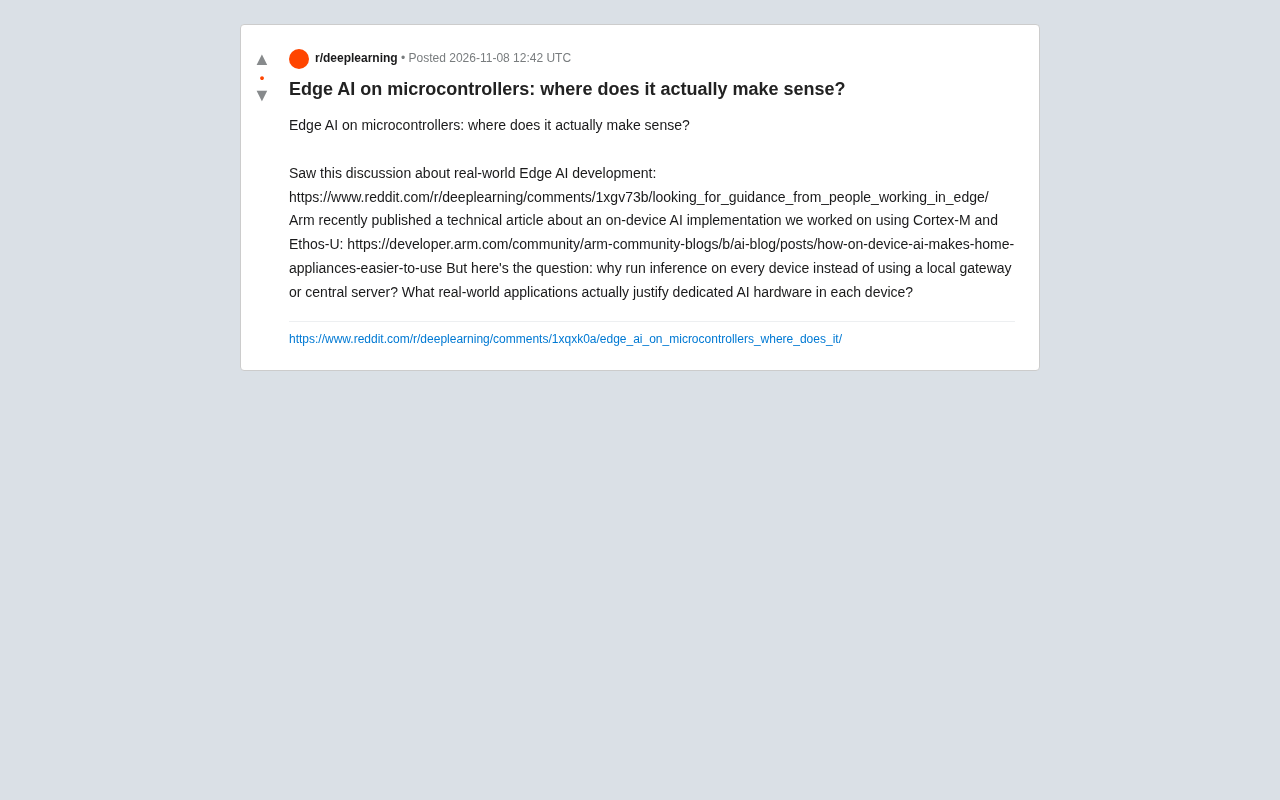
Edge AI on Microcontrollers: When Is It Actually Worth Deploying?
Drawing on Reddit discussions and Arm case studies, this article analyzes the real-world use cases for edge AI on microcontrollers: when each device needs independent inference, when a gateway or cloud is more reasonable, and the costs and boundaries of specialized hardware.
 Tech Frontiers
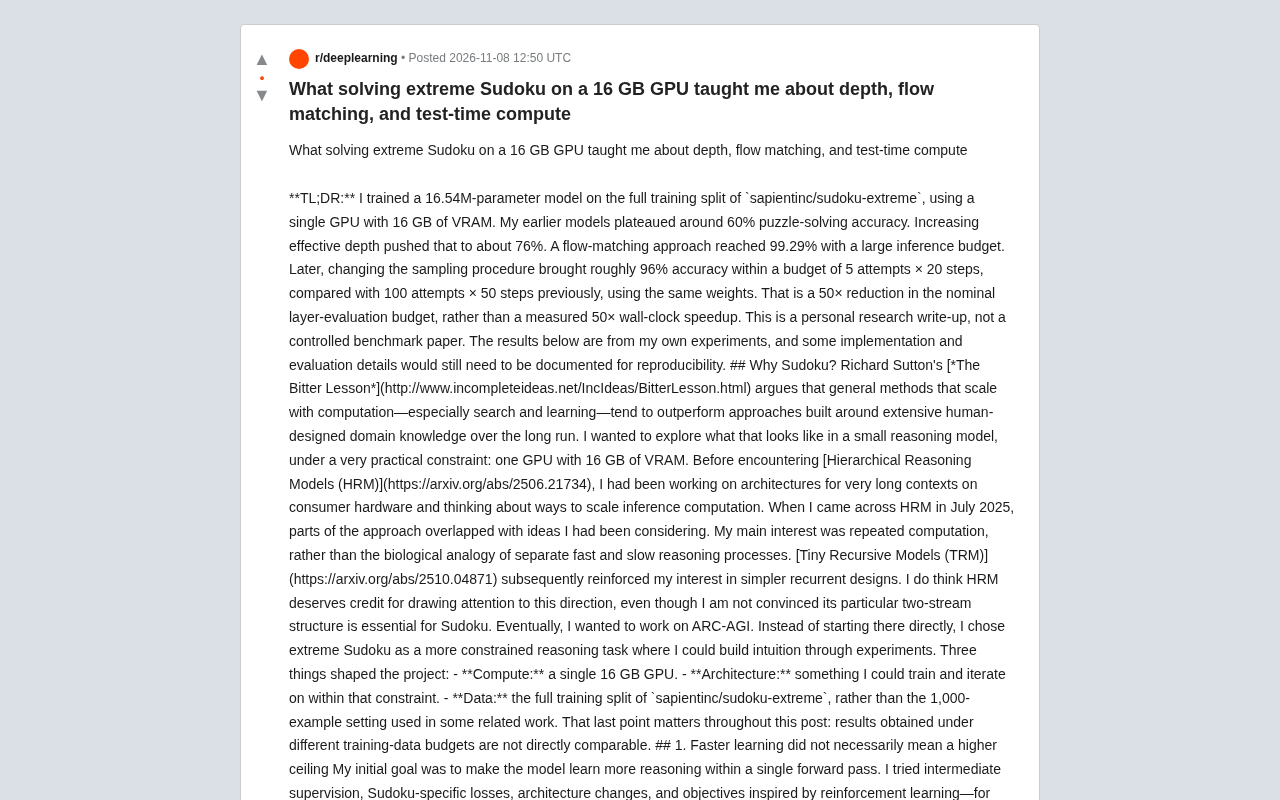
Pushing the Limits of Extreme Sudoku on a 16GB GPU: Insights from Depth and Flow Matching
A researcher trained a 16.54M-parameter model on a 16GB GPU to solve extreme Sudoku, finding effective depth breaks the 60% plateau and flow matching with improved sampling pushes accuracy past 99% with ~50× lower layer-evaluation budget.
 Tech Frontiers
AI Agent Approval Workflows: Why Human Confirmations Always Get Mindlessly Clicked
Why do AI agent approval workflows always get mindlessly clicked? A Reddit discussion shows that separating rules from keys, low-frequency high-risk approvals, and GitHub Environments-style gates are the keys to effective approvals.