GitHub Trends · Nov 1: The Offline Speech Duo
GitHub Trends · Nov 1: The Offline Spe…
Deep dive into 9 new GitHub projects trending today
Deep dive into 9 new GitHub projects trending today
So a few new faces just hit GitHub Trending today. And there's one area that's especially crowded—I noticed it right away.
You're not wrong. Let me give you the bottom line first: among today's new entries, two projects in the speech-to-text space popped up at once. That's not common.
Two? Okay, let's start with the first one: cjpais/Handy. It gained over 600 stars today, with a total of over 36,000.
Handy comes down to three words: free, open source, and completely offline. It's written in Rust, and transcription runs entirely on your local machine.
Wait, completely offline? So you don't need to upload recordings to the cloud?
Exactly—that's the gap it fills. Most good transcription tools on the market require an internet connection. The moment a company hears data leaves their intranet, they shut it down.
I can really relate to that. When we were building AI products, we had a healthcare client who said recordings absolutely could not leave their servers. The whole requirement just hit a wall.
So that's exactly what Handy and tools like it target: compliance-sensitive scenarios. Lawyers, doctors, internal meeting notes—all can use it.
So how does it pull that off? Rust is for speed, but running models offline—where do the models come from?
It's extensible—you can choose different small models for local inference. But that's not the main point. The main point is they've packaged the engineering so it works out of the box.
Alright, here comes number two: anomalyco/hex. This one's for macOS—you hold a hotkey, speak, and it pastes directly into any app.
See, this is today's best contrast. Handy leans cross-platform and general, while hex is the ultimate local dictation tool on macOS.
It only has about 2,400 stars—much smaller than Handy. Why did it make the list too?
It's small, but it gained over 170 stars today—the growth rate is actually steeper. Plus it takes a lightweight approach: one hotkey and you're done.
So Handy is like a full-fledged transcription tool, and hex is more of a handy little assistant.
Right, and both are Rust, both run models locally, both sell privacy as the key feature. That's definitely a signal.
What kind of signal? Go on.
In speech, cloud solutions have already been validated—now it's time to squeeze models onto local devices. Users don't want to compromise on experience for privacy anymore.
That makes sense. And two projects popping up on the same day feels like they're cross-validating that the demand is real.
To sum it up: offline speech-to-text is moving from geek toy to something ordinary people can use.
Okay, moving on from speech, here's an interesting third one: public-apis/public-apis. A free collection of APIs.
This one's an old face—459,000+ stars—but today it surged again with over 2,400 new stars.
An old project suddenly back on the list is actually more worth discussing. Why did it blow up again today?
Think about it: so many people are building agents now, and the first step for everyone is finding data sources and tool interfaces. This is the yellow pages.
So it's not an old tree sprouting new leaves—it's the AI agent wave pushing an old resource back into the spotlight.
Exactly. A README with over 4,000 lines and 50,000+ forks has become the starting point for countless projects.
Next up, I've got to ask about this one: shiyu-coder/Kronos, a foundation model for financial market language. Can finance really be understood by models?
Kronos takes a different path—it models market data as a kind of language rather than just doing prediction.
That's different from the quant models I remember—wasn't it just feature engineering plus regression before?
Right, that's the gap. Financial data is noisy and non-stationary; feeding it directly into general-purpose large models doesn't work well. This is domain-specific.
32,000+ stars, gained over 100. That's pretty high for finance, isn't it?
Very high. Open source in finance is already rare—people keep things under wraps. Having 30,000+ stars shows both the research and quant communities are watching.
So is it competing with or complementing general financial prediction tools?
More like a foundation. Others build strategies and signals on top of it. It doesn't trade itself—it provides the layer that understands the market.
Okay, then we have two projects aimed at developers and AI engineers. One is kornia/kornia.
Kornia is a geometric computer vision library with 11,000+ stars. It turns differentiable vision operators into standard building blocks—needed for spatial AI.
What does differentiable mean? Explain it in plain language.
It means these image transformations can be plugged directly into neural networks and trained together. Before, you had to hand-write them; now you just use them.
It didn't gain much—only 80+ stars. Why did it still make the list?
This is a long-distance runner—usually low-key, but people doing robotics and SLAM can't do without it. It's infrastructure.
Then there's patchy631/ai-engineering-hub. Sounds like a tutorial repo from the name.
Yes, covering LLM, RAG, and agent hands-on practice. 39,000+ stars, gained 570+ today. The demand for learning keeps growing.
See, tools are trending, and tutorials are trending too—shows the ecosystem is still in rapid expansion.
Right. And another one: beenuar/AiSOC, an AI security operations center. 5,800+ stars, gained 400+ today.
It's called SOC—so it's for security teams? What does it have to do with AI agents?
It aggregates alerts, uses LLM agents for initial triage, and logs every decision step so they can be replayed. Basically an AI analyst for security teams.
The replay part is key—in security, the worst is AI making blind judgments and not explaining why.
Exactly, that's the gap it fills. And no API key required, self-hosted, and it can connect to Claude and Cursor.
Last one: FlashML-org/FreeToken. Bringing data-center-level model serving to the desktop?
15,000+ stars, gained 200+ today. It aims to let ordinary computers run large models, relying on smarter memory management and scheduling.
Isn't that going head-to-head with cloud inference? Look at today—Handy, hex, FreeToken, all about local.
Yes, that's today's biggest common thread. From speech to model serving, local-first has become the main theme—because of privacy, and because hardware is now capable enough.
What about Hyprland? How did this Wayland compositor sneak in—it only gained 20+ stars.
It's an old favorite in the Linux desktop world, 36,000+ stars. Small gain today, but it's always hovering on the list—shows strong stickiness in the geek community.
So to sum up, today's keywords are local-first plus AI infrastructure, right?
Yes. On one end, pushing AI capabilities onto your devices; on the other, providing foundations and tutorials for AI builders. Both ends are hot at the same time.
Alright, let's pick a must-see for today. I'd choose Handy—the need for offline transcription is just too real.
I recommend FreeToken. The direction it represents is that someday everyone will be able to run large models on their own machines.
Okay, that's it for today. Pick one and give it a try—see you next episode.
Related articles
 Tech Frontiers
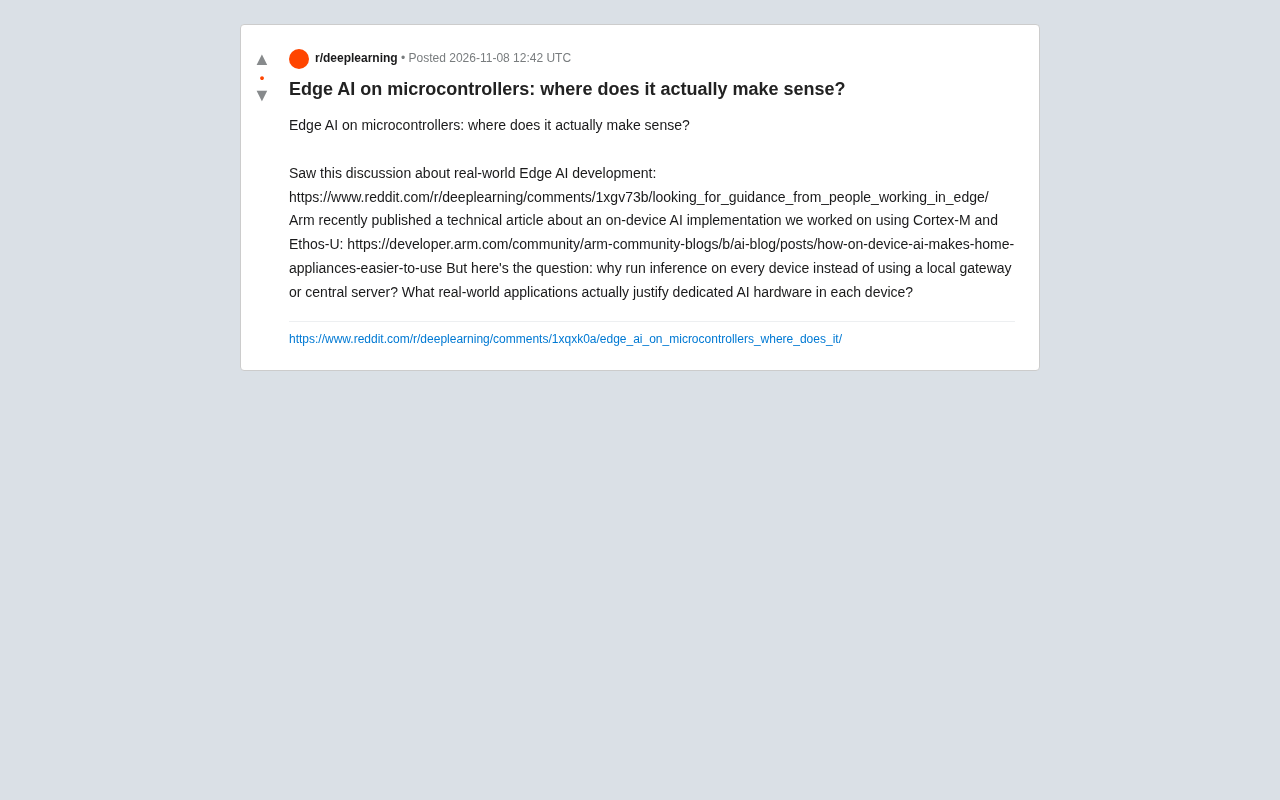
Edge AI on Microcontrollers: When Is It Actually Worth Deploying?
Drawing on Reddit discussions and Arm case studies, this article analyzes the real-world use cases for edge AI on microcontrollers: when each device needs independent inference, when a gateway or cloud is more reasonable, and the costs and boundaries of specialized hardware.
 Tech Frontiers
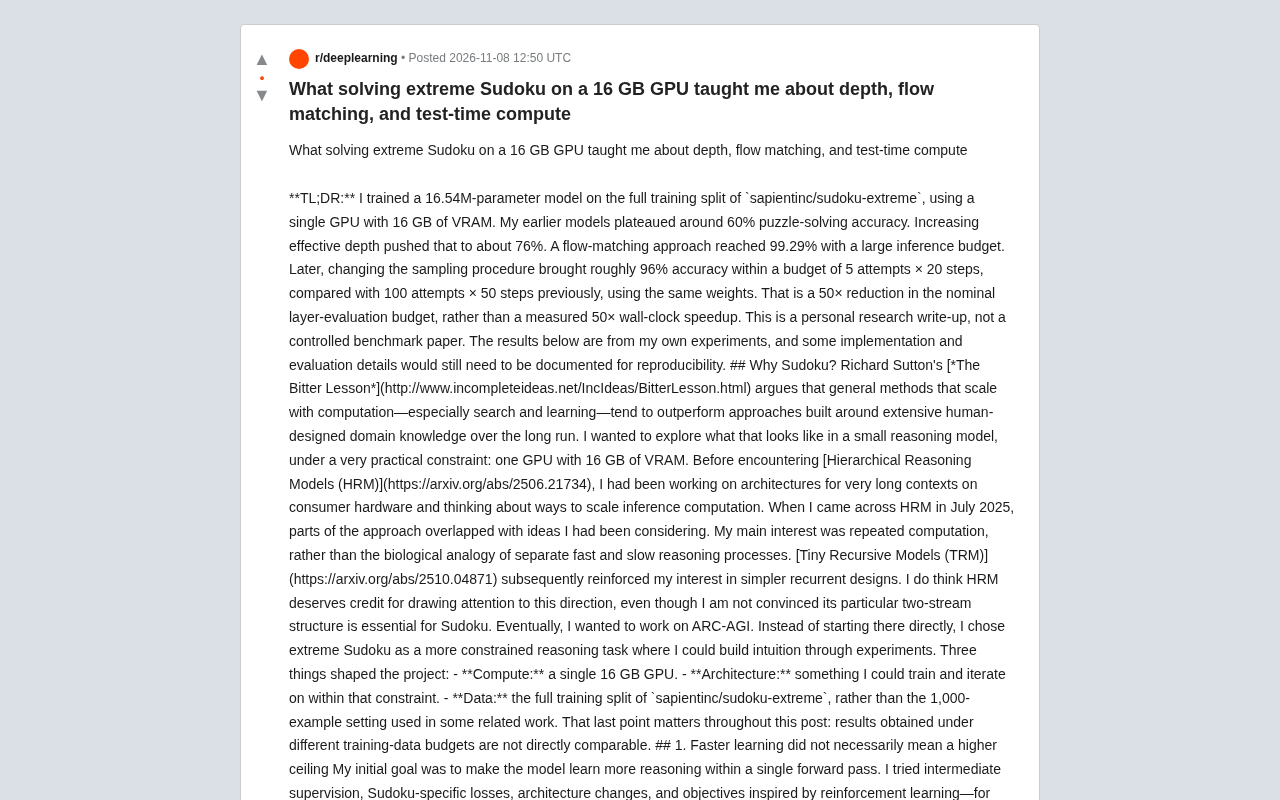
Pushing the Limits of Extreme Sudoku on a 16GB GPU: Insights from Depth and Flow Matching
A researcher trained a 16.54M-parameter model on a 16GB GPU to solve extreme Sudoku, finding effective depth breaks the 60% plateau and flow matching with improved sampling pushes accuracy past 99% with ~50× lower layer-evaluation budget.
 Tech Frontiers
AI Agent Approval Workflows: Why Human Confirmations Always Get Mindlessly Clicked
Why do AI agent approval workflows always get mindlessly clicked? A Reddit discussion shows that separating rules from keys, low-frequency high-risk approvals, and GitHub Environments-style gates are the keys to effective approvals.