GitHub Trending Nov 09: WiFi Vision and Stock Analysis Go Viral
GitHub Trending Nov 09: WiFi Vision an…
Deep dive into 4 new GitHub trending projects today
Deep dive into 4 new GitHub trending projects today
GitHub Trending has a whole new batch today — yesterday's list got completely pushed out.
Yeah, and all four are on the list, which means the bar to get on today is pretty high.
Let's start with the first one, garrytan/gbrain. That name looks familiar — his gstack was on the list a few days ago.
You're right. It's Garry again, but this time it's different — this is the agent brain he wrote for OpenClawAd and Hermes.
Wait, agent brain? How's that different from that config repo before?
That's not the point. gstack was a toolset; this is the decision layer. It's like giving the agent a brain that can think.
Written in TypeScript, 31,000+ stars, up 200+ today. The idea is to codify the agent's workflow preferences into code.
So it's opinionated, then — he's open-sourcing his personal preferences. Users have to buy into his logic.
Exactly. So it's not popular because it's generic — it's popular because the agent community is desperate for reference architectures with a point of view.
Got it. The second one is even crazier — daily_stock_analysis, 60,000 stars, up 287 today.
And look at the fork count — over 51,000. That ratio is insane. It means people are directly modifying the code to run their own.
Why so many forks? What problem does it actually solve?
LLM-driven multi-market stock analysis. Market data, news, dashboards, push notifications — all in one, and crucially, it can run on a schedule at zero cost.
The 'zero cost' part is interesting. So you don't buy data feeds — you just stitch together free APIs?
That's the gap it fills. Retail investors want quant-level info but have no budget. It uses LLMs as analysts — it's like a dimensionality reduction attack.
But for stocks — is LLM analysis reliable? I have my reservations.
Reliable or not is another question. But think about it — these tools used to be either paid or required you to build your own. Now it's one-click deploy. The demand is just too rigid.
So the reason it blew up today is essentially that it tapped into ordinary people's anxiety about using AI for personal finance.
Right, and it's written in Python, so the barrier is low — anyone can run it and take a look.
OK, next one — ha-mcp. This one connects AI assistants to Home Assistant.
This one I'm interested in. Use Claude or ChatGPT to directly configure and automate Home Assistant — no more clicking through those complicated interfaces.
So you just tell the AI 'turn off the lights at 10 PM' and it writes the automation rule for you?
Yep, and this is a typical implementation of the MCP protocol. 5,000+ stars, up 30+ today — not huge growth, but the direction is solid.
If growth isn't huge, how did it make the list? Was yesterday's base small?
Could be that the Home Assistant community itself is discussing it. Smart home plus AI — that combo always has heat.
The last one I have to ask about — RuView. Using WiFi signals for spatial sensing?
This is the hardest core one. Written in Rust, 76,000+ stars, up 130+ today. No camera — it uses WiFi signal reflections to infer body posture and vital signs.
Without a single pixel of video? Isn't that pseudoscience? How does it even work?
When WiFi signals pass through walls, the human body disturbs the channel state. From those disturbances it extracts breathing, heartbeat, presence. Think about how disruptive that is.
That opens up privacy instantly — you can monitor an elderly person falling in their bedroom without installing a camera.
That's exactly the scenario. And commercial-grade WiFi is enough — no special hardware, cost is almost zero.
So compared to radar sensors, what's the advantage?
Radar you have to buy separately; this uses your existing router. So it's about turning existing devices into sensors.
Now that you mention it, I just realized — these four have something in common today.
Go on.
They're all about stuffing AI into things ordinary people already have. Routers, stock accounts, home lights, and agents' workflows.
That's a very accurate summary. Let me add one more — they're all lowering the barrier. These capabilities used to belong only to professional teams.
So the conclusion is: today's trend isn't about building new models, it's about plugging models into existing scenarios. Whoever plugs in smoothly makes the list.
So for today's must-see, I recommend RuView — technically the most imaginative.
I recommend daily_stock_analysis — the demand is the most real. Both are worth clicking into.
Alright, that's it for today. See you on tomorrow's list.
Related articles
 Tech Frontiers
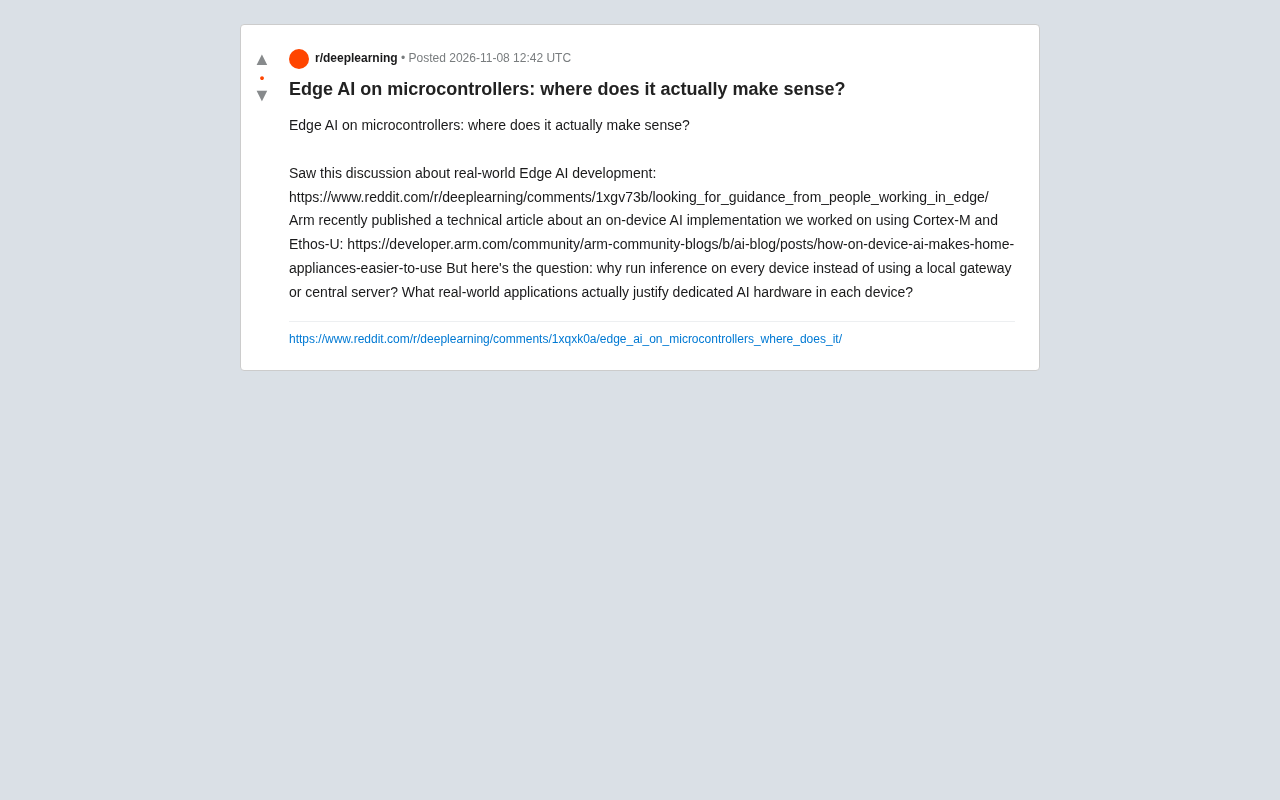
Edge AI on Microcontrollers: When Is It Actually Worth Deploying?
Drawing on Reddit discussions and Arm case studies, this article analyzes the real-world use cases for edge AI on microcontrollers: when each device needs independent inference, when a gateway or cloud is more reasonable, and the costs and boundaries of specialized hardware.
 Tech Frontiers
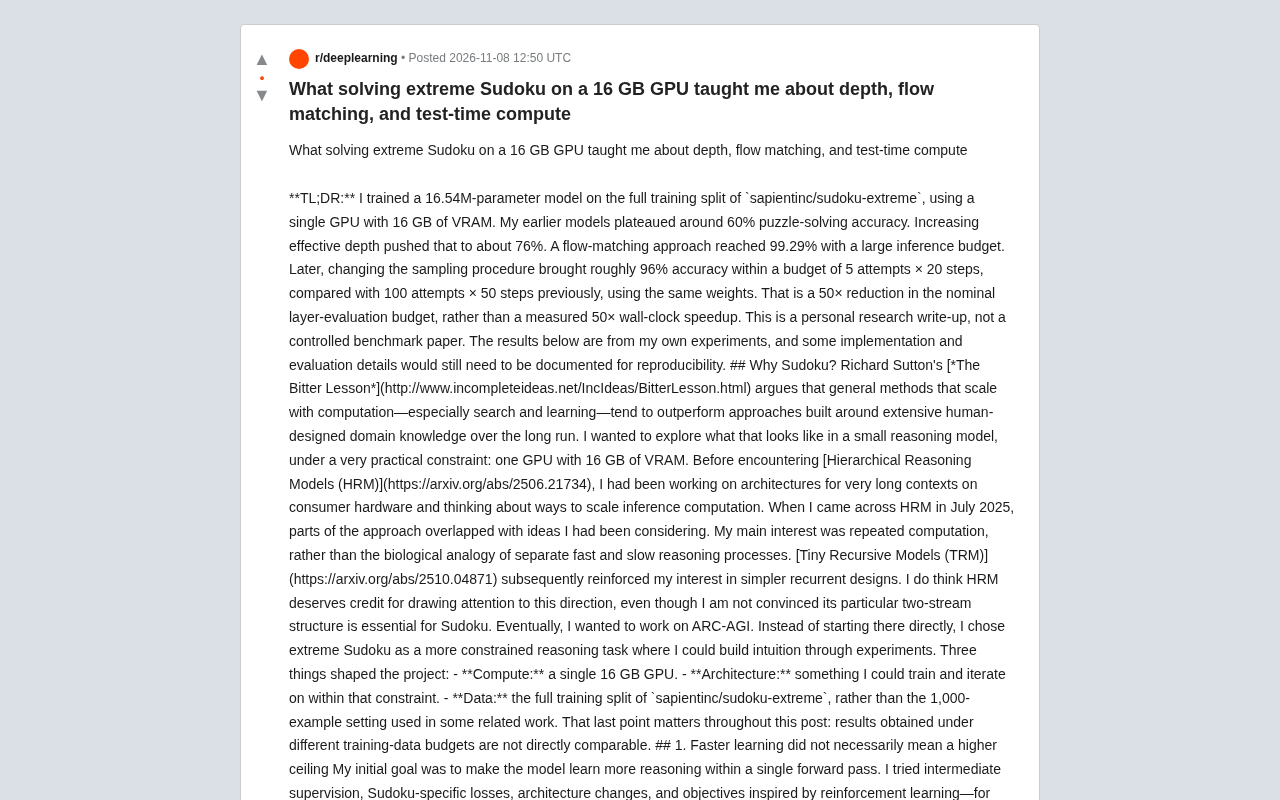
Pushing the Limits of Extreme Sudoku on a 16GB GPU: Insights from Depth and Flow Matching
A researcher trained a 16.54M-parameter model on a 16GB GPU to solve extreme Sudoku, finding effective depth breaks the 60% plateau and flow matching with improved sampling pushes accuracy past 99% with ~50× lower layer-evaluation budget.
 Tech Frontiers
AI Agent Approval Workflows: Why Human Confirmations Always Get Mindlessly Clicked
Why do AI agent approval workflows always get mindlessly clicked? A Reddit discussion shows that separating rules from keys, low-frequency high-risk approvals, and GitHub Environments-style gates are the keys to effective approvals.