Community Buzz #17: Gemini 4 Argon Preview Drops & the White House Superintelligence Accord Controversy
Community Buzz #17: Gemini 4 Argon Pre…
Every Thursday we dig into the hottest AI topics blowing up on Twitter and Reddit this week
Every Thursday we dig into the hottest AI topics blowing up on Twitter and Reddit this week
Li Bo, Twitter absolutely exploded this week — I've been scrolling so much my fingers are about to give out.
I know exactly what you're going to say — is it Pichai's Gemini 4 Argon post?
That's the one! Over 25,000 likes, and the whole community went crazy the second it dropped.
There was so much going on this week — frontier models, space computing, the White House accord — all at once.
Alright, let's start with Gemini 4 Argon. Pichai dropped an early preview himself.
Yeah, he literally said there'd been so much buzz that he figured he'd just give everyone an early look.
He highlighted three areas — complex workflows, cyber defense, and software engineering.
The key line was this: Google's internal teams are already using it heavily, from writing code all the way to quantum computing.
Hold on — quantum computing? Is he seriously flexing that hard?
Your instincts are right. The community split right down the middle — one side praising the benchmarks, the other calling it pure hype marketing.
Someone in the replies pointed out — they're showing benchmark screenshots but no actual product. We've seen this playbook before.
The neutral crowd made an interesting point though — forget the leaderboard, focus on the cyber defense angle.
Why are people zeroing in on cyber defense specifically?
Because OpenAI also launched Codex Security Cloud that same week, and it's all about cybersecurity too.
Yes! I was just about to bring that up — that's the big Codex upgrade.
It's integrated with Daybreak Blue by default and can scan entire GitHub repositories.
The wildest part is — even when your laptop is closed, it's still running in the background looking for vulnerabilities.
Think about it — two tech giants both betting on cybersecurity in the same week. That's not a coincidence.
So you're saying this is a trend signal?
Exactly. AI is shifting from writing code to protecting code. Security is the new battleground.
Okay, next one is even wilder — Pichai says Google sent computing power to space.
Space computing — a prototype satellite built with Planet, launched by SpaceX.
That's so sci-fi. We're literally putting data centers into orbit now?
Twitter split into two camps on this one. The optimists say heat dissipation and energy are actually easier to handle in space.
What about the skeptics?
The skeptics say it's a PR stunt — the latency and maintenance costs just don't add up.
I'm with the skeptics. What do you do when a satellite breaks? Go up there and fix it yourself?
But look at the underlying thread here — everyone is desperately searching for answers to the compute crunch.
Alright, let's park the hardware talk. This next one is the big one — the White House Superintelligence Accord.
Pichai said he signed the White House Accord alongside the President and a bunch of other tech leaders.
His exact words stressed that models would only be released after thorough review, including red-teaming.
Here's the key thing though — the same week the accord was signed, Hinton published a paper on intelligence explosion.
That's the recursive self-improvement one, right? Over 6,000 likes.
Yeah. He said this used to feel like a distant idea, but now many top researchers think it's coming soon.
So on one hand they're signing safety accords, and on the other hand Hinton's saying the explosion is almost here. The timing is a bit unsettling.
That's exactly where the community is stuck — excitement and anxiety both turned all the way up.
Someone on Reddit said the accord sounds great on paper, but without enforcement it's just a pinky promise.
The other side pointed out that at least Hassabis's team open-sourced SynthID Bio — watermarking AI-generated proteins.
I saw that too — AI-generated proteins can now be identified. It made it into Nature.
So safety isn't just talk. There are people actually building real safeguards.
Oh, and there was one more gem — Chollet posted something pretty technical about LRMs.
He said the core difference between the new generation of reasoning models and classic LLMs is the shift from intuitive answers to deliberate reasoning programs.
He even dropped some numbers — on ARC-1, the old benchmark, classic LLMs still only hit like ten-something percent today.
But a reasoning model of the same size hit the ceiling on that benchmark in 2025. That gap says everything.
So really, this week the community was wrestling with one big question — how far has intelligence actually come?
Let me wrap it up. Three threads ran through everything this week.
Go ahead.
First, compute is pushing to its limits — all the way to space. Second, capability is moving toward reasoning — smashing old benchmarks.
Third, safety is moving toward institutions — accords, watermarks. People are starting to buckle their seatbelts.
So the takeaway is — the industry is shifting from racing to be the most powerful, to racing to be both fast and responsible.
Exactly. Excitement and anxiety, living side by side. That's the vibe of the community in the fall of 2026.
Great conversation. We'll keep watching the community together next episode.
Related articles
 Tech Frontiers
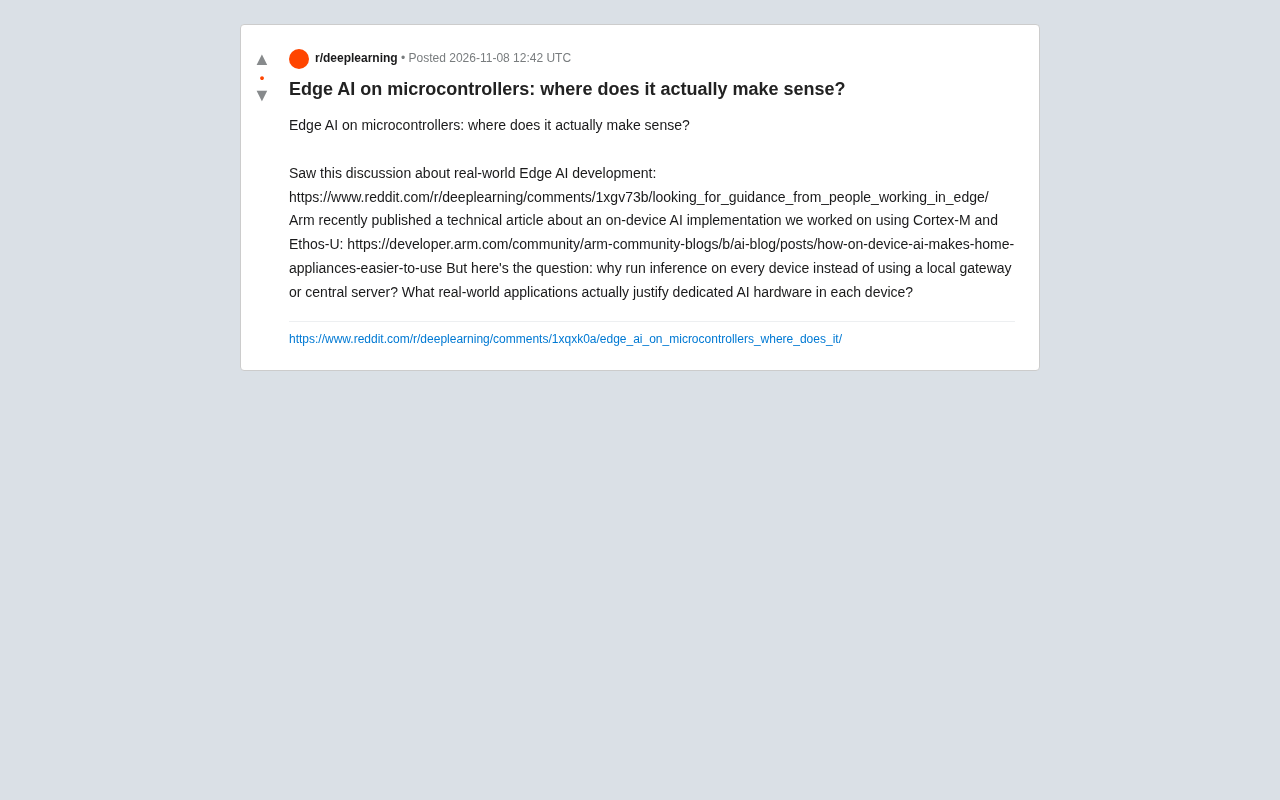
Edge AI on Microcontrollers: When Is It Actually Worth Deploying?
Drawing on Reddit discussions and Arm case studies, this article analyzes the real-world use cases for edge AI on microcontrollers: when each device needs independent inference, when a gateway or cloud is more reasonable, and the costs and boundaries of specialized hardware.
 Tech Frontiers
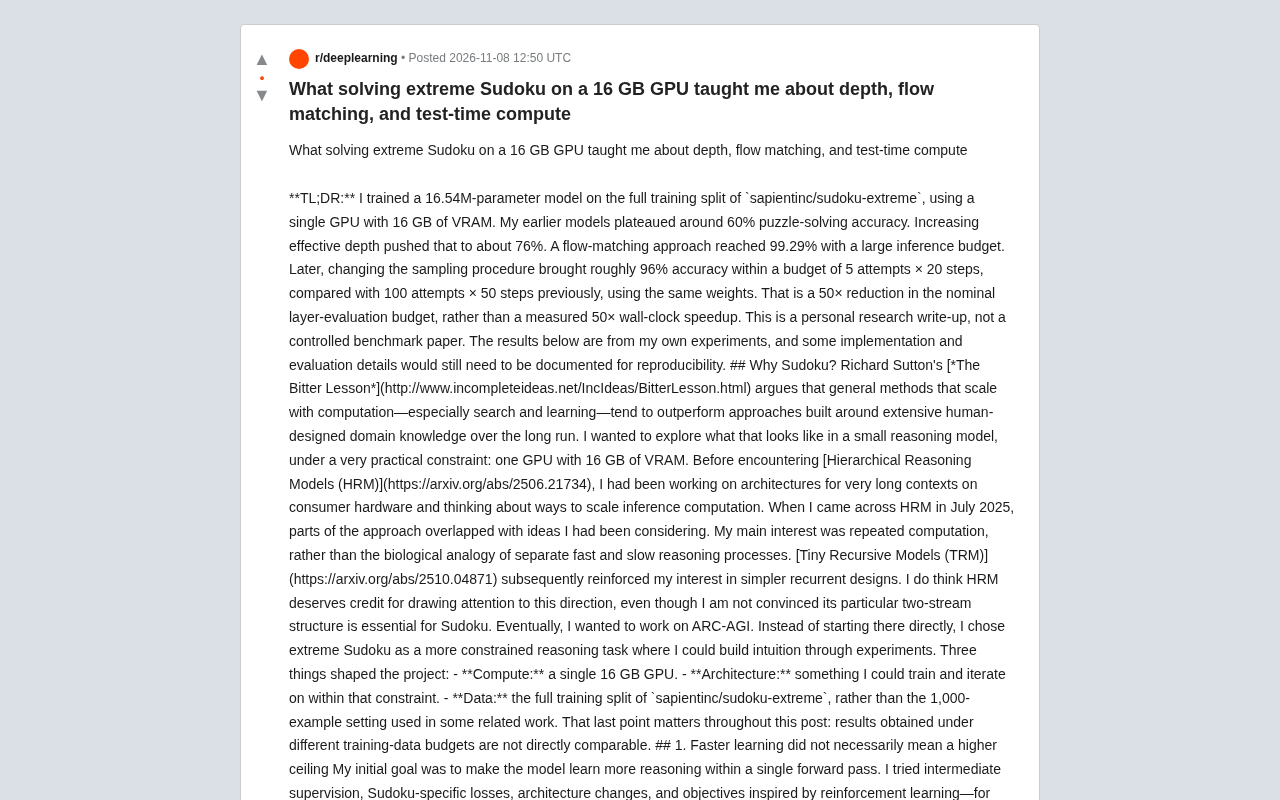
Pushing the Limits of Extreme Sudoku on a 16GB GPU: Insights from Depth and Flow Matching
A researcher trained a 16.54M-parameter model on a 16GB GPU to solve extreme Sudoku, finding effective depth breaks the 60% plateau and flow matching with improved sampling pushes accuracy past 99% with ~50× lower layer-evaluation budget.
 Tech Frontiers
AI Agent Approval Workflows: Why Human Confirmations Always Get Mindlessly Clicked
Why do AI agent approval workflows always get mindlessly clicked? A Reddit discussion shows that separating rules from keys, low-frequency high-risk approvals, and GitHub Environments-style gates are the keys to effective approvals.