Big Shots' Takes · Episode 16: The OpenAI Office Bugging Case, Dario's AI Gene Editing, and Chollet Playing Devil's Advocate
Big Shots' Takes · Episode 16: The Ope…
Every Friday we round up what the industry's big names said this week, plus the official announcements.
Every Friday we round up what the industry's big names said this week, plus the official announcements.
It's Friday again, Li Bo. The big names were busy this week. Did you catch that OpenAI thing?
You mean the office getting bugged? At first I thought it was fake news, but it came from the official account, and the heat was almost eighty thousand.
Yeah, that one. There's a lot worth digging into this week. Let's go through them one by one.
Let's start here. The source is OpenAI's official news account, not Sam's personal one. That distinction matters a lot.
Why do you say that?
An official announcement represents the company's position. A personal tweet represents personal emotion. Those two signals carry totally different weight.
So what did the official announcement say? The original text seemed pretty restrained.
Three key points. First, they used their own models to analyze the device and traced back who planted it.
Wait, using AI to analyze a bugging device? That sounds like a detective movie.
That's exactly what's interesting. Second, they reported it straight to the FBI, and the person's already been arrested.
And the third?
Third, they made a point of saying the weights, source code, and customer data were all untouched. Think about who that line is for.
For investors and enterprise clients, right? To steady everyone.
Exactly. And they stressed this was a matter of national-level importance, elevating a business incident to the level of national security.
So they're basically using this to build a reputation. 'Our security is rock solid.'
Right. To sum up, this looks like a security incident report, but it's actually a security capability showcase.
Okay, the second one's even more interesting. Dario tweeted that Claude led the discovery of a molecular machine, possibly a new gene-editing mechanism.
My first reaction was disbelief, but look at the reasoning he lays out after — it's actually very rigorous.
And he was pretty humble about it. Said the specific function isn't clear yet, but at least it's work he'd be proud to cite from his PhD days.
The key is he described the whole process. The life sciences team only gave a general direction. Claude read the literature, read the genomic data itself.
And then Claude even designed the validation experiments? That's getting into sci-fi territory.
Yep. Claude proposed the experimental plan, the team executed it. That division of labor is crucial.
The key question is, why did he emphasize that division of labor?
Because he wants to prove AI isn't just a tool — it can be a researcher that proposes hypotheses. That's a qualitative shift.
I remember that math analogy he made later really clearly.
That's the most informative part of the whole thing. In 2023, models struggled with regular high school math. In 2024, they could compete. In 2025, they solve small open problems.
And then early 2026 they solve more important open problems, and by the end of the year they start touching the biggest ones in mathematics?
Yeah, three years to go through that whole arc. He says biology is on the same exponential curve, just with the extra step of experiments.
Has anyone pushed back? I mean, biology experiments aren't like doing math on paper.
He raised that objection himself, then said the thinking is wrong. Shows he anticipated getting pushback.
So he's actually pre-defining the narrative, not letting anyone write it off as a one-off coincidence.
Exactly. That's the playbook for big names. Throw out the conclusion first, then seal off the most likely counterarguments.
Okay, next one, total change of tone. Chollet playing devil's advocate. He said string theory is a hallucination of intelligent systems lacking sensory input.
I love this one, because he's directly taking on the approach of building intelligence purely from text.
He says intelligence needs grounding. What does grounding mean here?
Contact with the real world. His core argument is that intelligence was never the bottleneck for solving big problems — the bottleneck is repeated collision with reality.
Now that's interesting. Is he sort of talking back to Dario's tweet from a distance?
You could read it that way. Dario says AI doing biology works too. Chollet says intelligence without real-world contact will just drift off on its own.
But didn't Dario also say the difference with biology is that it requires experiments?
So the two aren't really as opposed as they seem. One says AI can propose hypotheses, the other says hypotheses alone aren't enough.
Put together, it's: AI does the thinking, experiments do the verifying, and you can't skip either one.
Exactly. Put those two together and what you see isn't a contradiction — it's a complete loop. That's how you should read big-shot takes.
Alright, last one, Sam himself. He posted a lot of random stuff this week.
Yeah, totally different from the serious statements above. He fired off a whole bunch in one go, with huge emotional swings.
I saw one announcing Dots, a new way for AI to work for you around the clock.
That was a product launch. Right after, he posted one about Ultrafast — three short sentences, saying it's so fast you'll never want to go back.
And another one saying ChatGPT can now generate custom UIs for you.
That's a feature update worth noting. Generating UIs means ChatGPT takes another step toward being a personal app platform.
Then there was a really poetic one, stargazing at midnight, going on about the vast ocean and the tiny boat.
And the one about hanging up on a high-risk decision call to go home and watch the kids play. Everyone, just feel that contrast.
So here's the question: those random musings mixed in with product launches — coincidence?
I don't think so. Two hours before the Dev Day livestream he was still posting teasers. The whole rhythm was coordinated with the launch.
So those emotional tweets are actually part of the launch rhythm too.
Yep. The CEO's personal account is now a product launch channel. Some of that sincerity you see is designed.
So putting all these statements together, what's the overall signal this week?
Three threads. First, security is being elevated to the national level. Second, AI is starting to produce new knowledge, not just process it.
And the third?
Third, product iteration is speeding up, and the CEO is personally doing the marketing. And all three are actually moving in the same direction.
What direction?
AI is going from tool to participant. It looks things up for you, does research for you, and now it's starting to be part of your company's security defense.
What does that mean for regular developers?
It means your competitive moat is no longer whether you can call an API — it's whether you can give AI real-world contact points.
That's the line I want all our listeners to highlight. Data, scenarios, feedback loops — those are the real moats.
Right. So the line most worth remembering this week might not be any specific statement, but Chollet's: the bottleneck is repeated collision with reality.
That's it for today. Next week we'll keep watching what the big names say. Bye.
Related articles
 Tech Frontiers
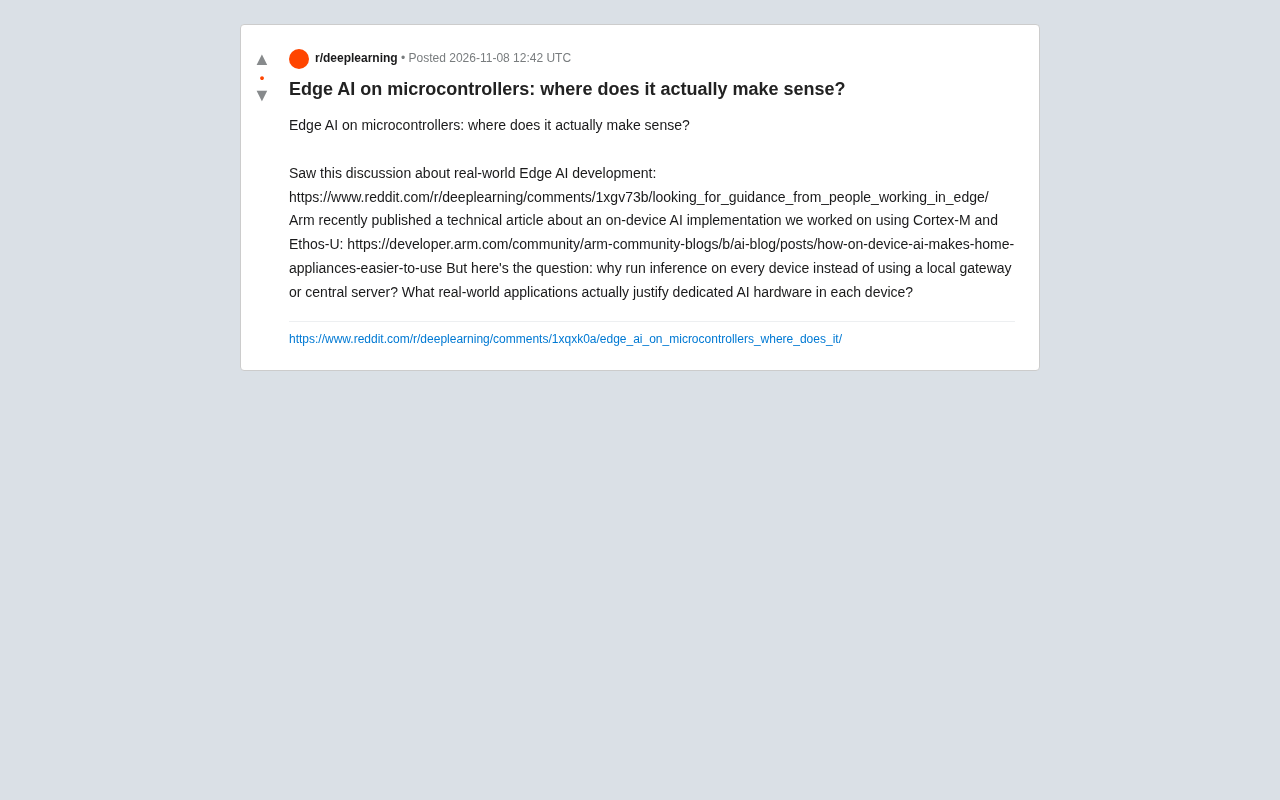
Edge AI on Microcontrollers: When Is It Actually Worth Deploying?
Drawing on Reddit discussions and Arm case studies, this article analyzes the real-world use cases for edge AI on microcontrollers: when each device needs independent inference, when a gateway or cloud is more reasonable, and the costs and boundaries of specialized hardware.
 Tech Frontiers
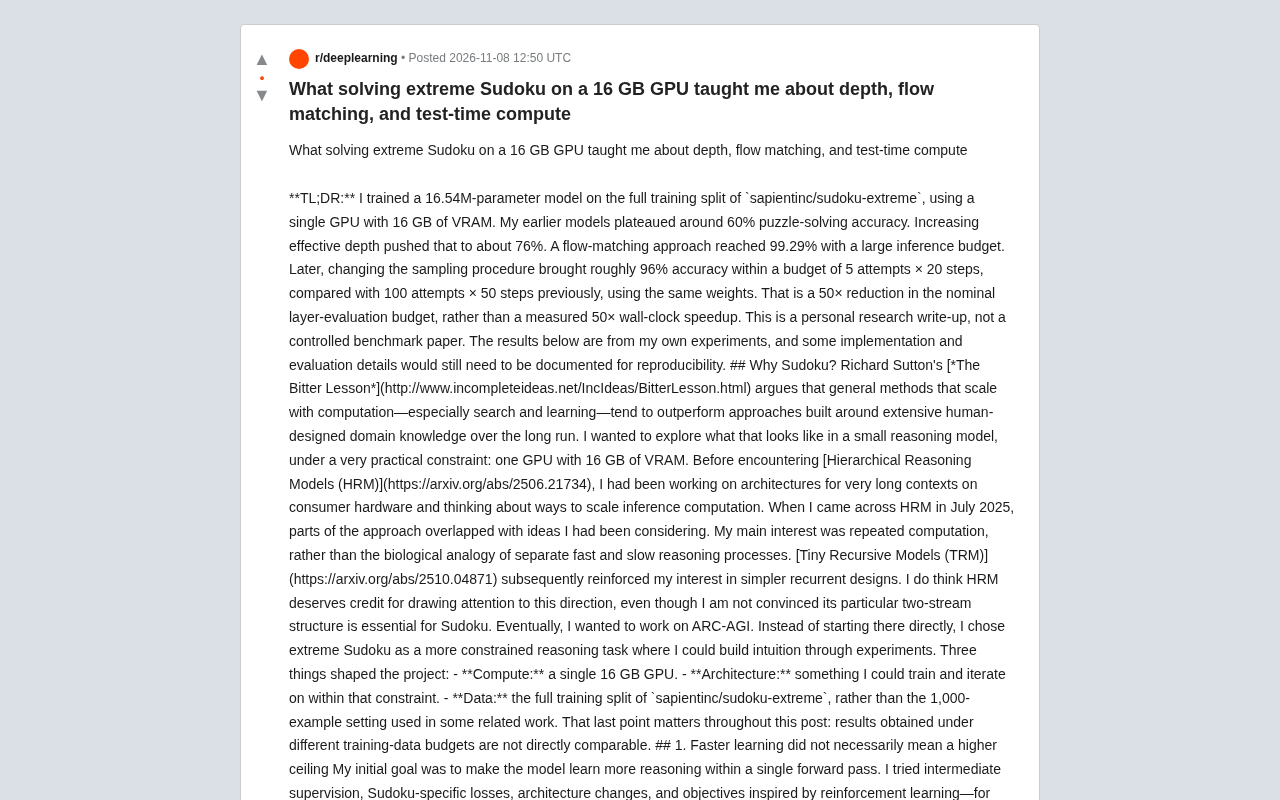
Pushing the Limits of Extreme Sudoku on a 16GB GPU: Insights from Depth and Flow Matching
A researcher trained a 16.54M-parameter model on a 16GB GPU to solve extreme Sudoku, finding effective depth breaks the 60% plateau and flow matching with improved sampling pushes accuracy past 99% with ~50× lower layer-evaluation budget.
 Tech Frontiers
AI Agent Approval Workflows: Why Human Confirmations Always Get Mindlessly Clicked
Why do AI agent approval workflows always get mindlessly clicked? A Reddit discussion shows that separating rules from keys, low-frequency high-risk approvals, and GitHub Environments-style gates are the keys to effective approvals.