GitHub Trends · Episode 16: Agent Skill Libraries Explode and Reverse Engineering Takes Off
GitHub Trends · Episode 16: Agent Skil…
Every Monday we round up the week's hottest GitHub projects and dig into how to use them and where they fit.
Every Monday we round up the week's hottest GitHub projects and dig into how to use them and where they fit.
It's Monday again, time for our roundup. I took a look at this week's GitHub charts and it felt really consistent. Guess what?
The way you say that, I have a feeling. A bunch of projects adding skill packs to agents? I was looking at that direction last week too.
Yeah, but there's another hidden thread you didn't guess. Reverse engineering projects are surging too, and the numbers are absurd.
Then we've got plenty to talk about today. One makes agents do more work, the other makes agents take apart other people's work—totally opposite directions.
Let's start with number one: morluto/rea. Full name is Reverse Engineer Anything. It uses agents for reverse engineering, going from app behavior all the way down to native binaries.
This project gained over 126,000 stars in a week, 130,000 total. My first reaction was the data must be wrong. But look, it has 29,000 forks, so people are actually doing things with it.
So what problem does it actually solve? My understanding is it breaks down work that used to require a senior reverse engineer doing it by hand into steps an agent can execute.
Right. Traditional reverse engineering is: observe behavior, capture packets, then drag it into a decompiler. rea orchestrates that whole flow into an agent task chain, written in TypeScript.
So what's its relationship with Ghidra? Ghidra made the list this week too, over 86,000 stars, up nearly 5,000 in a week.
That's not the point. The point is the layering. Ghidra is the NSA's open-source static analysis framework—it's the eyes at the bottom layer. rea is the brain on top.
So one is a tool, and the other is an agent that knows how to use tools? That combo is like pairing a veteran craftsman with an intern.
And a tireless intern at that. Think about it—the most draining part of reverse engineering is repeated trial and error, and that's exactly what agents are best at.
But I have to throw some cold water. What happens when this kind of tool falls into the wrong hands? Taking apart other people's software is no joke.
That's a fair concern. But on the flip side, people doing security research and malware analysis finally have a handy tool. It's a double-edged sword.
Okay, second thread: speaking of agent skills, anthropics/claude-plugins-official gained another 2,000+ stars, nearing 40,000 total.
It's not a new face, but its very existence says one thing: the official team is getting serious about the plugin ecosystem. That's a signal of platformization.
Next up, K-Dense-AI's scientific-agent-skills. Bold tagline: turn any agent into an AI scientist.
177 out-of-the-box skills plus over 100 scientific databases, covering biology, chemistry, medicine, drug discovery. Over 52,000 stars.
It claims 250,000 scientists are using it. I'll believe half of that, but the idea of vertical skill libraries is worth discussing.
Why do vertical libraries take off? Because general agents know a little about everything but aren't great at anything. In research scenarios, being a little off means wrong conclusions.
Wait, so is cathrynlavery's diagram-design the same logic? A skill pack specifically for drawing diagrams.
Exactly. 44 chart types, output includes HTML plus SVG, and it specifically emphasizes not using Mermaid-style cheap stuff. Gained over 9,000 stars in a week.
It's compatible with Claude Code, Codex, Copilot, Cursor, plus Factory Droid and Pi—basically covers all the mainstream tools.
That's the trend. Skill libraries are no longer tied to a single platform; they're written to open standards. Whoever has the bigger ecosystem gets more skills.
Does mksglu's context-mode count as the same category? It does agent context window optimization, gained over 4,000 stars in a week.
Close cousin. It sandboxes tool output, claiming a 98% reduction, and it persists session memory, routing across 17 platforms via MCP and hooks.
I know this one well. The biggest headache in our product line is context blowing up—long tasks start forgetting things halfway through.
So it solves the agent's memory problem. Once memory improves, reliability on long tasks has a foundation. Otherwise they're all sprinters.
Then there are two that are less agent-focused. storytold's artcraft, a design engine for artists and filmmakers, written in Rust.
Gained over 22,000 stars in a week—impressive. Its positioning is intentional crafting, emphasizing deliberate creation, not one-click generation.
And heygen's hyperframes, one sentence: write HTML, render to video, built for agents. Over 56,000 stars.
That's a smart approach. The interface for video generation isn't prompts, it's code. Agents are naturally good at writing code, so it clicks.
Let me add one: MadsLorentzen's ai-job-search, job hunting built on Claude Code. Over 51,000 stars, up 4,200.
This is especially good for regular people. Run it locally, evaluate jobs, tweak your resume, write cover letters, and even prep for interviews. Fork it and it's yours.
Last one: boykopovar's AnyPS5, automatically ports PS5 programs to Linux and Windows. Only 3,000+ stars but up 1,800 in a week.
Technically extremely difficult, but the fast growth shows real demand. Still, I'd remind people that projects like this carry legal risks you need to weigh yourself.
So to sum up this week, what do you think is the core signal?
In one sentence: agents are shifting from model capability competition to skill and surrounding engineering competition. Whoever has thicker skill libraries and manages context well wins.
I'll add: the reverse engineering surge also shows agents are starting to tackle high-barrier work that only experts could do before.
If you must-check, I recommend two. rea for direction, scientific-agent-skills for how vertical skill libraries land.
For regular folks, I recommend ai-job-search—tweak it and it's ready to use. Okay, that's this week's roundup. See you next week.
Related articles
 Tech Frontiers
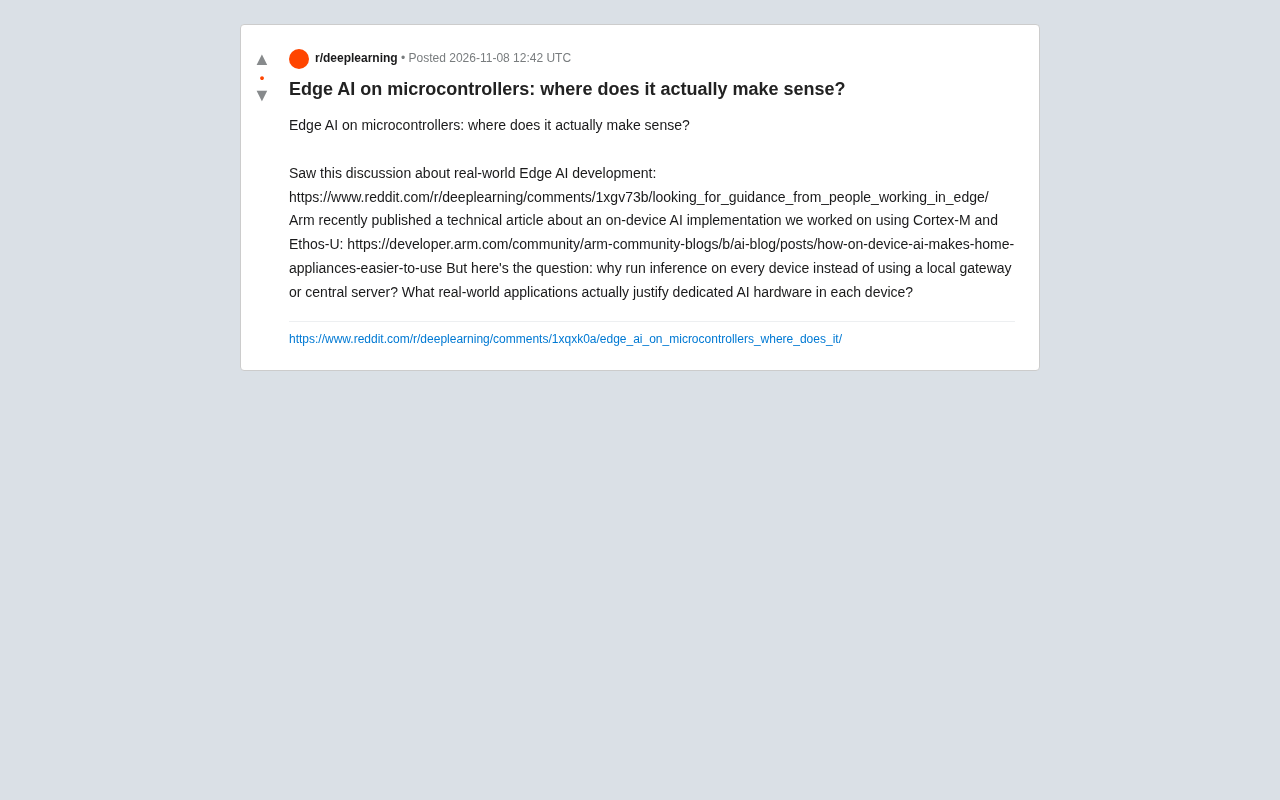
Edge AI on Microcontrollers: When Is It Actually Worth Deploying?
Drawing on Reddit discussions and Arm case studies, this article analyzes the real-world use cases for edge AI on microcontrollers: when each device needs independent inference, when a gateway or cloud is more reasonable, and the costs and boundaries of specialized hardware.
 Tech Frontiers
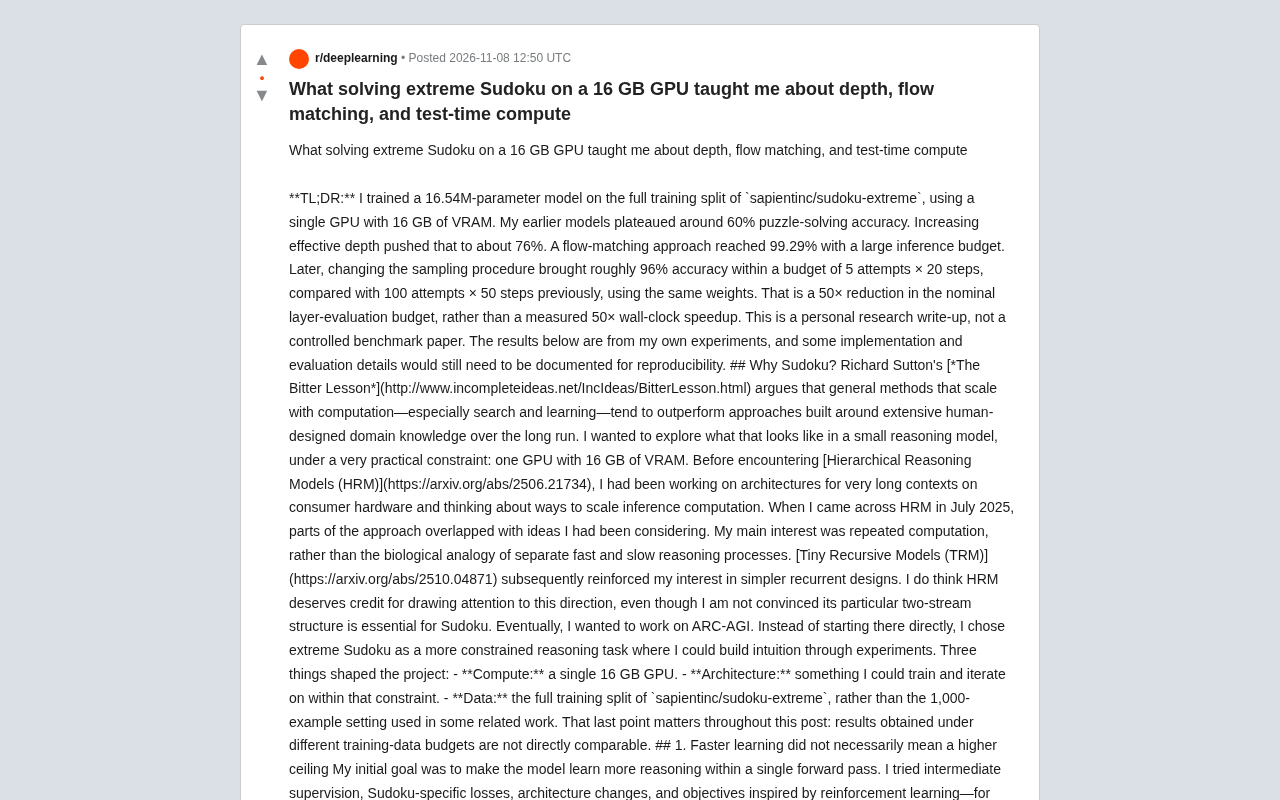
Pushing the Limits of Extreme Sudoku on a 16GB GPU: Insights from Depth and Flow Matching
A researcher trained a 16.54M-parameter model on a 16GB GPU to solve extreme Sudoku, finding effective depth breaks the 60% plateau and flow matching with improved sampling pushes accuracy past 99% with ~50× lower layer-evaluation budget.
 Tech Frontiers
AI Agent Approval Workflows: Why Human Confirmations Always Get Mindlessly Clicked
Why do AI agent approval workflows always get mindlessly clicked? A Reddit discussion shows that separating rules from keys, low-frequency high-risk approvals, and GitHub Environments-style gates are the keys to effective approvals.