GitHub Trends · Episode 20: Skill Packs Explode, Agents Enter the Era of Inner Strength
GitHub Trends · Episode 20: Skill Pack…
Every Monday we round up the hottest GitHub projects of the week and dig into how to use them and where they fit.
Every Monday we round up the hottest GitHub projects of the week and dig into how to use them and where they fit.
Happy Monday, Li Bo! This week I was scrolling the GitHub trending page and noticed something really odd — half of the top ten projects have 'skills' or 'skill' in their name.
You're not imagining it, and this isn't small potatoes. I went through every project on the list this week, and almost all of them are basically add-ons for coding agents.
So let's follow that thread today and see just how far the agent ecosystem has evolved.
Let me give you the bottom line first. This week's theme in one sentence: agents are no longer competing on who chats better — they're competing on who's equipped with more inner strength.
First up, let me mention hallmark — full name is 'anti-AI-cliché design skill,' built specifically for Claude Code and Cursor.
Over 43,000 stars, up more than 11,000 in a week. It solves a really painful problem: AI-generated stuff is instantly recognizable as AI-made.
Right, that purple-blue gradient with big rounded corners — after a while it's just aesthetically exhausting. So how does it actually fix that?
It's essentially a set of design constraints you drop into the agent's context, so the model runs through an anti-cliché checklist before it produces any output.
Wait — so it's basically giving the AI a design director who reviews the work before any code gets written?
Exactly. And the key point is it's not just a prompt trick — it's a reusable skill asset that works across projects.
Okay, number two: pbakaus's impeccable — the name means 'flawless' — also a design language, 75,000 stars, up 3,300 in a week.
This and hallmark are twin stars in the same lane. But impeccable is more foundational — it defines the grammar for how agents understand design.
Aren't they stepping on each other's toes? I want to ask: if you could only install one, which would you pick?
They don't overlap. Hallmark is a negative checklist — tells you what not to do. Impeccable is a positive system — tells you what to do.
One hits the brakes, the other hits the gas — that makes sense. Is it useful for non-technical people?
Product managers and designers can use it directly. Hook this onto Cursor and the quality of your prototypes visibly goes up.
Next, the biggest bomb this week: obra's superpowers — 300,000 stars, up over 4,600 in a week, shooting straight into the top of the overall rankings.
I think this is the highest-value project this week. It's not just a skill pack — it's a whole methodology for agent development.
'Methodology' sounds a bit vague. Give me something concrete — what does it actually make the agent do?
It breaks software development into a process the agent can execute — requirements analysis, solution design, coding, self-review — each step handled by a corresponding skill.
Oh, I get it — it's codifying the work habits of senior engineers into a script the agent can read.
Right, and it's written in Shell, super lightweight — essentially a bunch of composable skill directories plus scheduling rules.
So why did this one blow up and not other methodology projects?
Because it actually works. Lots of people in the community say following it noticeably cuts down on agent rework — that kind of word of mouth is worth more than any documentation.
Then there's claude-mem — 96,000 stars — doing persistent memory across sessions.
This patches the agent's most awkward shortcoming: every time you start a new session, it's like it has amnesia and asks everything from scratch.
So true. Last week I had an agent modify a module, and the next day when I opened it again it had no memory of what we'd talked about.
claude-mem's approach is to record everything the agent does, compress it into summaries with AI, and inject the relevant parts back in next time you start a session.
Sounds like giving the agent a long-term memory hard drive. How many harnesses does it support?
Claude Code, Codex, Gemini, Copilot, OpenCode — all can connect. Coverage is among the broadest in its category.
But let me throw a little cold water here — storing the wrong memory is worse than storing none, right?
You hit the nail on the head. That's why the quality of its compression and filtering is the real moat — memory isn't about quantity, it's about accuracy.
Okay, next up is Cloudflare's security-audit-skill — 42,000 stars, up 11,000 in a week, same growth level as hallmark.
I think this one is especially significant because it's a major company officially stepping in to write agent skills.
Why does 'major company stepping in' deserve its own callout?
Think about it — security audits used to be a manual pass by the security team. Now it's a multi-stage automated scan by an agent, and it outputs machine-readable conclusions.
That machine-readable point really resonates with me — reports meant for humans can't go straight into a pipeline.
Right, and it emphasizes independent verification — every finding has to be reproducible, which directly drives down the false-positive rate.
So the conclusion is: in security auditing, agents have gone from supporting role to primary output.
Then there's the one I find most ridiculous — andrej-karpathy-skills, 220,000 stars, and the content is literally just a single CLAUDE.md file.
One file with 220,000 stars — that alone tells you something. It compiles Karpathy's observations on LLM coding pitfalls into behavioral constraints.
What kind of constraints? I'm guessing things like 'don't randomly touch unrelated code' and 'don't add abstractions on your own initiative.'
Pretty much — the core is getting the model to restrain its urge to over-engineer. Anyone who's had AI write code has stepped in those potholes.
What's interesting is it proves one thing: experience itself can be packaged as an asset — no code required.
Right, that's the most counterintuitive signal this week. Once the cost of distributing content drops to zero, judgment becomes the most expensive commodity.
Then there's claude-seo — 21,000 stars, 26 sub-skills plus 19 sub-agents, focused entirely on search engine optimization.
This project is terrifyingly detailed — technical SEO, E-E-A-T, schema, plus new tricks like GEO and AEO for optimizing for AI search.
What are GEO and AEO? I only know traditional SEO.
Simply put, it's about making your content easier for AI engines to cite and recommend — that's the new battlefield now that search traffic is shifting.
So for content people this is a real need — it's not just a developer thing.
Exactly — it's the kind of skill pack that non-technical roles can benefit from directly. Marketing folks can install it and run keyword and competitor analysis right away.
I'll do the last two together: JetBrains' thinkrail and pingdotgg's t3code — both in the IDE space.
thinkrail only has 6,800 stars but gained over 5,700 in a week — its growth rate is fiercer than many big projects.
A veteran IDE maker like JetBrains personally entering vibe coding — that's a pretty significant signal, right?
Very much so. Its main pitch is that the IDE customizes itself to how you work — that's elevating personalization from the plugin layer to the core layer.
And what about t3code? Its positioning seems more about toolchain integration.
It takes a different path — welding coding agents more tightly to existing tech stacks. 16,000 stars, up 1,400 in a week — steady and solid.
Okay, time to wrap up the trends. I counted this week's list — seven out of ten projects are skill packs or methodologies. That density is kind of scary.
That's the core judgment I want to make. Agent competition has shifted from front stage to back stage — it's all about how many handy skills you've equipped it with.
And I noticed a really interesting split — big companies are starting to officially supply skills, while individual developers can become legends with just one file.
Right, and the flip side of low barriers is huge variance in quality — that's why engineering requirements like independent verification and machine-readability are becoming standard.
So let's give listeners the highlights — which ones are must-sees this week?
If you want to build products, check out superpowers and impeccable. For security, go for the Cloudflare one. And if you just want to broaden your horizons, look at that Karpathy skill pack that's just one file.
To sum it up: agents have gone from chatting to actually doing work, and now we're in the second half where inner strength is what matters — whoever turns skills into assets wins the next round.
Related articles
 Tech Frontiers
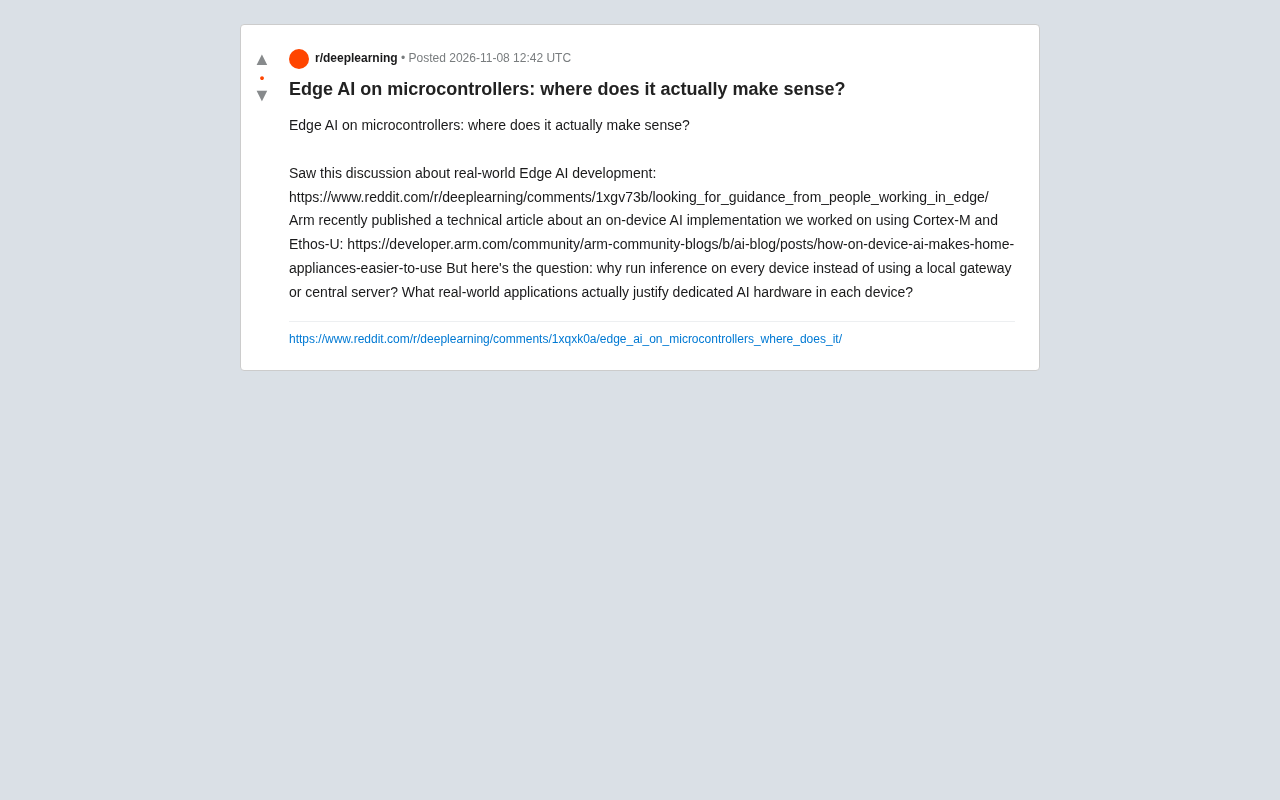
Edge AI on Microcontrollers: When Is It Actually Worth Deploying?
Drawing on Reddit discussions and Arm case studies, this article analyzes the real-world use cases for edge AI on microcontrollers: when each device needs independent inference, when a gateway or cloud is more reasonable, and the costs and boundaries of specialized hardware.
 Tech Frontiers
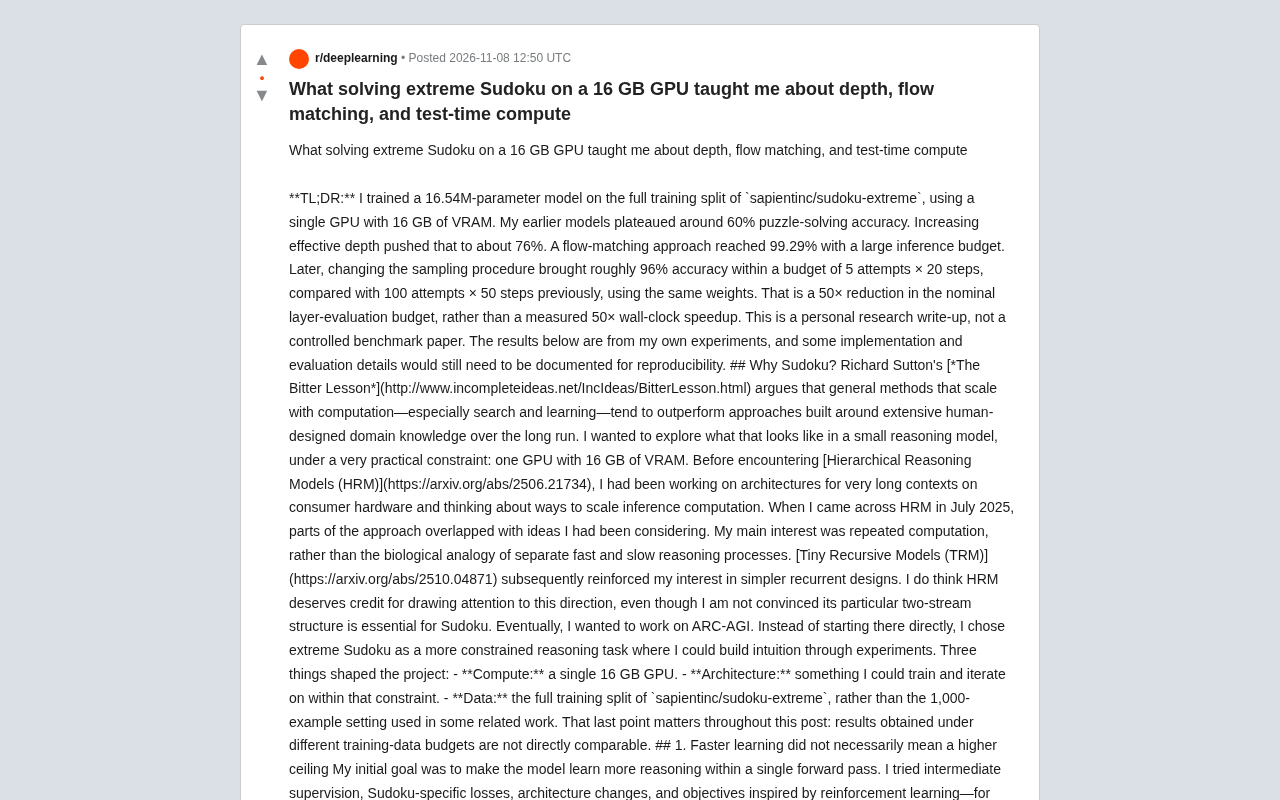
Pushing the Limits of Extreme Sudoku on a 16GB GPU: Insights from Depth and Flow Matching
A researcher trained a 16.54M-parameter model on a 16GB GPU to solve extreme Sudoku, finding effective depth breaks the 60% plateau and flow matching with improved sampling pushes accuracy past 99% with ~50× lower layer-evaluation budget.
 Tech Frontiers
AI Agent Approval Workflows: Why Human Confirmations Always Get Mindlessly Clicked
Why do AI agent approval workflows always get mindlessly clicked? A Reddit discussion shows that separating rules from keys, low-frequency high-risk approvals, and GitHub Environments-style gates are the keys to effective approvals.