GitHub Trends · Episode 22: Old Infrastructure Resurgence and PR Agent Explosion
GitHub Trends · Episode 22: Old Infras…
Weekly Monday roundup of GitHub's hottest projects, with in-depth takes on usage and scenarios
Weekly Monday roundup of GitHub's hottest projects, with in-depth takes on usage and scenarios
It's Monday again, time for our roundup. I scrolled through this week's Trending, and my first reaction was a bit of surprise.
You're not wrong. This week is really unusual—a lot of the names at the top are old-timers from ten years ago.
The kind of projects you thought were just sitting in textbooks, and suddenly they pop up again.
Exactly. No new faces in the Agent framework space this week. The ones growing fastest are all laying the groundwork for AI to do its thing.
Let's go through them one by one. First, the most stable one in the top tier: etcd.
Over 52,000 stars, and 120+ today. That growth isn't explosive for a new project, but it's a long-term foundation.
It's pretty much standard in K8s, right? So why is an old project like this getting dug up again?
That's not the point. The point is the Go ecosystem has been heating up in discussions lately, and people are re-examining distributed consensus.
Think about it: now an agent cluster needs to share state, elect a leader, lock things. In the end, you circle back to etcd.
So it's not a revival, it's demand coming back. I get that angle.
Right. Anyone running clusters can't avoid it. For newbies trying to understand consensus, reading its docs is faster than reading papers.
Okay, second: ruff. I'm familiar with this one—our team switched to it entirely last year.
50,000 stars now. A Python linter written in Rust, going up against the old flake8 + black combo.
I used to work on an AI product line with a terrifyingly large codebase, and after switching to ruff, CI got an order of magnitude faster.
Its advantage is being a single binary—no need to install a bunch of Python dependencies. Think about how much hassle that saves.
And now coding agents are writing more and more Python, so a fast linter is like giving the agent an instant error corrector.
So it's actually riding the wave of the agent era.
Exactly. Even non-technical people can just install a plugin and use it—it handles code style out of the box, very low barrier.
Third: openssl. 31,000 stars, only 20+ today—pretty flat growth.
But its significance isn't in the star count. The entire internet's TLS handshakes rest on its shoulders.
I remember its history is quite bumpy—there was a very serious vulnerability incident before.
So it's actually a good thing people are paying attention now. It's about adding manpower to critical infrastructure.
Written in C, good performance but prone to memory issues. If you want to learn low-level cryptography implementations, it's a living textbook.
To sum up: it's on the list not because it's new, but because it's too important to ignore.
Next, fourth: 90DaysOfDevOps, 30,000 stars, up 150+ today.
This one's interesting. It's not code—it's a learning roadmap. A course structure organized with Shell.
It strings together everything from DevOps principles to tools to case studies, and it's been updated for three years.
Right. It shows one thing: the more complex the tools, the more the learning path itself becomes a scarce commodity.
Can non-technical people follow it? I have a friend in operations who asks me every day how to get started.
The first half is totally doable. Later, when it gets to specific CI and containers, you have to actually do it hands-on.
Okay, fifth: claude-quickstarts. 19,000 stars, a whole set of deployable examples for the Claude API.
Its value is saving you the time of building scaffolding. RAG, agents, tool calling—all have ready-made starting points.
I've always had a question about these kinds of projects: do official examples help you or trap you?
Depends on how you use them. As a starting point, no problem. But be careful about shipping directly—example code rarely considers edge cases.
If you just want to quickly validate an idea, do you think it's faster to copy or write from scratch?
For validation, definitely copy. But once it works, you have to rewrite it. That's my habit.
Sixth: mujoco, Google DeepMind's general physics simulator, 16,000 stars.
This is an old foundation in robotics. Multi-joint contact dynamics—sounds scary, but it's just simulating the real world.
Why is it on the list this week? Embodied AI is really hot right now.
Perfect match. To train robots, they first have to fall countless times in simulation before going to the real machine. This is that practice ground.
Its competitor is Isaac Sim, but mujoco wins on being lightweight—academia uses it a lot. C++ core, friendly Python bindings.
Non-technical people definitely can't use it, but if your AI product friend wants to touch embodied AI, they can't avoid it.
Seventh is the one I most wanted to check out this week: pr-agent, up 270+ stars today.
14,500 stars, the fastest single-day growth on the list. AI helps you review code PRs.
It even specifically says in its name that it's not the free version of Qodo—that's a bit interesting.
That's an identity statement. The open-source and commercial versions were once entangled; now it wants to draw a clear line.
So what can it actually do? Our team's PR reviews are like a tug-of-war.
It auto-generates PR descriptions, gives line-by-line review comments, and supports multiple models. Think about how much time that saves.
But its biggest bottleneck isn't the model—it's false positives. If it generates too many comments, people stop reading them.
Yeah, I've experienced that deeply. No matter how good a tool is, if it's noisy, people will turn it off.
So what these tools really compete on is who better understands when to shut up.
Finally, eighth: scenario-labs' skills, only 2,000 stars, but up 220+ today.
The highest percentage growth on the list. It lets any agent generate usable images, video, audio, and 3D.
The key is two design choices: pick the model first, and quote a price before spending. It's like giving the agent a wallet awareness.
The quoting point is so practical. With agents now, the scariest thing is them secretly burning money.
And it can maintain character and brand consistency, and even drive professional software like Blender and Unreal.
Can non-technical people use it? I feel like content teams would love it.
As long as you connect it to a scene platform, you can use it. For teams making marketing materials, the barrier is much lower than learning 3D software.
Alright, that's the roundup. Looking back at these eight, I think there's a very obvious common thread.
Go ahead, let's see if it matches my thinking.
Except for two AI tools, the other six are all foundations. Storage, encryption, linter, physics engine.
Completely agree. Let me add: this isn't simply getting old—it's demand sinking downward.
The hotter agents get, the more people realize fancy stuff isn't enough—whether the foundation is solid is the lifeline.
So if I had to recommend must-sees, I'd say two: pr-agent and scenario-labs' skills.
I agree, and I'll add ruff. If you want to get started, begin with it—fastest results.
So the conclusion is: this 2026 AI wave is pulling attention back to infrastructure. With a solid base, you can go far.
Related articles
 Tech Frontiers
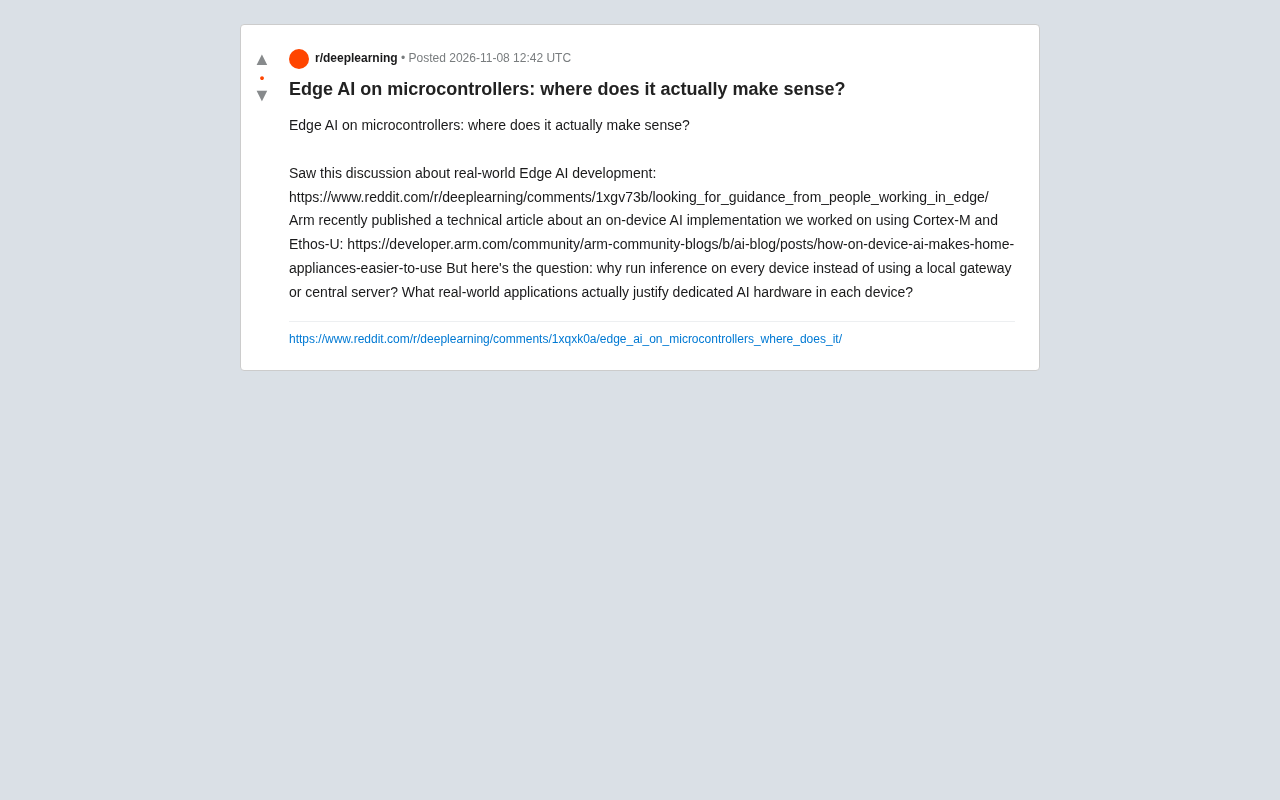
Edge AI on Microcontrollers: When Is It Actually Worth Deploying?
Drawing on Reddit discussions and Arm case studies, this article analyzes the real-world use cases for edge AI on microcontrollers: when each device needs independent inference, when a gateway or cloud is more reasonable, and the costs and boundaries of specialized hardware.
 Tech Frontiers
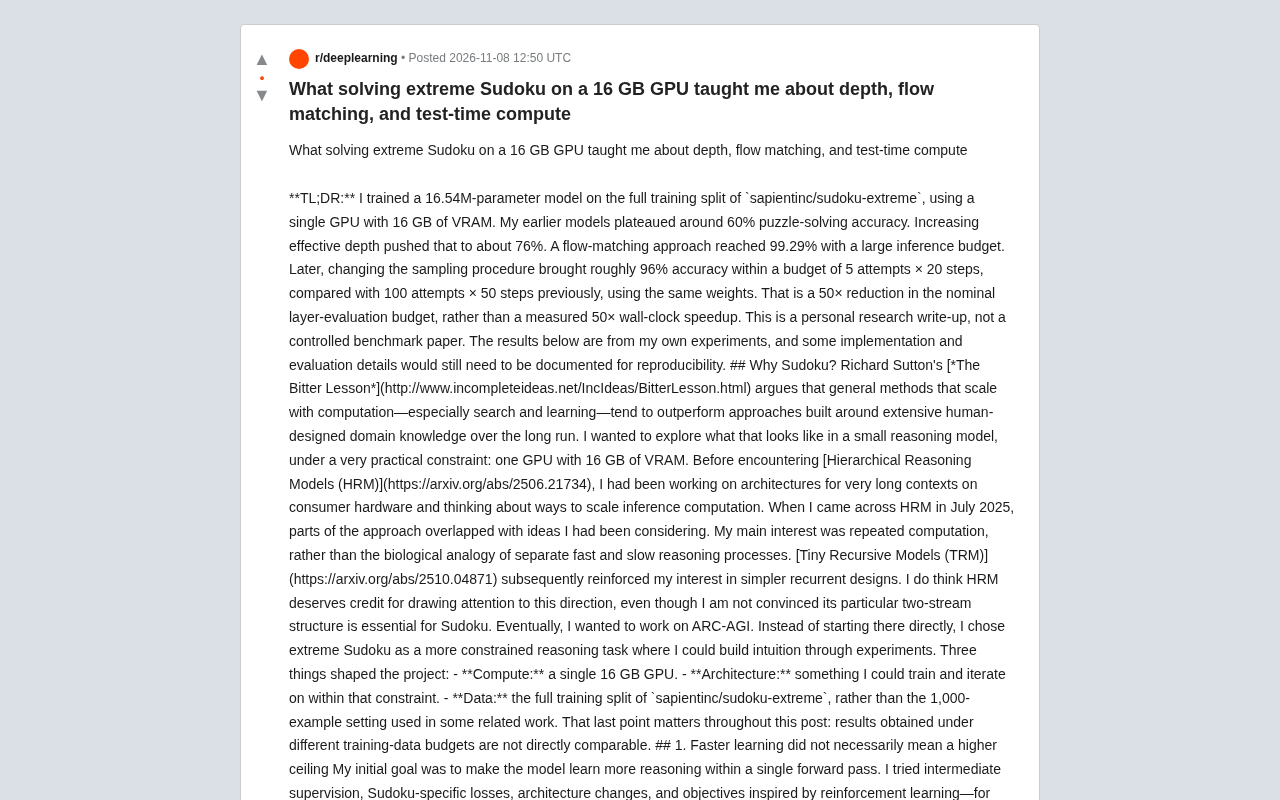
Pushing the Limits of Extreme Sudoku on a 16GB GPU: Insights from Depth and Flow Matching
A researcher trained a 16.54M-parameter model on a 16GB GPU to solve extreme Sudoku, finding effective depth breaks the 60% plateau and flow matching with improved sampling pushes accuracy past 99% with ~50× lower layer-evaluation budget.
 Tech Frontiers
AI Agent Approval Workflows: Why Human Confirmations Always Get Mindlessly Clicked
Why do AI agent approval workflows always get mindlessly clicked? A Reddit discussion shows that separating rules from keys, low-frequency high-risk approvals, and GitHub Environments-style gates are the keys to effective approvals.